Image via YMC
As a model who has been in the fashion industry in London for almost a decade I have some real concerns about the industry right now. I’ve seen great leaps forward for diversity but also major setbacks. I’ve seen the visibility social media has allowed models but also the obsession with followers and constant comparing that comes with it, not to mention the entirely new breed of ‘influencer’ model that has spawn from it.
I sat down with Sarah Bunter, a London-based casting director who has been in the industry as long as me. We actually met in her office seven years ago when she cast me for an Ostwald Helgason lookbook but haven’t spoken since so I was eager to see what she has made of the developments in the industry from her perspective.
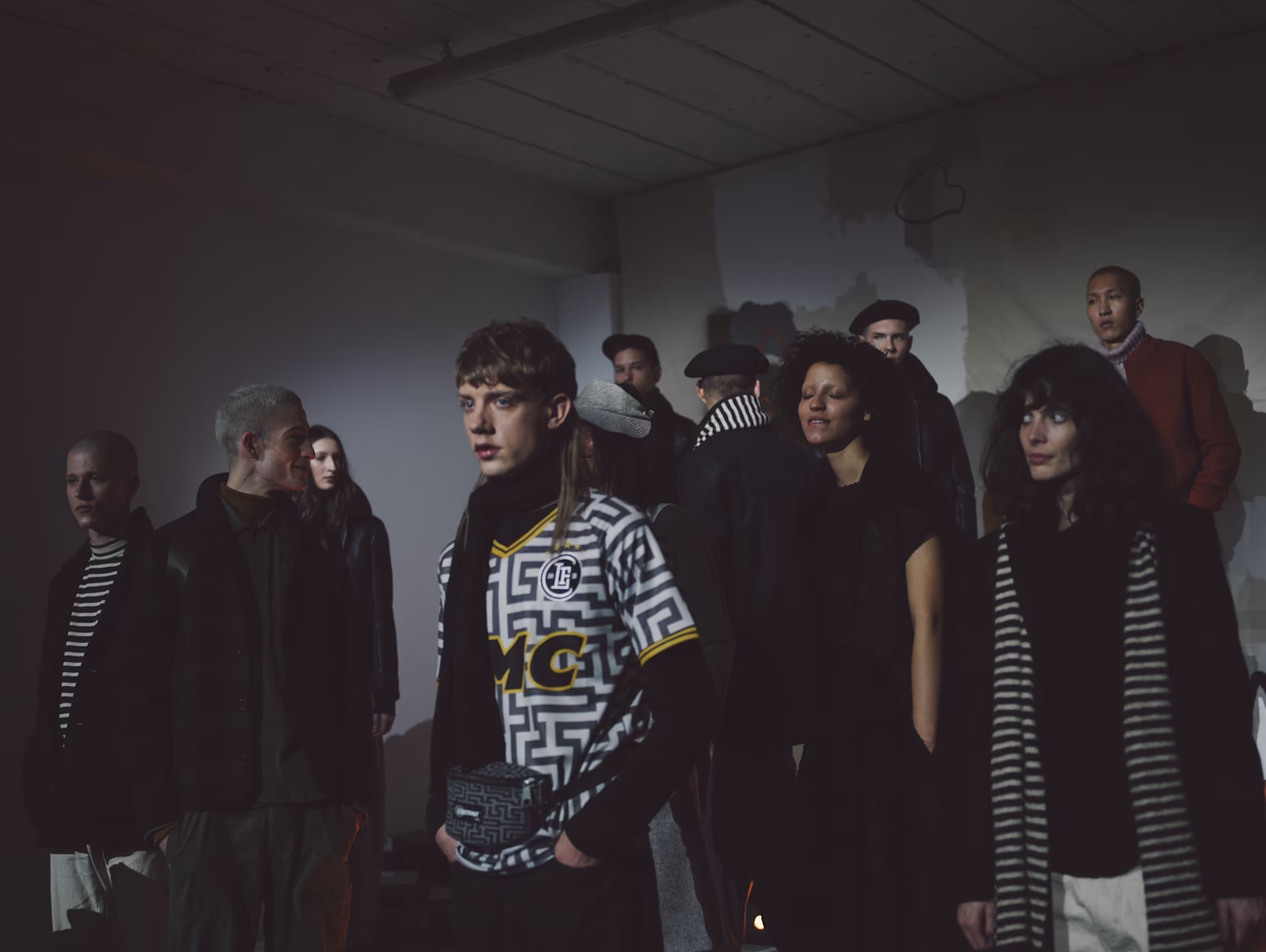
Sarah’s long-standing quest to bring age and race diversity to commercial projects has been met with resistance from many clients, but the ones that agree with her keep coming back and those include Kinfolk, Toast, Peter Jensen, Whistles and Wrangler, as well as designers such as Christopher Raeburn, YMC and Matthew Miller. Some of her most widely seen work is The Vaccines popular ‘Come of Age’ album cover portraying each band member as a female look-a-like. In advertising, Sarah recently cast the first gay couple as parents for Mamas & Papas progressive, award-winning and much discussed ‘How We Roll’ campaign.
We talk about trend forecasting today, why agencies should actually be worried about Instagram, how a man in his sixties is seen as aspirational but a woman as expendable, the anti-beard backlash and the extremes young models are taking to be ‘unique’.
I’ve been told that I have lost out on jobs because I don’t have enough followers on Instagram. How important is social media to your decision?
It hasn’t been quite so literal yet where a client says I want the person with the most followers - but I think that day will come as it’s a very easy way to get more marketing. Luckily at the moment it’s not the deciding factor, at least not in London. To me it’s useful as a tool because I can see what the girl looks like today. Often digitals can be a few months old so it’s practical it that sense.
It’s interesting how models will start to present themselves on social media based on what they think clients want. It’s almost like they are cutting out the agent and the client can go straight to the model and vice-versa but I really believe in the role of an agent as a mentor and protector, especially for young girls, so agents should be careful.
How has the diversity of talent changed over these ten years?
Certain areas of the industry are getting better - but some seem to be very set in their ways. There are certain brands that pride themselves on exclusivity and it’s starting to look really dated. ‘All-white’ fashion shows look really dated to me.
Your website says that your passion is to ‘champion the unexpected’ what does that mean to you exactly?
I get really excited when I see someone who hasn’t been referenced previously, hasn’t done a big show or been shot by a big photographer, as they can be the most surprising and in turn the most iconic. Sometimes a model can walk in and I wouldn’t have picked her for that brand but when you put the two together it comes alive and doesn’t look like anything that’s been done before and I think that’s lovely.
I know you support diversity, uniqueness and the unexpected, but i’m a little worried for the future of high fashion. Girls see that suddenly deciding to get a buzz-cut one season or a sleeve of tattoos works to set you apart from the ever-growing crowd. With a need to be individual on social media too I think that some girls are turning to extremes to be a cut above the rest. Equally the designers are so desperately searching for the next big thing that girls, and boys, are resorting to extremes. I don’t see this trend towards extreme beauty ending well. What advice would you give them?
I’d ask them to consider the longevity of their career. Also many of these people are copying each other so there’s actually a lot of girls with tattoos now, it’s not that unique. There’s already an anti-beard backlash in men’s modelling.
Really?!
Yeah, it happened about two years ago as that’s how far in advance these British heritage brands shoot. They just started saying ‘no more beards’.
So if you can see two seasons ahead are there any trends we should be looking out for? What’s ‘the next big thing’?
There used to be a whole school of thought to ‘trend forecasting’ but everything moves so fast now that someone could do something today, everyone will know about it tomorrow and be over it by the next day. I really hope authenticity becomes a trend - actually having something to back up who you are and what you say. I hope the girls with PHDs get as many followers as the girls posting bikini selfies. That would be an amazing trend - getting an education!
I would love that - I'd be first in line, waving my history degree!
I mean look at Christy Turlington - I think part of her longevity is in that she has so many dimensions to her.
You said yourself that the black female models in town for Fashion Week get so much work that they’re hard to book or expensive - they’re sought-after. Over the past ten years it’s increasingly seemed like being a minority is better, easier, that there’s more work. This is how I perceive it from my end - is this not true?
I think once you have the backing of a few different credits and have been ‘OKed’ by the fashion industry then it’s fine, you’re in. But I think the criteria for non-white models is more stringent. They can be looked over much quicker by a designer if they haven’t already done a big show, or worked with a big photographer. Unfortunately in the way that Lara Stone paved the way for another dozen models with gap-tooths, I’ve yet to see that happen with a non-white model. I mean, where were the ‘next Naomi’s’?
You had a client that was interested in casting an all non-white menswear show this season for LCM. Is this hypocritical? That an all-white show is bad but the opposite is fine?
I really thought about it for a long time and I decided that it’s good. A show of non-white models doesn’t represent and perpetuate an long-established and oppressive system so therefore has none of the detrimental effects of that of a show using only white models. In the end we actually did cast three white boys as they fit the style and the clothes perfectly - the plan was never to be ‘anti’ anything, but open to everything.
An all non-white show might still be shocking but I can't imagine there being a problem if you wanted to cast a few non-white runway models for a British brand. Why would they say no?
I have a friend who is a mix of ethnicities and has beautiful naturally curly hair. She Googled ‘unprofessional hair’ and her hair type came up. How can your hair dictate if you’re a professional or not? I’ve had natural black hair described to me as being ‘too political’... and these comments don’t come from stupid people. They come from very articulate people in positions of power at brands. I think it's ‘political’ to not have anyone of any other race on a catwalk now.
‘Lose an inch off your hips’ is a common thing to hear at a modelling agency before Fashion Week, I know girls that have flown to New York for Fashion Week only to be sent home by their agency because they don’t have a 34 inch hip, yet in the shows there are now a number of these ‘celebrity’ models, with their famous families, that are just waltzing right into shows, no casting required and they’re, comparatively, bigger or shorter than the ‘requirements’ agencies have been giving girls complexes over. This means that there actually isn’t really a standard ‘show’ size. How is this fair?
It’s really contradictory. And we aren’t looking at those celebrities saying ‘they don’t look thin enough’ in comparison. I’m a massive pioneer for moderation. It used to be that during fashion shows in the 90s people looked at the models and talked about them, then people started looking at the clothes and now with the Kendalls and the Gigis we seem to be looking at the models again. It’s probably financial reasons again - all the coverage those girls will offer is free advertising. As it is, I don’t cast those kinds of shows.
I do feel strongly however that our obsession with size and weight is directly related to falling mainstream food standards - especially in the US. It's no coincidence that this unachievable level of thin has risen with the dominance and availability of preservative-packed and sugar-filled food. In america apparently ‘fit is the new rich’ and their more affordable supermarkets are filled with really unhealthy stuff - this has to be somehow related.
Everyone seems to blame someone else for the ‘why are models so skinny’ epidemic. It’s not the model’s fault, but the agency’s, it’s not the agency’s fault by the casting director’s, it’s not the casting director's fault but the designer’s. Are the designers to blame and if so, why is no one reprimanding them for it? Does no-one care anymore?
It is really tricky, it’s not quite as simple as being one person’s fault otherwise people would do something about it. It’s also interesting, and scary, that as many complaints as there are about the girls being too skinny there’s an equal number of negative remarks on social media for the girls that someone might deem as looking ‘big’. It’s hard to win.
Why are older men still looked at as inspirational but older women not?
The difference with guys is they can cross over to younger brands because an older man is seen as aspirational to a younger man, and they can be models you’ve never heard of but for women, unless she’s an ex-supermodel she’s just seen as old - and they aren’t even that old! A man can be in his 60s and be aspirational. Some brands, since what Celine and COS have done, have asked for models in their mid-30s but the girl used is often no older than 28. Older models that are still making good money but aren’t ex-supermodels are few and far between. It throws up the bigger question of why you can sell the image of a 60 year old man to a 25 year old male consumer, but you can’t do that with women - to a man with age comes acquisition, of wealth, of education, the right car, the right watch, the right wife - we have to ask what is it about society (of all genders) that makes us think that women can not be aspirational after a certain age?
So is this a deep-rooted societal problem?
I think it is. If women aren’t sexually available or portrayed as the maternal or matriarchal figure, it’s almost as if there is no demand. I really hope that Daria Werbowy and the independent academic looking woman seen in COS and Celine is a trend that stays.
What would be your ideal next project that you think could be unique?
I don’t think it would be a fashion show, that medium is too rife with criticism and in editorial it feels like everything has been done before, it’s all just a re-make. I’d like to see brands get back some authenticity, storytelling and creativity and maybe that’s not possible in the conventional formats. Maybe it’s something three-dimensional, maybe it is about a story, something deeper than an image. Like this website itself - maybe it’s about a brand aligning themselves with a collective endeavour or a movement - what people think. It will still be image led, but those images will come about by covering aspirational things that have longevity and authenticity. If you want something to last and be iconic you have to be part of something bigger.