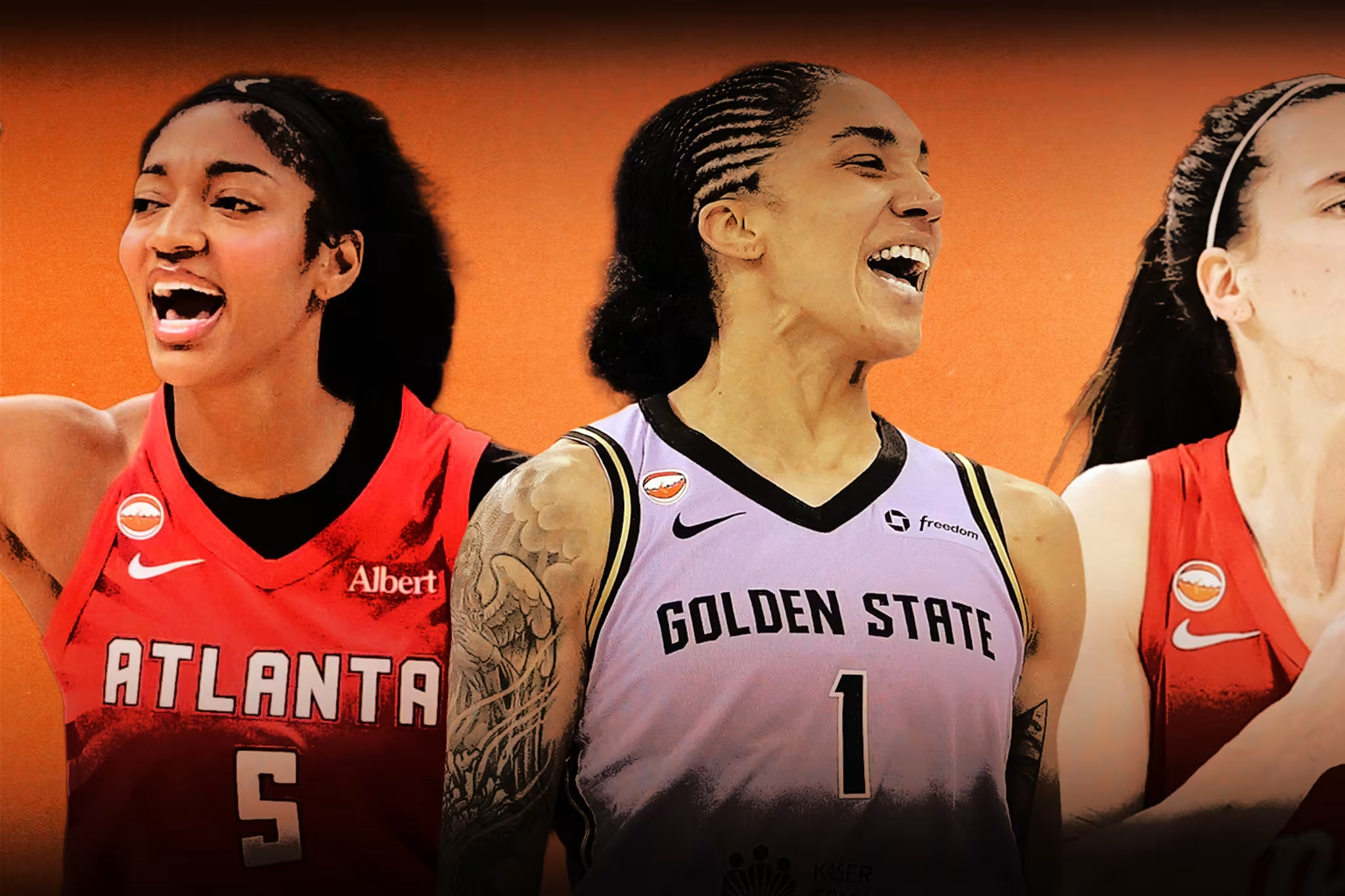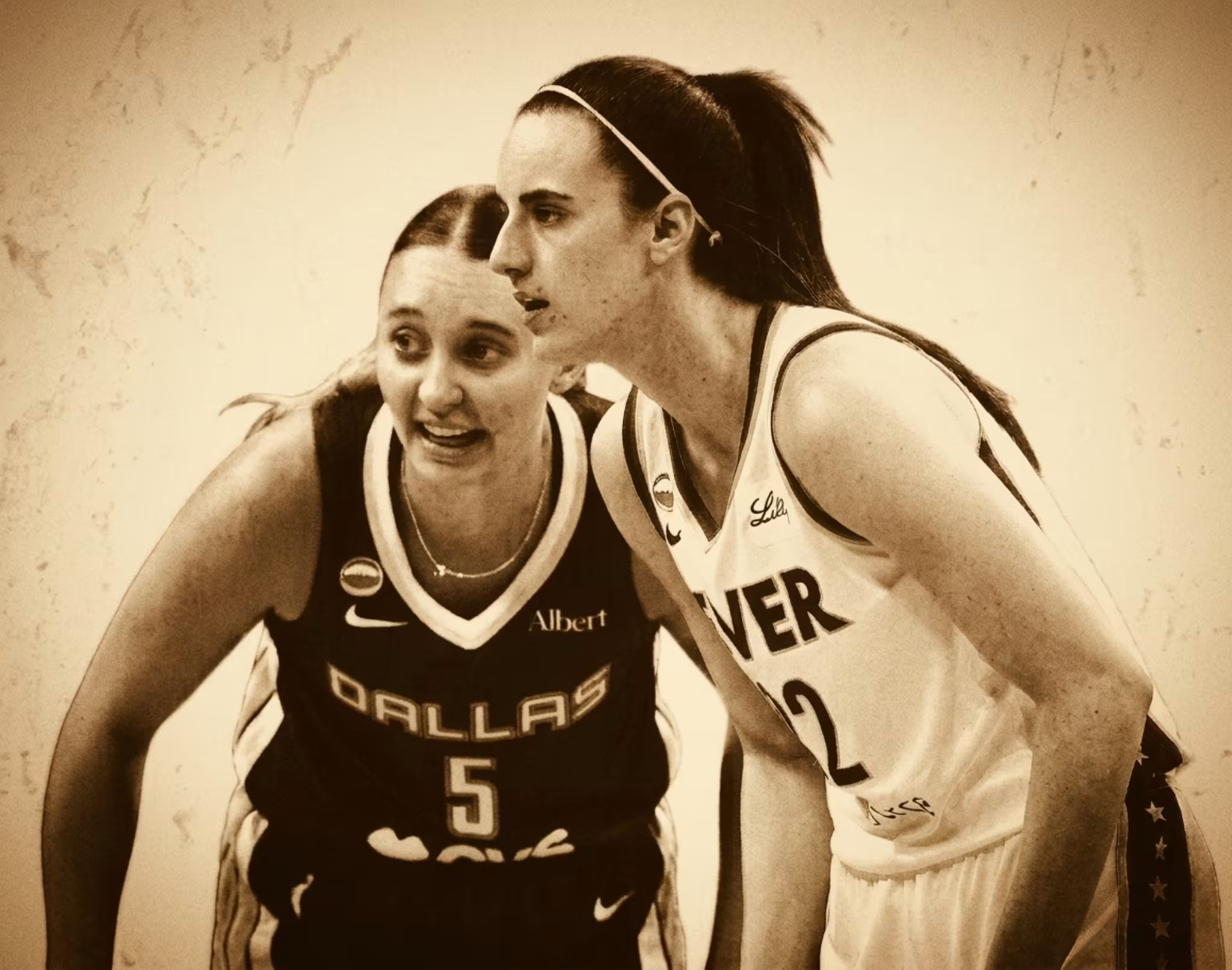
Caitlin Clark and Paige Bueckers have been friendly rivals for over a decade. They played against each other in middle school AAU tournaments and were then teammates on Team USA’s U19 squad. As members of the celebrated Class of 2020, they entered college with great expectations, then somehow exceeded them.
Now in the WNBA they’re both already multi-time All Stars and entrenched on the list of the best WNBA players right now.
Both Clark and Bueckers possess three-level scoring tools, they can both pass, and just as importantly, they’ve both got aura and attention. But the question is, who is the better basketball player? For now, the answer is Paige Buckets, who we ranked as the fourth best player in the WNBA right now; Clark lands at six on the same list.
We break down How Paige Bueckers Took Caitlin Clark’s Spot as the best guard in the WNBA.
*All stats as of the WNBA All-Star break*
Shop the Basketball Collection on Complex Shop
Scoring
Caitlin Clark
After an injury-plagued sophomore season Caitlin Clark has resumed hitting shots from everywhere on the court. Despite only shooting 33% from the three-point line, Clark’s range effectively disrupts the defense. Because she shoots more shots between 27 and 32 feet away from the basket than anyone in the Association, defenders have to come up to guard her, yet she has the reflexive ballhandling imagination to take advantage of their aggression and get to the rim regularly. Once there, she uses a solid frame and ambidextrous touch to finish 67% of her shots at the rim. The threat of her deep ball, along with her ability to finish, helps her get to the line 6.1 times a game, where she hits about 86% of her free throws. Despite her jumper not falling with the same consistency as it did in her college career or rookie season, she’s still sixth in the league in scoring, averaging 20.7 points per game on a true shooting percentage that’s four-percentage points above league average.
Paige Bueckers
Bueckers has all the pivots, cobra-strike crossovers, pull-up threes and one-footed fadeaways that “Bag Twitter” loves, except she’s as functional as she is flashy; regardless of where she’s positioned on the court, she can use an abrupt stop or dribble move to create the separation needed to get her shot off. But creating the space for shots wouldn’t be all that meaningful if she couldn’t hit them. But she does more than half the time. This season, she’s finishing an astonishing 79.5% at the rim while making about 58% of her shots from 10 to 16 feet. Oh, and she still knocks down about 39% of her threes, a higher percentage than Clark. Looking at her splits, it’s not too surprising she’s averaging 20.9 points per game on 51.8% from the field and an elite 61 true shooting percentage.
Edge: Bueckers
Playmaking
Caitlin Clark
Caitlin Clark’s scoring alone would make her an All Star, but combined with her playmaking clairvoyance, she becomes all-world. The potency comes from the symbiosis between her shot-making prowess and court vision. The same ambidexterity that allows her to finish effortlessly allows her to make pocket passes and skip passes with either hand. The defensive attention she gets on or off-ball necessarily creates openings, ones she fills with timely passes to cutters or shooters ready to hit their mark. Her creativity and gravity help her average 7.8 assists per game, good for second in the league this season. Unfortunately, her shot-taking audacity can seep into her distributing habits, which lead to more errant passes than a player of her caliber should be making. Dating back to her rookie season, she’s averaged 5.2 turnovers per game. This season that number is down to 4.6. That’s still a lot, but when you consider that she’s responsible for over 45% of the Fever’s assists, it’s much more tolerable.
Paige Bueckers
While Bueckers leaves her mark primarily as a deadly three-level scorer, she also stands as one of the league’s more economical playmakers. And she’s not some 2-Guard cosplaying as a table-setter. With her height and shot-creation skills, she’s able to identify openings as soon as she creates them; cutters arrive at the hoop just as the ball materializes in their grasp and shooters don’t need to reset their form to fire away because the ball lands directly in their shooting pocket. Bueckers can’t match Clark as an improvisationalist, but she is more efficient; she’s averaging 6.2 assists with only two turnovers per game. She’s sixth in assists per game while Clark is sixth in scoring.
Edge: Clark
Rebounding
Caitlin Clark
With good size and adequate timing, Clark is a strong positional rebounder who pulls down about five boards per game for her career. She’s at 3.9 now. While it’s a decline, Clark is special for how she turns rebounds into advantages. When Clark grabs a rebound, it’s a potential fast break. Combined with the speed to take it coast to coast, Clark’s rebounding helps keep the Fever’s transition game above average, even if her raw rebound numbers are not.
Paige Bueckers
Bueckers rates as one of the better board-getters at her position, pulling down 4.2 rebounds and .6 offensive boards per contest. The offensive rebound number is about twice as many as Clark’s, and to her credit, it does lead to more second-chance point opportunities. Still, she lacks a degree of Clark’s open-court dynamism as a cross-court passer and transition scorer, so even if her raw numbers seem to give her the edge, Clark’s rebounds appear to be more impactful.
Edge: Draw
Defense
Caitlin Clark
By most surface-level accounts, Clark fits the “offensive engine, defensive turnstile” archetype, lacking the lateral quickness to defend the more athletic attackers. She seems to be conserving energy on defense because of the load she carries on offense. But up until this season, she averaged about two stocks per game, and her rebounding and spatial awareness make her an adequate team defender. She’s at about 1.5 this season, but the general idea remains true, and the advanced stats roughly bear that out with a mix of positive and negative indicators. The team allows 4.7 fewer points per 100 possessions with Clark on the bench. But she still has a solid 0.7 defensive win shares this season. The film generally supports this; she’s neither stalwart nor turnstile, but when you’re an offensive superstar, that’ll do.
Paige Bueckers
Bueckers is a more than adequate defender. At a legit 6 feet tall, she’s got the length to put up good contests, and the fluid athletic ability that helps power her shot-making lends itself well to isolation defense, too. Her stock totals are fairly pedestrian at about 1.1 this season, but according to Basketball Reference, the Dallas Wings only allow 1.8 more points per 100 possessions when she’s on the court, which is a slight compromise when considering the offense she generates for the team. She’s also sitting at a solid 0.8 defensive win shares thus far this season.
Edge: Bueckers
Leadership
Caitlin Clark
That viral video of Clark seemingly ignoring her teammate wasn’t a good look, but it also wasn’t comprehensive. Dating back to her days at the University of Iowa, Clark has embodied the sort of fiery, outwardly vocal kind of authority that galvanizes teammates. Her talent level gives her a “lead by example” credibility, and the fact that she’s the driving force of her team’s offense makes her leadership just as functional as it is symbolic.
Paige Bueckers
Calm, collected, and surgical, Bueckers’ leadership reflects her playing style. She can get fiery, but she’s not overly demonstrative or loud when she’s actually on the court. Still, you can see her encourage teammates and she’s willing to take responsibility for wins and losses without taking up all the oxygen in the room.
Edge: Draw
Aura
Caitlin Clark
If cultural significance were a box score stat, Clark would lead the league. People who’ve credited her as singlehandedly popularizing the WNBA haven’t been paying attention to league trends long enough to make such a claim. But the numbers don’t lie: She has the second-best-selling jersey in all of basketball, trailing only Stephen Curry. She has the most lucrative shoe deal of any player in WNBA history, her logo three has become a kamehameha wave-level signature move, and her fiery demeanor does lend itself well to the world of sports mythology.
Paige Bueckers
Due to her college dominance and Instagram approved style, Bueckers, too, already has a sustained aura. She dominated at UConn, where she won a national championship and has resumed breaking ankles in the WNBA. By nature, her game just has swag; she’s an aesthetically pleasing shotmaker with a game designed for both offensive efficiency and social media ubiquity. She doesn’t sell as many jerseys as Clark, but Fanatics says that on draft night 2025, she became the second-best-selling WNBA jersey in league history. Bueckers might not trigger the same visceral, cultural reaction as Clark, but in some ways that’s also a good thing; Clark’s fans, as well as the media, have politicized her to the point where she’s become more polarizing than she should be. But still, eliciting that gut reaction means something.
Edge: Clark
Verdict
While their individual attributes are nominally close, and our own tally system has them at a tie, Bueckers stands out as the superior ball player. Clark is known for shot-making heroics, but Bueckers is still technically a more efficient scorer. Clark is an extremely talented playmaker, but Bueckers is also a high-level distributor, who turns the ball over 2.6 times less per game. Cumulatively, those lost possessions result in lost opportunities to score the ball while giving other teams the chance for more buckets. When you combine those lost opportunities with some of Clark's defensive deficiencies, the gap becomes clear. It reflects in many of the advanced stats, too; Clark's win shares per 48 mark on Basketball Reference sits at .181, while Bueckers is at .231. That's about the difference between an All-WNBA season and an MVP-level outing.
Winner: Bueckers