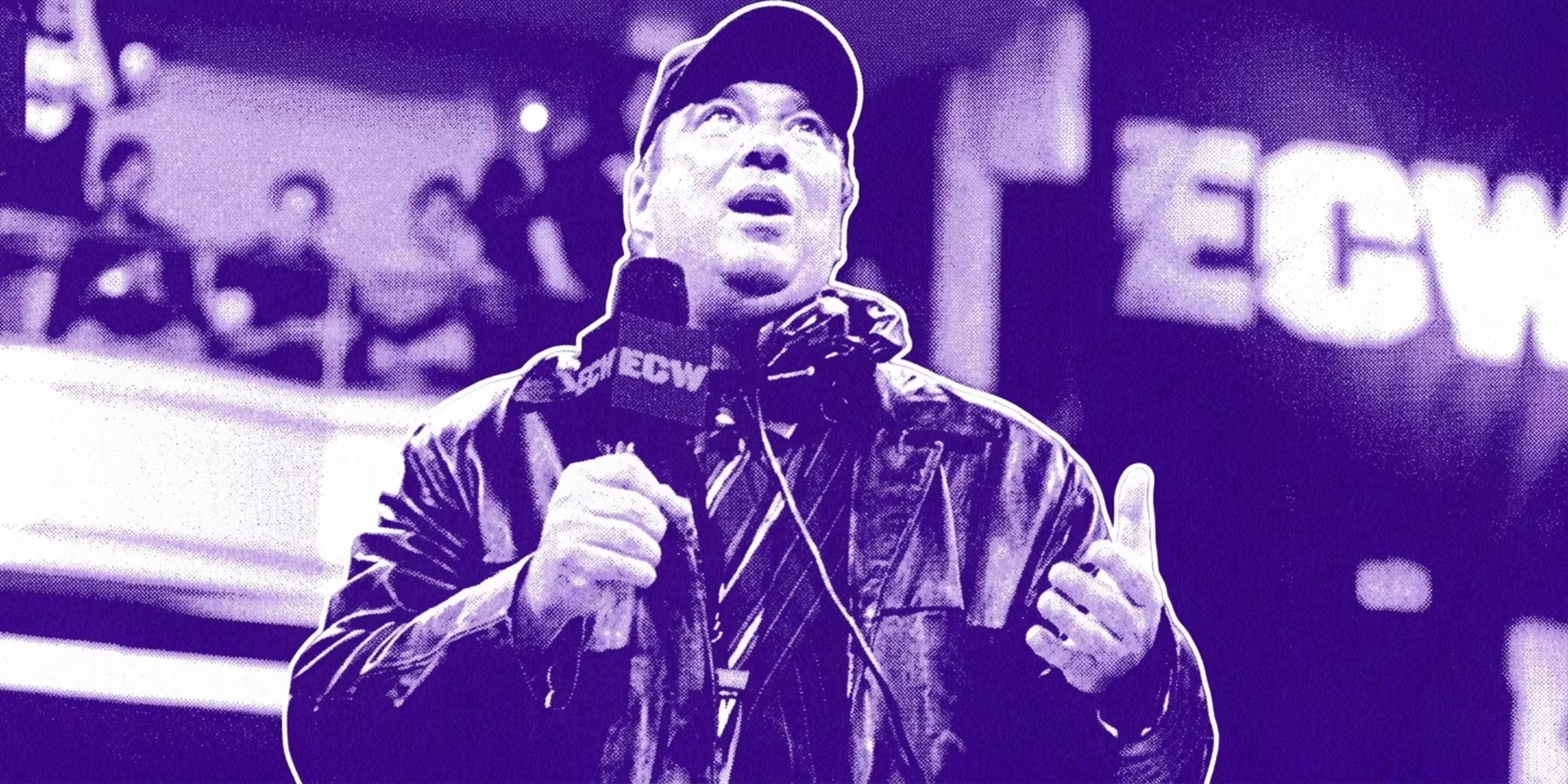
Heading into WWE SummerSlam Minnesota, one of the premier matches on the two-night card is the 2026 King of the Ring Oba Femi facing former 10-time world champion Brock Lesnar in Hell in a Cell. Walking alongside Lesnar is a man by the name of Paul Heyman, who is known by many names, including “the Wiseman” and as Roman Reigns’s “advisor.” For a while, everyone wanted to be a Paul Heyman Guy, primarily because he has a knack for spotting talent, and if Heyman saw that spark in you, you were guaranteed to be going places. Where does that come from, though?
Part of it is that Heyman had been in the industry since he was a teenager, taking photographs at wrestling shows. He’d later transform into a pro wrestling manager, Paul E. Dangerously, backing some of the best heels in the business while talking some of the foulest shit to their opponents. (Most people hated that his clients would back up the smack he talks.) We have to paint that picture to let you know why folk were excited when Heyman made his way to a small independent wrestling promotion in Philadelphia in the early 1990s. That one move not only changed the course of pro wrestling in the city of Philadelphia—it marked the beginning of a true change in the pro wrestling landscape.
Shop for WWE on Complex
It began as Eastern Championship Wrestling
Eastern Championship Wrestling launched on February 25, 1992, but its roots go back a little further than that date. The Tri-State Wrestling Alliance had been running cards across eastern Pennsylvania, Delaware, and South Jersey before the money dried up early that year. They needed someone willing to back a replacement and found Tod Gordon, who owned a Philadelphia pawn shop called Carver W. Reed & Co. "It started from the ashes," Gordon later said.
Gordon took the reins as owner and ran the promotion through 1992 to 1995. During that stretch, Eastern Championship Wrestling operated as an affiliate of the National Wrestling Alliance, working within the established framework that governed much of the regional wrestling landscape at the time. Philadelphia would prove to be the right city for what came next, but the NWA-affiliated version of the company was still finding its footing, a conventional regional outfit that hadn't yet discovered what it would eventually become.
How Paul Heyman transformed ECW
Paul Heyman wasn't a stranger to the wrestling business when he joined ECW in 1993; at the time, “Hot Stuff” Eddie Gilbert was lead booker, and had suggested that ECW become part of the National Wrestling Alliance. Heyman had already built a reputation in the late 1980s as Paul E. Dangerously, managing wrestlers and stirring up heat in World Championship Wrestling (which had previously been affiliated with the NWA). When Gilbert exited ECW, Heyman stepped in, shifting the company from one of a number of tri-state independent wrestling organizations to ushering in a brand of pro wrestling dubbed “hardcore,” which helped usher in the official name change for ECW.
In August 1994, after a phenomenal tournament final match against 2 Cold Scorpio to win the vacant NWA Worlds Heavyweight Championship, Shane Douglas threw down the NWA’s championship, christening the company Extreme Championship Wrestling from then on. “The name ‘Eastern’ did not brand our product,” Heyman explained. “I wanted a global branding for our unique form of sports-entertainment. The only way to describe the vision we were implementing was the word ‘Extreme.’ I didn’t like ‘Hardcore,’ because it was limiting. I didn’t like ‘Eastern,’ because it was regional. ‘Extreme’ is a global branding word. And I could keep the letters!“
What Heyman built under the "Extreme" banner was a full rejection of how professional wrestling was supposed to look and feel. Matches regularly spilled into the crowd, tables and chairs were used as weapons, and blood was ready to be spilled, especially when the stakes required it. They ran monthly shows out of the under-2,000-seat ECW Arena, and the Philadelphia faithful became equal participants, letting their voices be heard loud and clear. To this day, if you hear a pro wrestling crowd chanting “E-C-Dub! E-C-Dub!” during a bout, you know that whatever’s going on in the ring is dope.
ECW wasn’t just build on hardcore matches and brutal violence, though; Heyman’s “extreme” attitude bled into the presentation of ECW Hardcore TV (their weekly wrestling show that became sought-after on the wrestling tape-trading circuit), with emerging styles and super-talented performers sharing the spotlight with the ultraviolence and unique storytelling that Heyman filled ECW with every month.
How ECW changed professional wrestling forever
The irony of the situation was, for as small as ECW was on the American pro wrestling scene in terms of money and crowd size, its influence bled into the Monday Night War between WCW and WWE (then-WWF). Ever wonder why pro wrestling had to shift to a more adult-oriented / mature content to stay afloat? A lot of that had to do with the work Tommy Dreamer and Raven were doing in their timeless feud. Why was Monday Nitro opening their show with some of the finest in lucha libre? That’s probably because a young Rey Mysterio was putting on lucha clinics on ECW TV. Future WWE Superstars like Chris Jericho and Eddie Guerrero were introduced to American audiences through stints in ECW, while acts like Steve Austin were able to use ECW to get things off of their pro wrestling chest while developing the characters that would help change the industry.
Going national
ECW's move to TNN in 1999 marked the first time the promotion had a national cable platform, a significant step up from the regional Philadelphia syndication and pay-per-views that ECW utilized in the past. Heyman created the show himself, shooting it across multiple cameras at familiar venues (including the ECW Arena in South Philadelphia and the Burt Flickinger Center in Buffalo, New York). The opening theme, "This is Extreme!" by Harry Slash & The Slashtones, set the tone for the next chapter in Extreme Championship Wrestling.
The run on TNN produced 59 episodes, but the relationship between ECW and the network was troubled almost from the start. TNN wanted a broader audience and had little appetite for ECW’s brand of pro wrestling, which put Heyman in the position of trying to keep both of his bosses happy: the suits at TNN and the audience in the arenas. Somehow, TNN expected a company with “Extreme” in their name to tone things down for the masses, aka a recipe for disaster.
Going under
For a company that made so much noise, its end felt equally as quiet. The final episode of ECW Hardcore TV aired in December 2000, with its final pay-per-view airing in January 2001, with its final live show happening that same month. Part of the issue was WWE and WCW’s continued talent raids on ECW; Heyman and company were a distant third in the ranking of top wrestling companies in the country, and the other two were ran by millionaires who could afford to pay top dollar to continue their War. Once ECW hit TNN, their biggest and best talent started to disappear.
Heyman, much to his credit, was still kicking, picking up a job in WWE doing color commentary in the midst of the financial trouble ECW was in. With no new TV deal and no pay-per-view money being paid to them, ECW ended up filing for bankruptcy after acquiring almost nine million dollars in money owed to wrestlers and other entities. The spirit of ECW lived in promotions like Ring of Honor and Total Nonstop Action, which allowed many talented former ECW performers to find places to work. Those who WWE had picked up already (including Rob Van Dam) were even made part of the infamous Invasion angle, which found a faction of wrestlers from WCW (which WWE had acquired in March 2001) “invaded” WWE, with former ECW wrestlers initially being part of the storyline.
Why ECW still matters today
ECW closed in 2001, but its grip on the wrestling world never really loosened. Referencing another ECW legend, Bubba Ray Dudley, during his 2024 Hall of Fame speech, Heyman said, “ECW wasn’t meant to last, we were meant to go out in a blaze of glory. We were Napster, we were here to change the business. We were here to disrupt the industry, and it’s exactly what we did.”
Heyman and ECW were the catalyst, they were the spark that the wrestling industry needed to show that you can shine as the alternative. You could look like Mick Foley or wrestle like Dean Malenko or inflict violence like New Jack and you can have a place within the squared circle. ECW proved that if you gave wrestling fans a break from the norm, they will gravitate to what’s dope. And through ECW, the pro wrestling industry was directly gifted Eddie Guerrero, Rey Mysterio, Chris Jericho, Taz, Sabu, Rob Van Dam, Sandman, the Dudley Boyz, and countless others.
Love live Extreme Championship Wrestling.