Minor spoilers ahead! Proceed with caution.
It is hours and hours into my GTA VI playthrough when Mattio—my newest, shadiest criminal friend—takes me into Vice City for the first time.
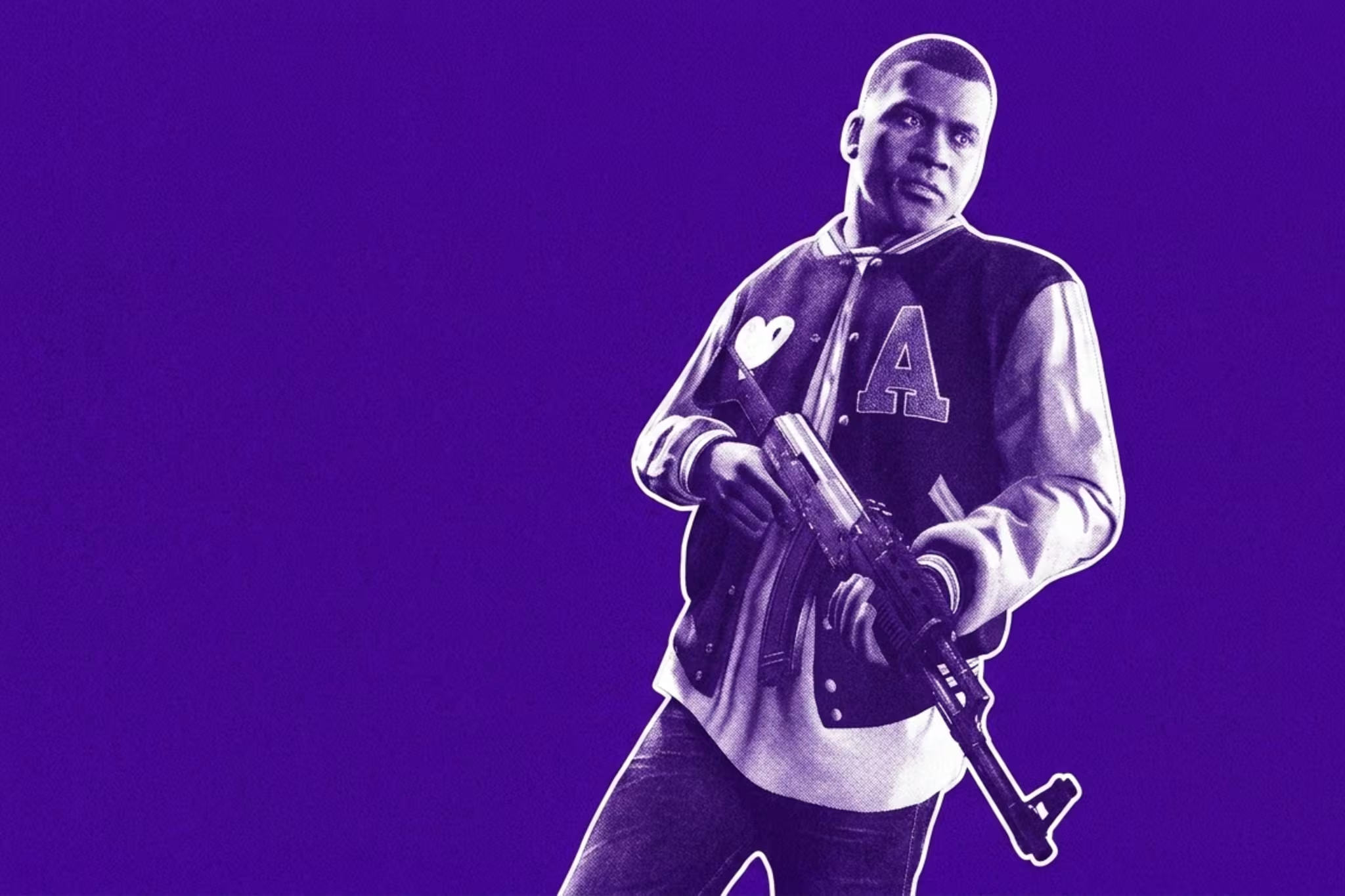
The missions have been low-stakes up until this point, all things considered. You play as Jason, an ex-military vet with model looks, cool nerves, and unresolved trauma. He speaks with a deep-voiced, laconic drawl, and he's monotone by default. Jason is even and capable, and he doesn't rattle easily.


He works for Brian, a tanned retiree who runs a local drug operation in the Leonida Keys. Brian's not a bad boss, per se, but he's a grouch who's deep in his cups. Jason is one of Brian's most trusted runners; his job is to shake down renters, provide security for sit-down meetings, and recover misplaced cocaine. For his labor, Jason receives infrequent cash payments, plus living privileges at one of Brian's properties: a beach house with rotting stairs, a leaky roof, and shoddy electric wiring. Jason has bad credit and no bank account; just an envelope of rainy-day money hidden in his bedroom's floorboards. It is a shitty life, but Jason tolerates it because its dead-endedness is a known quantity he can handle.
It's Lucia, Jason's girlfriend and the second playable character, who sees that he's built for more—who recognizes that the lowlifes surrounding him have already maxed out their potential. Lucia is the yang to Jason's yin; she gets angry, unlike Jason, and she's more likely to choke someone out for pissing her off, unlike Jason. And in this game, you suffer the consequences of your actions. I tuned up three guys during one drunken party night, and days later, I ran into them hanging out at the local bar. They remembered me, and they let me know.
Lucia is fresh out of prison for an impulsive armed robbery, a crime borne of misguided desperation. It's this same recklessness that drives her to network with "friends of friends," who can provide "opportunities" for her and Jason to move ahead.
That's how she and Jason end up on a luxury yacht, rubbing shoulders with criminal elites, in Vice City's harbor. We see the city's skyline on the horizon, looming like a debauched Emerald City, and we end the evening by driving towards it down the main highway, high and drunk off our asses. The neon lights glow brighter and blur as we pick up speed. It's a moment of giddy, devil-may-care hedonism. We are not in Kansas anymore.
Several debauched scenes later, we black out, and we wake up the following morning with vicious hangovers. It's morning, and we're back to the grind—back to Brian's small-time bullshit, playing grab-ass with rednecks. The game gives us a hallucinatory glimpse of the good life and then yanks it away just as quickly. Someday, hopefully. But not today.
This game is, among many incredible things, seamless. GTA games were once a series of isolated vignettes. To begin a mission, you entered the highlighted, marked area, which triggered a noninteractive cutscene that then triggered a criminal objective. The mission felt psychologically walled off from the larger, open world your character inhabited.
In GTA VI, there is little to no distinction between what is "story" and what is free exploration. It all feeds into Jason and Lucia's overarching narrative; even when you're not 'doing' anything, the game provides narrative logic for your downtime. You use that time to build your relationship. You catch up on your text messages. You doomscroll on the in-universe social media. You engage in flirtatious banter. And doing these more passive activities unlocks new missions and new opportunities on the map. The developers are constantly telling the story, especially when you're meandering and wasting time.
Not every mission is based around a crime. There are some missions where you're meeting friends at the bar and dancing to live music. Or, as in my prior example, you're getting high at an exclusive club. There is often no "Mission Successful" prize, no practical, in-game "reward." The reward for these missions is increased characterization and narrative stakes. It's an intangible benefit that cannot be quantified in gold.
In GTA III (2001), Luigi tasked you with picking up Misty the prostitute and driving her to the strip club. In GTA VI, however, you're dropping Lucia off at her dead-end job, picking up trash in public areas. It's the same task from a gameplay standpoint, but with totally different framing. The scripted boredom and lack of criminality are a deliberate choice, so when things irreversibly spiral to hell, their impact hits even harder.
Mundanity is a significant part of GTA VI's opening hours. Lucia's getting out of prison earlier than anticipated, so Jason gets the house ready. He repairs the roof. He paints the bedroom. He cuts his hair and shaves. He picks up clothes from one of her girlfriends, so she has something to wear. When they finally meet up, they watch TV and have lots of sex. This is a domestic ideal they're chasing. Or at least, that's what they tell themselves, even as they take on numerous jobs that undermine their safety and security.
There's other mundanity that's less reassuring. One mission requires that you clean out your murdered associate's trailer home. You have to get rid of all evidence linking him to you, and make it look like he went on a long trip. As you impassively pull apart this man's home, finding photos and keepsakes that you'll later burn, you get a sick feeling in the pit of your stomach.
Granted, this man was a fool, and he did everything possible to earn his fate. But he died painfully and gruesomely, and now, the closest people to him were erasing his existence. The game uses no sentimental editing or musical cues during this sequence; it simply is what it is. It's cold shit, and again, it serves Jason and Lucia's larger narrative. What does any of it matter, really, if no one loves or mourns you when you're gone?
Prior GTA games advanced the storyline after you completed key missions. GTA VI does this too, but adds a new narrative wrinkle: to advance, you must also fill your bank account to a predetermined, fixed amount. You can fill this meter however you'd like—by robbing liquor stores, boosting cars, selling baseball card collectibles at the pawn shop, winning off-road races, or, in one memorable random encounter, helping a car cash victim commit insurance fraud.
Just when things start to feel normal, a character's betrayal confirms your worst suspicions at the end of Chapter 1. You go on the run, and you slowly make your way back to normalcy in Chapter 2. Then that, too, proves to be a false start. It reminds me of Dutch's gang in Red Dead Redemption 2 (2018). There's always a plan, always a new idea, always a new place to hide. Just one more big heist. Just one more big score.
This road doesn't end well, and it's hard to imagine an endgame where everyone gets what they want, or is content after getting it. I'm in Chapter 3 now. We seem closer than ever to the 'big score,' but the hypocrisies and contradictions keep piling up. And the noose keeps tightening.
Thirteen years ago, Rockstar released GTA V (2013), a nihilistic black comedy saddled with a cynical "everything sucks" ethos. Its unreserved contempt towards American culture was both its greatest strength and its biggest weakness; vacuous violence is easy to engage in and satisfying to escalate, even at the sacrifice of an emotionally affecting plot. GTA VI dares to break this established, successful formula.
The game pushes back against wanton violence, time and again. If you kill innocents, or kick dogs who are trying to rip your throat out, or headshot bad guys instead of winging them in the arm or leg, it affects a morality meter, which in turn affects how NPCs treat you, and in turn affects the story's outcome. GTA VI never prevents you from going on an old-fashioned killing spree, but it's narratively incoherent to do so, and the in-game costs are too steep, at least on a first playthrough, to experiment with it. I find myself de-escalating rather than planting my feet and shooting to kill.
I've never been so morally restrained in a GTA game. What I used to solve with a wooden bat, I now solve with words, while backing away with my hands up. In GTA VI, you must make the deliberate decision to be violent, and it's almost never your best option. Pulling your gun is your fallback Plan C, not your default Plan A. I've been playing GTA games for close to three decades, and this is the first time I've had any sort of conscience towards my in-game actions. This game wants to be something more than the broad satire we've come to expect.
Rockstar sacrificed a defining aspect of GTA's ethos—its gleeful, antisocial approach to violence—in service of a more grounded, impactful narrative. How this narrative resolves itself—or doesn't resolve itself—could affect how I view that decision.
We will publish a full review of GTA VI in the coming weeks. Stay tuned.