Key Takeaways
- E.D.I. Mean says Duane “Keffe D” Davis’ conviction brought relief and closure for Tupac Shakur’s family and fans, though he personally made peace with the murder years ago.
- The Outlawz member reluctantly testified after prosecutors contacted his children and sent a process server, arguing that authorities only pursued the case after Davis publicly detailed his role.
- He wants people to move past death conspiracies. E.D.I. Mean remembers Tupac as a loyal “big brother” whose music, poetry, films, and message matter more than how he died.
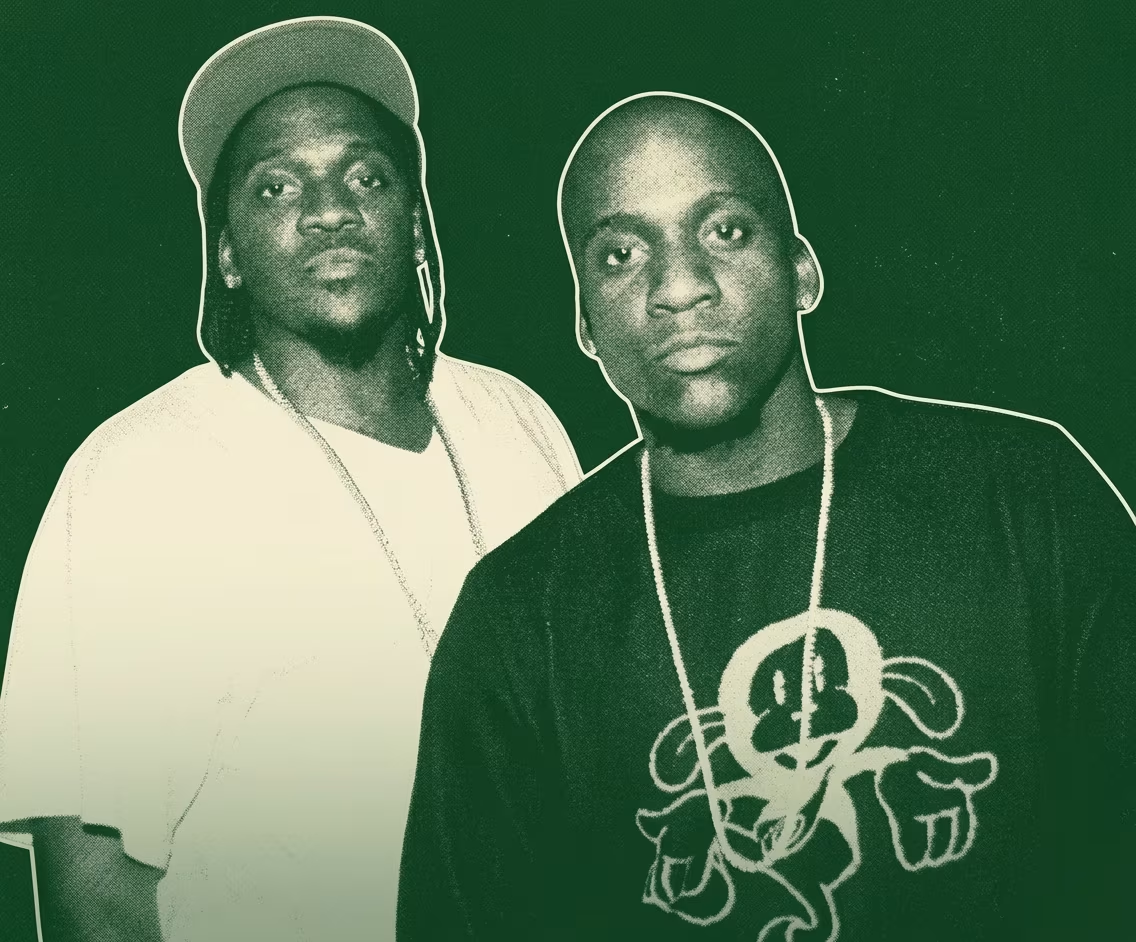
Malcolm “E.D.I. Mean” Greenidge is best known as part of Tupac Shakur’s group The Outlawz. But his connection to Pac goes all the way back to elementary school.
Greenidge remembers Shakur not as a superstar, but as a protective, loyal “big brother” type who remained that way until his final moments on the planet.
Greenidge recently popped back into the news when he testified (unwillingly, as you’ll see) in Duane “Keffe D” Davis’ trial, in which Davis was accused—and convicted—of taking part in Tupac’s murder. Davis was charged after years of publicly bragging about his role, in interviews and even in a memoir.
Greenidge is still extremely active artistically. His most recent releases include two albums and a graphic novel. He also maintains a very busy YouTube channel, where you can find his interview-based program The Outlaw Show.
Complex called him up one day after a Las Vegas jury found Davis guilty. We got his thoughts on the trial, the verdict, and his friend’s lasting legacy.
This interview has been condensed and edited for clarity.
I wanted to start with the most immediate thing. What are you thinking, and how are you feeling, about the verdict?
E.D.I. Mean: First off, I'm shocked at how fast the verdict came in. I didn't expect it to be wrapped up yesterday. I thought they would deliberate for maybe a day. So I’m kind of shocked at the speed of it. But overall, I'm relieved, glad this part of the saga is over. It's never fun to relive some of the worst moments of your life over and over again.
People have been throwing around the word “closure” when it comes to the verdict. I was wondering if that word has any resonance for you today.
I mean, for his fans and some members of his family, like his sister. Closure for them, yes. For me, closure happened a long time ago.
What do you mean by that?
Well, this wasn't as much of a mystery for myself. The streets had spoken and spoken loud many years ago, as far as who could possibly be responsible for what happened to Tupac.
When did you first become aware that Duane Davis was going around talking about his role in the murder?
I became aware along with everybody else —when he started becoming public with it. When those interviews started happening.
What did you think when you saw him talking?
It's not gonna end well for him.
Did you believe him when he began talking about his role in that night?
Why wouldn't I? He was using detail. He was pretty descriptive about it. So why wouldn’t I believe it?
Since the verdict, have you gotten a sense from any of Tupac’s close friends or family members as to how they're feeling about it?
Everybody is breathing a sigh of relief, and a sense of closure, and a chance to to continue healing and move on.
I wanted to get into your experience in court. Can you tell me the story of how you ended up on the stand? The prosecutor said publicly that you didn't want to do it.
Obviously, I was contacted by the Las Vegas D.A. They were reaching out to me pretty much any way they could and asking for my participation in this case.
How did you initially respond?
I didn't. I didn't respond at all.
So what were the steps between that and actually ending up on the stand?
I didn't respond. And they started to go through other measures to contact me, like reaching out to my children and other people in my circle. Eventually they had a process server come to my home, with instructions from a judge.
As far as my children were concerned, I didn't appreciate that at all. That compelled me to say, let's just get this over with, so not only I can move on with my life, but the people in my circle can move on with their lives.
Can you explain why you were reluctant to testify?
Well, because I felt like this had taken too long. If Keffe D doesn't start talking and basically embarrassing law enforcement out of Las Vegas, we're not here. I didn't see this as something that they were interested in solving. And so why would I want to help them?
How closely did you pay attention to the trial, other than the 25 minutes or so you were actually in the courtroom?
Whatever clips I could catch catch here and there.
So not watching every day?
No. I don't have time to sit and pay attention to this case that closely.
Did you have a sense of how your testimony fit into the larger story that the prosecutors wanted to tell?
No, not really. I don't know if my testimony helped or hurt the case. I really don't. I've been consistent in what I've said about this case for 30 years, so I don't know if I offered anything new or not. Obviously, I'm not an attorney, so law is not my forte. Initially I thought it was a big waste of my time, to be honest with you. But who knows?
The cross-examination was strange. I wasn't quite sure where the defense was going. What do you remember about cross?
I think for the most part they were trying to probably come with the angle that there was some disgruntle-ness with Death Row on behalf of Tupac—maybe Tupac and Suge had some type of beef.
You’re saying that the defense wanted to play up the idea that this was some sort of inside job and had nothing to do with with their client.
I’m assuming so. Don't hold my feet to the fire on that because, again, I'm not an attorney. But judging from the questions he was asking me, I believe that's the angle he wanted the jury to assume.
What was it like for you to relive this horrific night in such a public setting?
For me, it was something that I had to do, because I had my family and loved ones to consider. If I'm just this guy walking around single, with no children, no family to consider, [I wouldn’t do it]. Pac’s family and my family have been connected for over 50 years, since before I was born. So these are people on his side of the family that are now my family.
If I don't have all of those things to consider, you don't see me on the stand, because I don't go. It's not something, like I said before, that I was interested in doing.
Even if there's a potential fine or even incarceration held over your head.
From my understanding, it wouldn't have even went to that level, because there were other people that were subpoenaed and just didn't go. I don't know what consequences they suffered. I just know that they didn't end up on the stand.
I say all that to say: for me, justice for Tupac would have been eradicating the conditions that led to him being murdered on the Las Vegas strip 30 years ago. Things that he spoke about in his music and wanted to see change.
Also, he was out on bail at the time for a crime that he vehemently denied doing, and he never got justice for that. To me, that's justice for Tupac. As far as the trial and somebody being convicted, that's just a show for the people, and some closure for his family.
How did it feel to to speak about that night?
Like I said, I got closure with this many years ago. This is 30 years—three decades. And so my feeling was, let's get this over with. I've talked about this before. I gave a statement the night this happened. If you wanted to get like an emotional response for me, this would have had to happen at least 25 years ago, when I was still somewhat emotionally wrapped up in this.
At this point in my life, I'm not there anymore. Tupac has been gone for 30 years. He'll always be a part of me. But I get emotional talking about how he lived, as opposed to how he died.
During your testimony, you said that after the shots were fired and you came up to his car, Tupac was the one who warned you that there were armed police around and you need to watch out. That really says something about his character. Even in this extreme situation where he had received what turned out to be fatal shots, he's concerned with you. He's watching out for his friend.
For clarification purposes, it wasn't just me. It was me, [Outlawz member Yaki] Kadafi—Yafeu Fula, who’s no longer with us—and [Outlawz member] Katari Cox. We all grew up together. We're all childhood friends. We grew up looking out for each other.
I know for people, this is a wild moment. But Tupac was our big brother and he always looked out for us. That's who Tupac was. If he loves you, he loves you completely. He didn't just love you partially. He was he looked out for us until the very end. That's just who he was, man. My only regret is that I couldn't return the favor anymore. But that was absolutely his character.
As someone who was so close to Tupac, how do you want people to think about him now that we have a verdict?
People can stop with the “He's alive in Cuba” and all the other hoopla and dogma that has surrounded Tupac since he passed, and appreciate the art that he left. For me, how he died and all the mystery around that began to take away from the beautiful art that he created, from the music to the poems to the movies. What he stood for, his message—[the circumstances of his death] began to overshadow that, which I didn't like. Because how he died pales in comparison to how he lived.
But our culture—and I'm not just speaking about hip hop, I'm just speaking about American culture in general—has a weird obsession with death, especially celebrity death. We tend to get too wrapped up in how someone dies, whether it's Tupac, Michael Jackson, Prince, Whitney Houston, Elvis Presley, Marilyn Monroe, the list goes on and on. These celebrities could have done great things while they are alive. But as soon as they die, if they die in some type of tragic way, we all become obsessed with that.
For me, being so closely affiliated with this particular situation, I would rather focus on the the art. Let's get back to bumping Pac’s music. Let's go watch that movie that you loved and you haven't watched in years, and really dig into his message and what he stood for.
You mentioned these conspiracy theories that Tupac is alive and hiding in Cuba. As someone who knew him and knew that it wasn’t true, how did that kind of talk affect you over the years?
I was impressed by it. What I mean by that is, Tupac was very, very self-aware. Everything that he did was his own doing. When you switch your name to Machiavelli, a person that some believe may have faked his death, that's not an accident. That comes from reading, that comes from studying. Tupac was very clever in that sense. He was a forward thinker.
He never said this to us personally, but I would surmise that at some point he said, “Hey, if I die, me switching my name to Makaveli will have people thinking, am I really alive or not?”
So you viewed the conspiracy theory as a tribute to how smart he was about his own myth-making.
Very clever guy.
It seems that way! You're still releasing music. In fact, you put out two albums just this year. What can you tell me about them?
Music is still a part of me, is still part of my ecosystem. I did a collaborative project with an artist by the name of H-Ryda, who's been affiliated with us for many, many years. We just decided to do a project together to reintroduce him. It's called This Thing of Ours and it's a great project. It features Mopreme from Thug Life and Tash from Tha Alkaholiks. My solo project is the soundtrack to a book I just released called The Realest Shit I Ever Wrote. It's a graphic novel, almost like a comic book. I teamed up with this artist out of Australia. His name is Mark “Sketch” Bernard. He did all the graphics to it. It's a collection of different writings. I've always considered myself a writer first. Writing was my first love. It's a nice little collector's item for any Tupac and Outlawz fans.