Key Takeaways
- The piece is a track-by-track history of UGK's 1996 album Ridin' Dirty, from the perspective of Bun B. Thirty years later, the rapper looks back on how the album became one of the best rap releases of the ‘90s.
- Bun breaks down the creative process behind key songs like "Murder," "Diamonds & Wood," "Hi-Life," and "One Day," highlighting Pimp C's live-band sampling genius, their yin-yang writing dynamic, and the album's deliberate Screw-tape-inspired sequencing.
- Throughout, he ties Ridin' Dirty's themes to real Houston street life, faith, and loss, while honoring Pimp C's legacy, UGK's influence on artists from Jay-Z to T.I., and the album's lasting impact 30 years later.
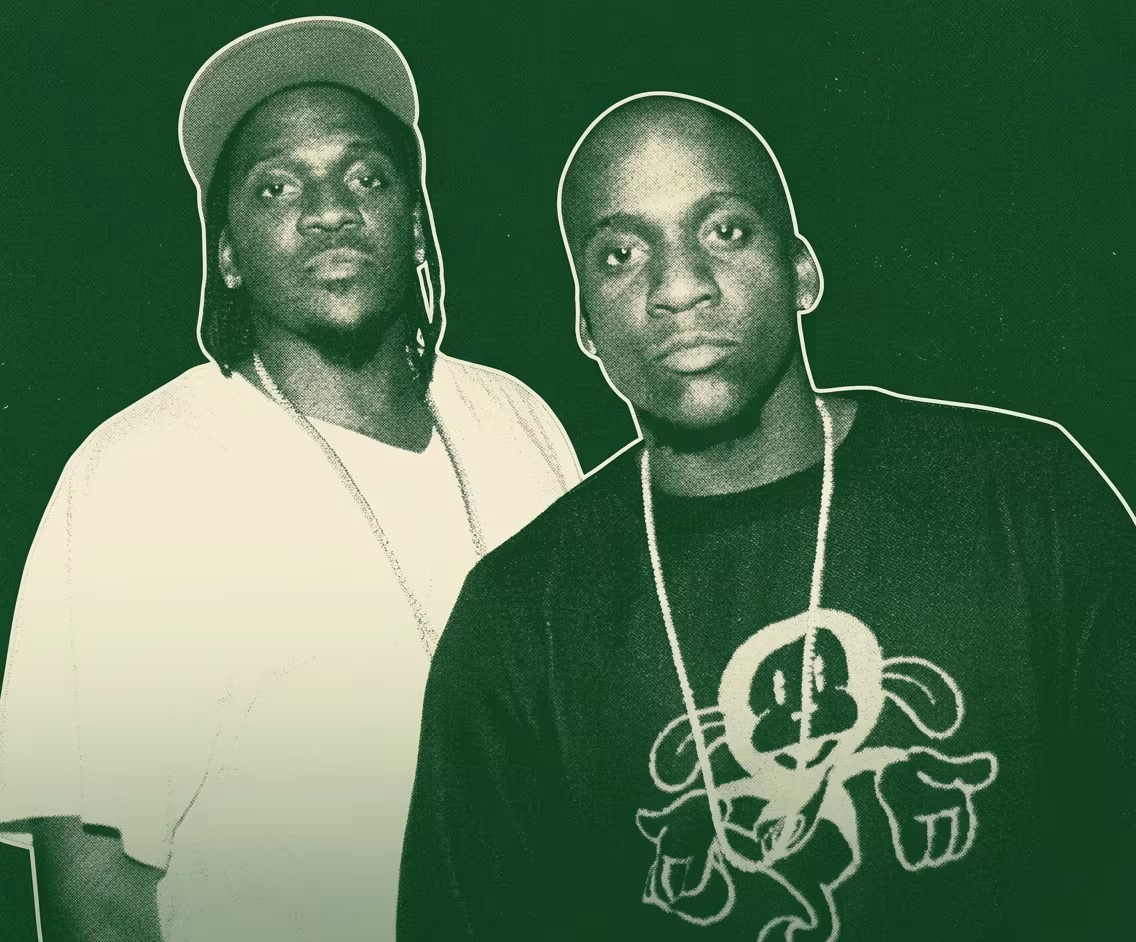
In July 1996, when Jive Records released Ridin’ Dirty the third studio album by the now-famed Texas duo UGK the label refused to put up a budget for a music video.
In fact, Bun B and Pimp C didn’t even appear in the commercial Jive filmed for the album. Music videos were especially important to crafting an artist’s identity in those days, so it’s a true testament to the strength of the music that the album has endured and has come to be regarded as a classic. (In a retrospective review written by Brandon Caldwell, Pitchfork gave the album a 9.5.) But it’s the way it resonated in the real world l that elevated the album to its timeless status.
Former U.S. Men’s Soccer Team captain Clint Dempsey has been quite vocal about his love for the album, citing tracks like “Hi-Life” as speaking to his experience growing up in Nacogdoches. T.I. is on the record saying that Bun B’s verse on “Murder” is one of the greatest verses of all-time (and his personal favorite). Pimp C’s verses from “One Day” and “Diamonds & Wood” were sampled by Method Man and E-40. Perhaps most famously, Jay-Z used, word-for-word, the first four lines of Bun’s verse on “Touched” to kick off the final verse of one of his biggest hits “99 Problems.”
Pimp C’s lush, cinematic beats and braggadocious rap style provided the perfect balance for Bun’s anchored, dexterous flows. Tragically, Pimp C was found dead in a hotel room in Los Angeles in December of 2007 and Bun has since carried the torch, making sure no one forgets his late partner’s name nor his contributions to the culture.
Nowadays, Bun makes headlines for selling more than 75,000 tickets to his concerts at the Houston Livestock Show & Rodeo in consecutive years and for creating “America’s Best Burger” in the restaurant that bears the name of a word he and Pimp helped popularize: Trill Burgers. Bun once told me that the album is “the first complete thought” of UGK as a group, so, as he prepared for a big, star-studded Ridin’ Dirty 30th anniversary concert at Smart Financial Center just outside of Houston in Sugar Land, we spoke at length over the phone about the album, track by track.
Here is the making of UGK’s Ridin’ Dirty.
“Intro”
Performed by: Smoke D
Bun: For a long time, people thought this voice belonged to me because I was known for doing voices and impersonations, but that was actually Smoke D.
He was supposed to be UGK’s first signed artist. He was in prison at the time, so what we did was we sent him a portable DAT machine and told him to just describe to us what he was seeing around the penitentiary.
The thing is, the portable DAT to the untrained eye looked just like a Walkman, so people thought he was listening to music, but he was really walking around recording himself narrating the scenes he saw. We hoped we would eventually be able to use it to have him record verses from the inside, send us the tapes, and then we could find a way to make music to those verses while keeping time with his flow. But before we could figure out how to do that, the penitentiary stopped letting us send him tapes. So we were just left with what we had. I don’t know if they confiscated the machine or not, but that was how Smoke D made it onto the album.
“One Day”
Featuring: Mr. 3-2 and Ronnie Spencer
Produced by: Pimp C & Mr. 3-2
Mr. 3-2 came over to play us an early version of his first solo album [The Wicked Buddah Baby] and the last song that he played stopped Pimp in his tracks.
Pimp was like, “Man, I ain’t gon’ lie, that’s the one right there.” And 3-2 was like, “I don’t think I’m gonna use it.” Chad [Pimp’s real name] was like, “Why not?” And 3-2 said, “It’s too slow, it’s too sad. I don’t think people are gonna fuck with it.” Pimp was like, “That’s the best song on the album!” 3-2 was like me, he was a lyricist, so he preferred faster tempos that could showcase his versatility as a lyricist. He really felt like it didn’t fit with the rest of his album, so Pimp was like, “Well, that’s a hit record, so if you don’t want it, give it to me and I’ll prove to you that it’s a hit.”
So we kept his first verse from the song and then we did the other two verses. At the time, we didn’t fully understand the poignancy of doing a song like that. Looking back now, 30 years later, Original E (one-half of OG Style, the original producer of the song,) is gone now. Chad is gone. 3-2 is gone. It’s just me and Ronnie Spencer left. And Ronnie suffered a stroke recently, but he’s been rehabbing very well, so he’ll be part of the show on August 1st.
The station 97.9 was asking recently: Who would you want to see go head to head in a Houston VERZUZ. The obvious one would be Swishahouse versus Screwed Up Click, right? But the problem with that is, many of the people from the S.U.C. with the biggest records are no longer with us. There’s no H.A.W.K., no Fat Pat, No Screw, no Big Steve, no Big Mello, no Big Moe. And on the Swishahouse side, we just lost Michael Watts. It’s a tragedy.
“Murder”
Featuring: N/A
Produced by: Pimp C
Bun: “Murder” was designed as an up-tempo song to allow me to showcase my lyrical dexterity because for years Chad had been arguing that nobody could outrap me.
He had a $100,000 bucks on it, even when we didn’t have a $100,000. But he really felt that I wouldn’t lose if I went up against any rapper. And that’s arguable because at that exact time, we had prime Scarface, we had prime 3-2, Big Mike. And that’s just from Houston.
The idea of UGK was Pimp C’s yin to my yang, so we affected songs differently. We approached them differently too. We would understand the idea of the song, the theme, and maybe the hook might get done first, but if he wrote his verse first, he wouldn’t say it to me, we just went and wrote and recorded the verses. Amazingly, even though it’s very obvious that we would go in different directions on almost every song, it never felt like there was any clash or any stepping on toes. Everyone likes to say that “Murder” is my all-time best verse, and that’s subjective to the listener, and I respect was that verse has done for me within hip-hop, but I would argue that Pimp’s verse is just as strong as mine. There’s way more quotables on Pimp C’s verse. Really it’s one of the best showings of he and I together on one record.
I remember I’d gone out the night before and got fairly drunk and so the next day in the studio I was hungover, one of the few times in my life I’ve ever been hungover. It was cold in the studio, but it was warm underneath the board, so after I finished writing my verse I crawled under the board and went to sleep while Pimp worked on the record. Eventually, Pimp woke me up and told me it was time to record. So I crawled back out, went in the booth, and recorded my verse.
When you hear me say, “Ask that boy Skip / that nigga Bun rip,” that’s because we were at Skip’s house. Skip was an engineer mainly for commercials, but he also recorded in Pro Tools which was a relatively new program. So until someone can prove me wrong, I believe Ridin’ Dirty is the first full hip-hop album to be recorded in Pro Tools
“Pinky Ring”
Featuring: N/A
Produced by: Pimp C
Bun: I think “Pinky Ring” is criminally underrated as a song.
That was a rapping style that I had never attempted before, and never tried again. I wanted to write a rhyme a different way. I wanted to write it where I would go through four bars and end on something and then start the fifth bar on that same thing and then switch into the next thing before we get to the ninth bar. Personally, I was more impressed with my ability to pull that off than I was with what I did on “Murder.” I always felt a certain way because, well, if people could recognize that “Murder” is hard, how can they not recognize it on “Pinky Ring”?
I never got the validation I wanted for how good a rhyme I wrote with “Pinky Ring,” but that’s because I was rapping with Pimp C and it’s very hard to attack the subject matter in a way that’s better than what Pimp does. His verse was a lot easier to relate to, right? Whereas I was more technical. That’s how it went on a lot of this album.
“Diamonds & Wood”
Featuring: Smoke D
Produced by: Pimp C
Bun: Without question, this is the song that embodies the sonic thesis of the album, which was that it was meant to feel like a DJ Screw tape without actually being screwed. Or our interpretation of a Screw tape at least.
This is the shortened version of the jam session you hear on the outro. And I’ve avoided talking about this in public before but I can talk about it now: Part of the genius of Pimp C was what he did with the jam sessions. He would have the band play a song and then he’d conduct. He’d say, “OK, bass player, take a solo.” Then the bass player solos. Then the guitars, the keys, the strings, et cetera. And then once it was all recorded, Pimp would go back on his own time and isolate the tracks. So he’d listen to only the lead guitar all the way through the jam, pick his favorite moments, separate the guitar from everything else, and then sample that. Then he’d take a piece of the guitar part from that jam session and make it the guitar for a whole record. So you’d get the warmth of live instrumentation, but you’d also keep the 4/4 time that some would say is essential to hip-hop. That’s how “Diamonds & Wood” was made.
Lil’ Keke was supposed to be on “Diamonds & Wood.” The whole album was meant to play like a night on the South Side of Houston, and the story of how he didn’t make it on the album is really emblematic of how true to life Ridin’ Dirty was. There was a night where we were with DJ Screw and we were going to pick up Keke and bring him to the studio. He was supposed to meet us at the Denny’s on 610 near South Main. We were waiting in the parking lot for about an hour and the manager of the Denny’s must have thought we were up to something because he called the police. Keke eventually called and said he was over by some condos around the corner.
So we left the Denny’s and went to the corner store near those condos where we met Keke and H.A.W.K. The whole time, by the way, the police had been following us at a distance. When Keke noticed the police, he just kind of walked out and left because at the time he had a blue warrant. By the time the rest of us walked out, the cops had already gotten out and surrounded the car.
So on that night in Houston, Texas, DJ Screw, Pimp C, and H.A.W.K. were in the Harris County Jail together. I was told that one of the correctional officers at the prison took a photo of them together, but to this day I’ve never seen it. I have no idea who that person was or if that picture even still exists. If that would have happened in today’s times? That picture absolutely would have gone viral.
So that’s why Pimp ended up having to put a third verse on “Diamonds & Wood.”
“3 in the Mornin’”
Featuring: C-Note of the Botany Boyz and Big Mitch
Produced by: Sergio
Bun: If you’re in the streets, three in the morning is the magic hour. At the time, there would be these little clubs that would be open past 2 AM, some of them not really “legal” I guess you could say. Really they were just a way for people in the hood to keep hanging out after the regular clubs closed. This song was meant to capture that late-night feeling.
It’s me on the first verse, Mitch on the second verse, Chad on the third verse, and the Botany Boyz on the intro and outro. Almost every day, some version of the Botany Boyz was at the studio—whether it was just C-Note, or C and D-Red, or Will-Lean, or Lil’ 3rd, or whoever, and it just got the point where we said, “Y’all might as well be on this record.” The problem was, there was no room left to rap on the song, so that’s why you hear C-Note doing the intro and the outro of the song. [The Botany Boyz are also featured on the inner sleeve of the physical copy of the album portraying car jackers stealing Bun and Pimp’s car. The album’s iconic cover is meant to be Bun and Pimp looking back as the car jackers approach. The car used for the cover was C-Note’s Chevy Suburban.]
The second verse on the song is Big Mitch, Mitchell Queen, from Port Arthur, who was part of the original UGK with Pimp. Meanwhile I had my own group [P.A. Militia] with my partner Jalon. And then before UGK as you know it, there was 4BM (4 Black Ministers,) which was Mitch and Pimp and then me and Jalon. As we were getting ready to graduate, Mitch had gotten a scholarship to play football at Prairie View A&M, where his father had also played. Jalon was a year younger and decided he was going to try and get a football scholarship as well. Eventually, Pimp and I were the last two rappers left and so we decided to use the UGK name.
“Touched”
Featuring: Mr. 3-2
Produced by: N.O. Joe
Bun: Some of these songs were really led by Joe, and “Touched” was one of them, although Pimp would always incorporate something into each of them. You might notice that each of the songs Joe led tended to lend themselves more towards strings, they resonated a little higher, sonically, than Pimp’s songs. But I think those qualities really added to the ebb and flow of the album. This song is really about getting back to the hook. Something people miss sometimes is that every hook on this song is different. This was part of the experimentation of the idea of making Mr. 3-2 a member of UGK. There was just a different dynamic that he added to the group and I would liken this song to a kind of audition, although we ultimately ended up not bringing him into the group.
The first time I heard Jay-Z quote my verse from “Touched” on “99 Problems” it caught me off guard. We entertained the idea of asking for publishing on the song, but we didn’t own our publishing, so we wouldn’t have seen any money from it anyway. Plus, I was never of the school of thought that rappers should be suing other rappers for utilizing part of a verse. Reasonable Doubt came out the same year as Ridin’ Dirty, we eventually did “Big Pimpin’” of course, but by the time The Black Album dropped, Jay was on another level. It’s cool. The idea that my lyrics were being heard and recognized by one of the best songwriters we’ve ever seen is pretty damn cool. The rapper Le$ recently reminded me that there’s an old MTV clip of Jay riding around Brooklyn listening to UGK. It’s good to be acknowledged by your peers in that way.
“Fuck My Car”
Featuring: N/A
Produced by: N.O. Joe
Bun: That’s a Pimp C song. All day long. It’s an honest look at how relationships are created in the hood, but not solely. Because this phenomenon exists elsewhere, right? In the hood, you may pull up in a slab and get attention, but on the other side of the tracks, if you’re pulling up in a Lamborghini or a Rolls Royce, you’re getting that same type of attention. It’s the idea that, well, I may not be handsome, but I do have a nice car, so, unless I drop the ball, I should get the girl. If I don’t, that’s on me.
On the flip side of that, in a state like Texas where everyone has a gun, having a nice car can also make you a target. Which is why the next song is…
“That’s Why I Carry”
Featuring: N.O. Joe
Produced by: N.O. Joe
Bun: At that time, people were really getting robbed and jacked and in certain situations killed for their car. For their slab specifically, because the rims were hard to get. I talk about it on the song: “I seen a slab get stripped / The disc, seats and sound gone, and candy paint burnt to a crisp.” They would burn the car after they got everything they wanted from it, to eliminate fingerprints, but also to piss the owner off even more.
Some of my lyrics on this song were also quoted by Jay-Z on “Murda Murda,” which he punctuated with, “That’s a little UGK for ya / Port Arthur, P-A for ya.” Yeah, that’s pretty cool, right?
“Hi-Life”
Featuring: N/A
Produced by: N.O. Joe & Pimp C
Bun: “Hi-Life” is the spiritual anchor of the album. It was about making an honest assessment of all the problematic things you’ve done. You’ve sold the drugs, shot your gun, used women, all of these things God would not agree with, and at the end of the night, when you go home and you lay in bed, how do you talk to God about that? We were not just a group that existed inside of Texas, we were part of the larger southern experience. We were raised in the church.
The first songs we learned were gospel songs. So how do we make sense of the decisions we made in the streets? This song was about acknowledging that some of the things we do are wrong, and we might even be doing wrong things for the right reasons, but we don’t really know how that sits with God. Even though we weren’t Catholic, this song is very close to the idea of confession. For a Christian, everything starts and ends with God and how God sees you and whether or not you have earned His forgiveness.
“One Day” was about the wrong we saw in the world, witnessing people we love experience loss, and asking God, literally, in the case of Pimp, how could He allow these things to happen? “Hi-Life” was about turning inwards and looking at the wrong we had done. People often looked at us as glorifying things that shouldn’t be glorified, but even we knew there were consequences. You don’t just get away from this life for free. We wanted to be clear that even though we were talking about doing all of these things, we weren’t disregarding that it goes against the scripture.
When Pimp says, “Most preachers just false prophets, fuckin’ hoes and getting paid,” he was talking to a specific preacher who we knew listened to our music. He was saying, “Who are you to critique me when you are probably doing as much if not more?”
At the end of the day, we’re all human. We’ve all made mistakes. We will spend our life trying to make up for those mistakes. The older you get, the more you want to make sure you’re right with God.
"Good Stuff"
Featuring: N/A
Produced by: Sergio
Bun: The flow of this album was very important to us.
So after “Hi-Life,” we had to get back to having fun. I very seldom talk about this but “Good Stuff” was produced by a good friend of ours at the time by the name of Sergio—or Serge as we called him.
He was from The Org, which was a crew of MCs and producers that we were part of. We were heavily influenced by Royal Flush, the group that was signed to Rap-A-Lot back in the day. We spent a lot of time around Rick Royal and Al-B and Big Munn and some other guys who eventually became members of (Bun’s later rap group) Mddl Fngz.
The Org was how we all got close. Serge was one of, if not the most poignant writers I had ever been around or recorded with or took tutelage from. He really taught us how to properly construct themes. Their sessions were very serious. You weren’t even allowed to laugh or crack jokes in their sessions. And as much as we appreciated every other aspect of the relationship, that was something we just couldn’t agree with because all me and Pimp did was have fun and crack jokes. We would laugh so boisterously. There’s so many pictures of me and Pimp where we’re just laughing. We would crack jokes during sessions to break up the heaviness of some of the subject matter in the music.
We really enjoyed each other’s company, Pimp and I. We never got into fights or arguments. We lived different lifestyles but neither of us judged the other for it.
As for Serge, I haven’t talked to him in years. I would like to believe he’s still alive.
"Ridin' Dirty"
Featuring: N/A
Produced by: Pimp C
Bun: Pimp was really adamant about the idea that you could make an album full of really good songs, but if you put them in the wrong order, the ebb and flow of the energy doesn’t properly work.
The sequencing on this album was very consciously done by Pimp. So that’s why this album starts on a very solemn note and then goes into the high-powered energy of “Murder.” If you pay attention, the whole album flows like that. So this was the natural choice to follow “Good Stuff.” We also didn’t accept any upfront money with this album. Instead, we asked for all the best equipment that Jive would give us.
We brought in live musicians, like Leo Nocentelli from The Metters. And all of this was intentional because, in part, we wanted to circumvent sample clearance issues with Jive.
"Outro"
Performed by: Pimp C
Produced by: Pimp C
Bun: What you hear on the outro is the jam session that “Diamonds & Wood” was born out of. On the outro you hear Pimp shout out the singer JOI and [Goodie Mob member] Big Gipp, who were a couple at the time. They’d just had a daughter. He also shouts out Fishbone, the rock group, because we were introduced to Fishbone through JOI. Years later, I ended up reconnecting with Fish from Fishbone. We were actually trying to form a group that was going to be me, Fish, Everlast, and we’re still trying to find that fourth person.
Anyway, I remember Fish telling me, “We know everybody. We started out with a lot of people. We empowered people. We gave people advice. Helped people along the way, helped them navigate the industry and the world. No one that we helped ever thanked us. Then here were you brothers, who met us one time, and you shouted us out on your album. Meanwhile, people who knew us for years never acknowledged us.” And Fish just wanted to thank us.
Guys like Fishbone, Public Enemy, Bad Brains, are the original counterculture people. They empowered those of us who knew what we were doing wasn’t socially acceptable or likable to keep pushing and do what we were doing because we knew it needed to be done. They are the precursors to UGK and what UGK wanted to represent. We were from a very small town that many people didn’t know about, we were talking about things that were not very popular, yet we still found our way into this industry, we found our way to a place of being looked at in high regard, we won awards, sold records, and all that kind of stuff. But it was only because of the sheer audacity of groups like Fishbone and Bad Brains and Public Enemy and The Coup and people like that being very clear and open about how they looked at the world.
When you create music like that, you’re letting someone out there know, “Hey, you’re not alone in this world. You’re not weird, you’re just different, and there’s nothing wrong with being different. And, really, on the cool, there’s nothing wrong with being weird either. ”
Conclusion
You can only be who you are, right?
So I can look back now and say I’m proud of Ridin’ Dirty. Of UGK. Of choosing our own direction. We weren’t successful for a long time, and there were many times where we didn’t know if we should even continue. There were times when Pimp wasn’t feeling confident and I lifted him up. There were times where I didn’t want to go on; I didn’t think we were making any ground, and we certainly weren’t making any money, but Pimp would keep me encouraged. No matter what, we never put anything above UGK. No matter how popular I got as a solo artist, UGK has always been the heart and backbone of my life and of my musical experience. And I can comfortably say that for him as well.
I can’t tell you how many people I’ve met from all walks of life who have told me that this album helped them get through the things they were going through. That’s the best you can hope for as an artist. It’s all because, for one moment in time, 30 years ago, we were exactly where we needed to be.