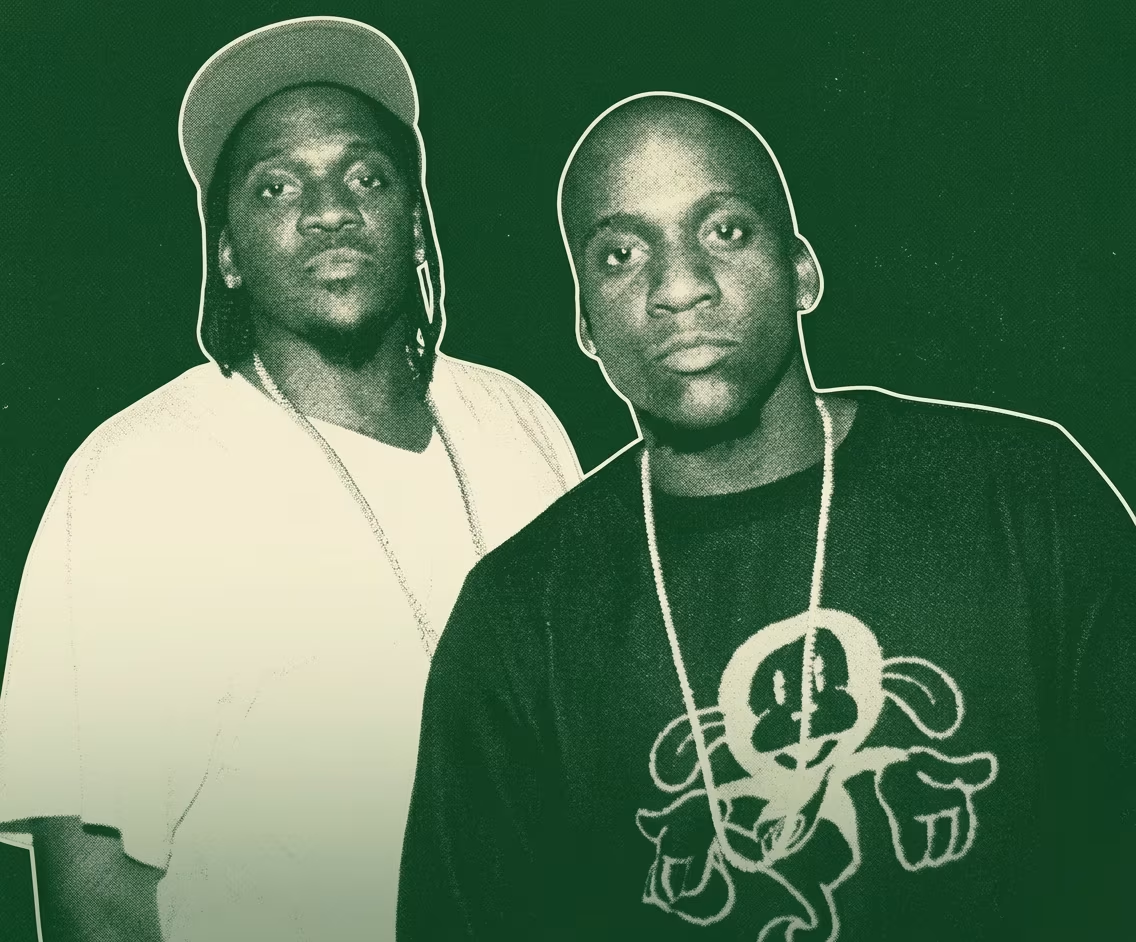
Image via Complex Original
The 1970s gave birth to rap music, and the 1980s helped raise it, but the 1990s were when rap really came into its own. Artists like 2Pac, Notorious B.I.G., Snoop Doggy Dogg, Nas, OutKast, Jay Z, Scarface, and many, many more helped make the decade memorable by dropping albums that were later hailed as classics. And outside of the studio, rappers were also involved in lots of different incidents—both positive and negative—that shaped the public perception of what rap music was and helped it become a force within the music industry. Looking back, it's easy to see just how far rap has come since the '90s ended, but also how influential the '90s were with regards to where rap music is today.
Which stories from '90s rap stand out the most, though? That's the question that we asked ourselves recently—and the question we're going to answer today. For the most part, you won't find any album release dates here (save for a few really important ones), or dates tied to specific rap songs that were big during the '90s. But you will find important events involving rappers from what will surely go down as one of the most important decades in the history of hip-hop music. These are the 25 Biggest '90s Rap News Stories.
Written by Chris Yuscavage
Big Daddy Kane Makes an Appearance in Madonna's "Sex" Coffee Table Book
Date: October 21, 1992
Despite his greatness on the mic, Big Daddy Kane made several questionable decisions in the early 1990s. There was the time he agreed to appear in the pages of Playgirl, the time he agreed to play a part in the movie The Meteor Man, and, of course, the time he agreed to take a bunch of nude shots with Madonna and Naomi Campbell for Madonna's Sex book.
The fact that Kane was naked in the controversial coffee table book wasn't the main issue, though. It was that after his lackluster fourth album, Prince of Darkness, he had decided to pose naked in a Madonna book rather than get back to work. He should have withdrawn his name from consideration for the book as soon as he realized that Vanilla Ice was also posing in it.
Canibus and LL Cool J Begin Beefing After the Release of "4, 3, 2, 1"
Date: Late 1997
When Canibus wrote his original verse for LL Cool J's posse cut in 1997, he included a line that LL didn't like. "L, is that a mic on your arm?" Canibus rapped. "Let me borrow that!" So LL asked him to remove it from his verse. But even though Canibus agreed to do it—and even though he told LL that he was trying to pay homage to him, not diss him, by mentioning his mic tattoo in the first place—LL decided to use his verse on the song to teach Canibus a lesson. So he filled it with references to Canibus asking to "borrow" his mic and included lines like, "Every little boy wanna pick up the mic/And try to run with the big boys and live up to the real hype."
It obviously didn't sit well with Canibus. So in early 1998, the young rapper released a diss track called "Second Round K.O." that featured an intro and ad libs from Mike Tyson and Canibus throwing shot after shot after shot at LL. It's widely regarded as one of the best diss tracks of all time, and it led to an all-out war between the two. LL struck back with a diss song of his own called "The Ripper Strikes Back" as well as another song called "Back Where I Belong." Canibus countered with a follow-up to "Second Round K.O." called "Rip the Jacker." And all hell broke loose. In the end, a true victor was never really crowned in their battle. But looking back, it's crazy to see what one little rap line was able to do.
C. Delores Tucker and the National Congress of Black Women Call for a Boycott Against Gangsta Rap
Date: 1993
After seeing a number of gangsta rap acts enjoy success in 1993—most notably, Snoop Doggy Dogg's debut Doggystyle landing at No. 1 on the Billboard charts that year—C. Delores Tucker, the founder of the National Congress of Black Women, decided to launch a protest against the entire gangsta rap genre. So she brought together a group of women, including Dionne Warwick, Melba Moore, and Sister2Sister publisher Jamie Brown, who were passionate about trying to take rappers like Snoop, Dr. Dre, and 2Pac down. They congregated outside of record stores in the Washington, D.C., area and protested against the sale of gangsta rap albums because, after sitting down and listening to a handful of successful gangsta rap projects in '93, they felt as though the music was harmful to the community.
"It was very offensive to us as women because it glorifies sex, drugs, rape, and the vilest form of human relationships anyone can imagine," Tucker told the Chicago Tribune in early 1994. "And our children emulate these things they hear and see… . We're not against rap. We're only against gangsta and misogynistic rap. Everybody wants to look cool like the gangstas and carry guns to school. Even going to prison is cool. Young minds are being exploited to see only the worst in the African-American community."
Tucker & Co. didn't stop at just protesting outside of record stores, either. They also bought shares in big record labels like Sony and Time Warner, which allowed them to protest at shareholders' meetings. And they made such an impact that, within just a few years, rappers were dissing Tucker in songs. 2Pac famously rapped, "C. Delores Tucker, you's a motherfucker/Instead of tryin' to help a nigga, you destroy a brother," on his 1996 single, "How Do U Want It?"
It did little to deter Tucker, though. She continued her crusade against gangsta rap throughout the 1990s and early 2000s until her death in 2005.
Dr. Dre Announces His Departure From Death Row Records and Says Gangsta Rap Is "Dead"
Date: March 22, 1996
In 1992, Dr. Dre and Marion "Suge" Knight came up with $250,000 together and started the record label Death Row. They signed a distribution deal with Interscope Records that allowed them to retain all of their publishing and all of their master recordings. And then, over the course of the next four years, they turned Death Row into a juggernaut, releasing projects from Snoop Doggy Dogg, Tha Dogg Pound, and, of course, Dr. Dre himself. The label sold more than 18 million albums during Dre's time there.
But by 1996, Dre had reportedly grown tired of working with Suge and was interested in starting his own label. So he announced that he was leaving Death Row, revealed that he thought gangsta rap was "dead," and founded a new label called Aftermath Entertainment. He also used his previous connections to obtain another distribution deal with Interscope for his new venture.
Aftermath wasn't an immediate success. The label's first project, Dr. Dre Presents the Aftermath, was underwhelming. But two years later, Dre signed Eminem to his label, and by that time, it was pretty clear that Death Row wasn't going to be able to achieve the kind of success that it had achieved under the watchful eye of Dre because of the 1996 death of 2Pac, and the racketeering charge that Suge caught in 1997. Dre then went on to turn Aftermath into a success, and he still heads up the label today.
The Last Episode of "Yo! MTV Raps" Airs
Date: August 17, 1995
Prior to Yo! MTV Raps making its debut, there were very few hip-hop videos that were played on MTV. So when the network started airing it in 1988, it was a big moment for the genre. Weekday hosts Doctor Dre and Ed Lover—and weekend host Fab 5 Freddy—played a huge part in helping spread the popularity of rap music around both the country and the world. And as a result, the show received some of the highest ratings in MTV history when it first aired.
However, ratings declined several years after the show debuted, and by 1995, MTV was only airing it once per week. So they decided to pull the plug on it. But before they did, they held a series finale that included a legendary freestyle session featuring a who's who of rappers on it. From Rakim and KRS-One to Method Man and Redman, the MCs who attended the finale helped the show go out in style. And while MTV did try to repackage Yo! MTV Raps as a show called Yo! throughout the rest of the '90s, it was never the same again. But during its run, the show did more than enough to push hip-hop into the mainstream.
A Tribe Called Quest Breaks Up
Date: Summer 1998
A few months before the release of their fifth album, The Love Movement, Q-Tip, PhifeDawg, and Ali Shaheed Muhammad started sharing some stunning news with their fans during concerts—they announced that they were breaking up. After signing with Jive Records in the late 1980s, Tribe quickly transformed into one of the most important rap groups of hip-hop's "Golden Era" thanks to their albums, People's Instinctive Travels and the Paths of Rhythm (1990), The Low End Theory (1991), and the classic Midnight Marauders (1993). But by 1998, they had grown tired of dealing with their label and decided to call it quits.
Since disbanding, the group has reunited on a number of occasions. Most recently, they got together to open several shows for Kanye West. But they haven't put out a proper release since the late 1990s. And despite numerous rumors over the years indicating that they might be interested in a reunion, they've never gotten back into the studio together.
Jay Z Is Arrested for Allegedly Stabbing Lance "Un" Rivera
Date: December 1, 1999
When Jay Z approached record executive Lance "Un" Rivera at a party at a New York City nightclub called the Kit Kat Club in 1999, he was trying to do what was best for his career. But in the process of stepping to Rivera, he nearly ended it.
Less than a month before he released his fourth album, Vol. 3…Life and Times of S. Carter, the Jay got wind of the fact that Rivera had been involved in the bootlegging of his project. So he stepped to him, at a party for his fellow rapper Q-Tip, and asked him about it. What happened next is still a little bit unclear. But a short time later, Rivera was stabbed in both the stomach and the shoulder, and according to him, Jay Z was the one who stabbed him. Jay was arrested the next day after turning himself into police, and he was later charged with felony assault and faced 15 years in prison.
Fortunately for Jay, the charge against him didn't stick, and he eventually reached a plea deal and received three years probation for his altercation with Rivera. But that stabbing almost cost him his career, and very nearly robbed him of the chance to do all of the things that he's done inside and outside of the music world over the course of the last 15 years.
Vanilla Ice Gets Exposed
Date: November 18, 1990
Remember when we all learned that Rick Ross, the rotund rapper from Miami’s Carol City neighborhood, was not the seasoned drug pusher he rhymed about being on record? Remember how we all thought it was going to be the end of his career? Remember when 50 Cent went on a full-court press trying to fully expose the guy who not only wasn’t a kingpin, but was a corrections officer? Remember how no one cared ‘cause “B.M.F.” still hit harder than anything that was out at the time? If only Vanilla Ice was so lucky.
In the late ‘80s Vanilla Ice’s career was on the upswing. His debut single, “Ice Ice Baby,” became the first rap song to top the Billboard Hot 100. He signed a million-dollar contract with SBK pictures to star in an action-adventure movie. He was raking in money from shows across the country. The white dude who reportedly learned how to rap and dance on the streets of Miami, went to high school Uncle Luke, and was a national Motorcross champion seemed unstoppable. If only all that was true.
On November 18, 1991, The Dallas Morning News ran a report that rebuked most of the backstory Ice was pushing onto fans and media. It turned out he didn’t grow up on the streets of the 305, and that he, Robert Van Winkle, was from a quiet suburb of Dallas. He didn’t go to high school with Luke, he went to an affluent Dallas high school. On top of that, it was learned that he didn’t win any of the national motorcross championships he claimed to have won. It was all a fraud. Too bad he didn’t live in the 2000s.
MC Hammer Becomes the First Rapper to Go Diamond
Date: April 15, 1991
Back in 1990, when he released his album, Please Hammer, Don't Hurt 'Em, there weren't too many people who would have put MC Hammer in the same category as U2, Van Halen, or the Beatles. But thanks to the success of his third album and, more specifically, his hit single, "U Can't Touch This," Hammer did something that no other rapper had ever done just one year after releasing the project. He sold more than 10 million copies and had his album certified as diamond by the Recording Industry Association of America.
It was obviously a big accomplishment for Hammer. But it came at a price. Because while he sold a ton of records, he was also labeled a "sellout" by some rap fans. It's the same label that was given to Vanilla Ice in 1990 after the success of his hit single, "Ice Ice Baby." And it's a label that Hammer had to eventually come to terms with and accept.
"One of the strangest things in the rap language is the word or the phrase 'sellout,'" he said a few years ago. "What it really means is 'Why didn't it happen to me?' If your record crosses over to pop, and you get white listeners, Latin listeners, and listeners who are not black—you are called a 'sellout.' If that is a 'sellout,' then here I am. I'm a 'sellout' because I want my music to be accepted by all people."
The term "sellout" made it difficult for Hammer to move forward with his career, though. And while he did enjoy smaller degrees of success after dropping his third album, he never reached the same heights again.
Nas' Debut Album, "Illmatic," Receives Five Mics From "The Source"
Date: April 1994
"Shortie" loved Nas' debut, Illmatic, when she heard it. "Shortie" was the pen name of The Source intern Minya Oh, who got her hands on a copy of Nas' first album in early 1994, and responded by convincing the editors at the magazine to give it their five-mic stamp of approval. She tried to find a reason—any reason—not to give it five mics. But she couldn't find anything on the album that she didn't like, and was confident that Nas had created a classic.
"Everything that I tried to analyze, I just couldn't get away from the fact that I couldn't find anything wrong," she told NPR earlier this year on the 20th anniversary of the album.
People agreed with her. Lots of people. And Nas' debut went down as not just one of the greatest hip-hop debuts of all time, but as one of the greatest albums, if not the greatest album, in hip-hop history.
Snoop Doggy Dogg Releases "Doggystyle" and Reaches the Top of the Billboard Charts
Date: November 23, 1993
After he made an appearance on Dr. Dre's classic album, The Chronic, in 1992, there was a very high demand for Snoop's solo material in 1993. So Snoop and Dr. Dre got back into the studio, and despite the pressure that was put on them to create another classic, they delivered one of the best debuts in rap history. Armed with a lot of the same G-Funk style of production that Dre used on his own debut, Snoop—who was just 21 when Doggystyle was recorded—tore through tracks like "Who Am I (What's My Name)?," "Ain't No Fun (If the Homies Can't Have None)," and, of course, "Gin & Juice."
The album was an immediate hit. It sold more than 800,000 copies in its first week—which was a record for a new artist—and was the fastest-selling album ever at the time. It climbed all the way to No. 1 on the U.S. Billboard 200 chart and has since sold more than five million copies. And it's widely considered to be one of the best West Coast rap albums of all time.
Not everyone loved it, though. In late 1993, C. Delores Tucker and the National Congress of Black Women staged a public protest against gangsta rap music in part because of the success of Snoop's debut project. And Snoop's glorification of violence on Doggystyle didn't help his public perception much since the album was released just months after he'd been arrested for allegedly taking part in the death of Los Angeles gang member Philip Woldermarian. Still, it was hard to deny the importance of Snoop's album, and the impact that it had on hip-hop at the time it was released.
Suge Knight, Snoop Doggy Dogg, Puff Daddy, and OutKast Make Noteworthy Speeches at the 1995 Source Awards
Date: August 3, 1995
Unlike most of the awards shows that take place today, everyone—and we do mean everyone—was at the second annual Source Awards in '95 in New York City. From Snoop Dogg to Wu-Tang to OutKast, the crowd was a who's who of great '90s rappers. But that led to a lot of tension in the room, and after that night, it was crystal clear that the East Coast/West Coast beef that had been bubbling for months was about to get out of control.
So what happened? Well, first, after performances from both Bad Boy and Death Row, Suge Knight took the stage to accept the Soundtrack of the Year award and threw some shots at Bad Boy. "Any artist out there that wanna be an artist, and wanna stay a star, and don't wanna have to worry about the executive producer being all in the videos, all on the records, dancing, come to Death Row!" he barked.
Then, a short time later, Snoop Dogg yelled at the crowd while accepting an award. "The East Coast ain't got no love for Dr. Dre and Snoop Dogg?" he said. "Y'all don't love us?"
And finally, Puff took the stage while presenting an award later and tried to keep the peace. "I'm the executive producer a comment was made about a little bit earlier," he said. "But check this out. Contrary to what other people may feel, I would like to say that I'm very proud of Dr. Dre, of Death Row, and Suge Knight for their accomplishments. And all this East and West? That needs to stop."
If only it were that easy. Oh, and as if that weren't enough, OutKast also got in on the action that night by repping for the South as well. After getting booed by the NYC crowd, Andre 3000 yelled, "The South got somethin' to say."
It was tense, to say the least. "I felt like a bomb was going to detonate," Roots member Questlove said during a Pitchfork interview in 2011. "None of us were the same after that day."
Slick Rick Is Charged With Attempted Murder
Date: July 3, 1990
Slick Rick is widely regarded as a rap legend, due in large part to his classic 1988 album, The Great Adventures of Slick Rick. But the London-born rapper could have been an even bigger success, if not for the legal troubles that he ran into at the beginning of the 1990s.
In the summer of 1990, Rick was shot at by a few men who were friends with his own cousin and former bodyguard, Mark Plummer. Several days later, Rick loaded a bunch of guns and his pregnant girlfriend into his car and sought revenge. He drove around his neighborhood until he found Plummer and, when he did, he fired a series of shots at him. One hit and wounded an innocent bystander and another caught Plummer in the foot. After a brief chase, the police caught up with Rick and arrested him and, the following year, he pleaded guilty to attempted murder and was sentenced to three to ten years in prison.
Rick continued to release music while incarcerated—he rushed his second album, The Ruler's Back, out in 1991 before heading to prison and dropped his third album, Behind Bars, in 1994—but his bid made it difficult for him to maintain his standing within the rap game and he more or less fell off the map until 1996 when he was released from jail.
2Pac Is Sentenced to Prison on Sexual Assault Charges
Date: February 6, 1995
In November 1993, less than a year after he released his sophomore album, Strictly 4 My N.I.G.G.A.Z., 2Pac and several other men were arrested and charged with sexually assaulting a woman in a hotel room. 2Pac maintained his innocence, repeatedly stating that he did not sexually assault the woman. But in early 1995, several months after he was shot outside the Quad Recording Studios in New York City, he was sentenced to 1.5 to 4.5 years in prison. He started serving his sentence a week later at the Clinton Correctional Facility.
The sentence ended up playing a vital role in his career, because in October 1995, while appealing the original sentence that was given to him, 2Pac was released from prison on $1.4 million bail. And that $1.4 million in bail money was put up for him by Death Row Records CEO Suge Knight, who agreed to bail him out in exchange for 2Pac agreeing to release three albums through Death Row. The first album he recorded for Death Row, All Eyes on Me, turned out to be the most successful album of his career, and solidified Death Row as a viable record label. 2Pac's involvement with the label also further ignited the East Coast/West Coast beef that was going on at the time.
2Pac Is Shot and Robbed in New York City
Date: November 30, 1994
Who shot 2Pac outside of the Quad Recording Studios in New York City 20 years ago—and why did they do it? It's a question that still hasn't been answered definitively, even though a man named Dexter Isaac accepted responsibility for the shooting back in 2011, and revealed that he was paid $2,500 to shoot 2Pac by Jimmy "Henchman" Richmond.
What we do know, though, is that 'Pac was shot outside of the studio after three men approached him and opened fire. He was hit five times, and had to be rushed to Bellevue Hospital Center to have surgery to save his life. And even though he was restricted to a wheelchair, he attended a court hearing the next day, and was found guilty of molestation after being accused of sexually assaulting a woman in November 1993.
In a 1995 interview with VIBE, 2Pac blamed Henchman, Puff Daddy, and the Notorious B.I.G. for playing a role in the Quad shooting. It's widely regarded as one of the key factors in the 2Pac/Biggie beef. But there is still quite a bit of mystery surrounding exactly what went down during the shooting.
Eazy-E Passes Away After Being Diagnosed With AIDS
Date: March 26, 1995
When Eazy-E checked into Cedars-Sinai Medical Center in Los Angeles on February 24, 1995, the legendary N.W.A rapper wasn't feeling well, and he believed that he was suffering from symptoms caused by asthma. Instead, doctors told the "Godfather of Gangsta Rap" that he had contracted the AIDS virus—and that his life was likely in jeopardy. Initially, Eazy kept his diagnosis to himself, but on March 16, 1995, he let the world know about his positive AIDS test in a public statement. And in doing so, he shed some light on the seriousness of the AIDS epidemic that was sweeping across America.
"I would like to turn my own problem into something good that will reach out to all my homeboys and their kin," he said in the statement, which was read by his attorney Ron Sweeney, "because I want to save [them] before it's too late."
Just 10 days later, at the age of 31, Eazy passed away as a result of "complications from AIDS." It was a sobering reminder that no one was immune from contracting the virus, regardless of how much money that person had or how important they were to an entire genre of music.
Will Smith Turns Into a Hollywood Superstar Thanks to "Independence Day"
Date: July 2, 1996
You could argue that Smith was already a Hollywood superstar because of his roles in the TV show The Fresh Prince of Bel-Air and the movie Bad Boys. But Independence Day proved that Smith had what it took to play the lead in a summer blockbuster—and to play it well.
The film, which featured Smith in the role of a pilot in charge of helping save the Earth from an alien invasion, cost a staggering $75 million to make. But due in large part to the popularity of Smith, it grossed more than $800 million total and was a huge success. It showed the kind of star power that Smith had at the time, and led to him starring in a string of successful blockbuster movies, including Men in Black, Ali, Men in Black II, Bad Boys II, and many more. It also showed that rappers could successfully transition into the world of acting and make a real impact there.
Puff Daddy, Jennifer Lopez, and Shyne Are Arrested for Allegedly Being Involved in a New York City Nightclub Shooting
Date: December 27, 1999
This moment just barely made the cut because it took place less than a week before the end of the 1990s. But it was a moment that rocked the rap world well into the new century and changed the futures of Puffy, JLo, and Shyne forever.
One night in late 1999, the three artists were inside of a New York City nightclub called Club New York when, according to reports, a fight broke out and Shyne responded to the mayhem by pulling a gun and firing it several times. Three people were injured badly in the mayhem, and soon after it died down, Shyne was locked up and charged with attempted murder, assault, and reckless endangerment, even though he claimed that he fired the gun in self-defense. He wasn't the only one who got in trouble, though. Puff and JLo also got arrested after the incident took place after police found the gun that was used in the shooting inside of Puff's car. And while the charges against JLo were eventually dismissed, Shyne and Puff were both put on trial.
In the end, Puff was found not guilty of any wrongdoing. He did end up facing several civil suits from the victims of the shooting but didn't serve any jail time. Shyne was found guilty of assault, reckless endangerment, and gun possession, though, and sentenced to 10 years in prison. And a short time after the trial ended—possibly due to the stress that it put on their relationship—Puff and JLo broke up. So the incident is still widely regarded as one of the biggest blemishes on Bad Boy Records' notable résumé.
A Florida Judge Bans 2 Live Crew's "Nasty As They Wanna Be"
Date: June 6, 1990
Florida Governor Bob Martinez was not a fan of 2 Live Crew's music in the early 1990s and went as far as to call it "audio pornography." So he asked the state's attorneys to see whether or not the group's third album could be banned under the obscenity laws that the state had in place. And unbelievably, U.S. District Judge Jose Gonzalez ruled that the state could ban the album because 2 Live Crew used their album to appeal to "a shameful and morbid interest in sex."
The ruling didn't sit well with 2 Live Crew founder Luther Campbell. He called the judge's ruling "toilet paper" a short time after it was handed down and said that the judge "doesn't understand our culture." And while the ruling did lead to a series of ridiculous arrests—record store owners and 2 Live Crew members were taken into police custody for selling and promoting the album a short time after it was handed down—Judge Gonzalez's ruling was eventually overturned at the federal level. The ruling backfired on the state of Florida as well as it helped propel Luther Campbell & Co. to new heights by making 2 Live songs like "Me So Horny" classics.
Biz Markie Is Sued for Using an Uncredited Sample on a Song
Date: December 17, 1991
Believe it or not, there was a time when hip-hop producers didn't feel like they had to clear every single sample that they used on a song. Production teams like the Bomb Squad flooded songs with samples without even giving it a second thought. But that all changed after singer Gilbert O'Sullivan sued Biz Markie.
O'Sullivan heard Biz's song "Alone Again" on his third album, I Need a Haircut, and realized that it used samples from his song, "Alone Again (Naturally)." So O'Sullivan and his record label, Grand Upright Music, sued Biz and his record label, Warner Bros. Records, for copyright infringement and claims that Biz had used O'Sullivan's sample without getting the proper permission for it. And while Biz and Warner Bros. tried to argue that sampling was something that all rappers and producers did, the court sided with O'Sullivan and his label.
The case had a huge impact on the entire music industry. Record labels became much more diligent about clearing samples, and some producers stopped using them as often as they had before because of what Biz went through. And Biz himself poked fun at the whole thing on his fourth album by calling it All Samples Cleared.
Ice-T Lands at the Center of Controversy Concerning His Group Body Count's Song "Cop Killer"
Date: 1990
In 1990, Ice-T and his group Body Count sat down and wrote a song called "Cop Killer," a track that featured a man taking a stand against police brutality by taking aim at several police officers. And when they finally got around to releasing in 1992—after performing the song live on several occasions in 1991—it had an immediate impact.
Just about all of the reaction to the song was negative. Everyone from Parents Music Resource Center co-founder Tipper Gore to President George H.W. Bush panned the track. And the reaction to it was so strong that, eventually, Ice-T chose to pull the song from Body Count's debut album—even though he reportedly told the other Body Count members that he suspected it wouldn't be the last time people would criticize his music because of its content.
"They're going to find something else to nail me for," he reportedly told the group. "I don't want Warner Bros. or Time Warner to have to defend this, because I am the issue. You'll see. You'll take [the song] off, and they'll still come after me because I've reached white kids. I'm tired of being the Willie Horton of the moment."
It's worth noting that Gerald Levin, the president and co-CEO of Time Warner Inc., did defend "Cop Killer" at the time along with a handful of other executives, advocates, and music critics. They argued that Ice-T's First Amendment rights allowed him to create the song, and that trying to censor him was wrong. And as a result, "Cop Killer" is still one of the most controversial rap songs ever recorded.
Lauryn Hill Becomes the First Rapper to Ever Win Album of the Year at the Grammy Awards
Date: February 24, 1999
Over the years, the Grammy voters have never taken too kindly to rap music. Even though rappers have boycotted the Grammys on a number of different occasions (Public Enemy famously did it in 1991), voters have passed rap albums over for prestigious awards like Album of the Year time and time again (just ask Kanye West). But in 1999, they found it impossible to ignore Lauryn Hill's The Miseducation of Lauryn Hill.
Hill's 1998 debut solo album was nominated for 10—yes, 10!—Grammys in 1999, making her the first woman ever to be nominated for that many awards in a single year. And she ended up winning five of those nominations, including Best New Artist, Best R&B Song, Best Female R&B Vocal Performance, and Best R&B Album. But the crowned jewel of her Grammy wins was, no doubt, the Album of the Year award. Her victory in that category marked the first time that a rapper had ever won the award, and since 1999, only one other act (OutKast in 2004) has ever done it.
"This is crazy," she said when she accepted the award, "because this is hip-hop music."
Snoop Doggy Dogg Is Arrested for Allegedly Murdering a Man
Date: September 4, 1993
Snoop Dogg's now-legendary career almost ended before it ever really got started. In August '93, while Snoop was still right in the middle of recording his debut album, Doggstyle, he was involved in the death of an alleged gang member named Philip Woldermarian. The man was shot and killed by Snoop's bodyguard McKinley Lee in Los Angeles while driving in a car with Snoop. And while the men pleaded self-defense with regards to Woldermarian's death, Snoop was forced to take part in a well-publicized trial that kept his name in the news for all the wrong reasons for nearly three years.
In February 1996, Snoop and Lee were both found not guilty on first- and second-degree murder charges. After the jury revealed their verdict, Snoop was photographed bowing his head in prayer and, a short time later, revealed the toll that the trial had taken on him and his family.
"This has been an ordeal that has affected our lives for the past two and a half years," he said. "I was just trying to figure out if I was going to be here to raise my son."
The Murder of 2Pac
Date: September 7, 1996 – September 13, 1996
On September 7, 2Pac, Suge Knight, and several other members of their Death Row Records entourage were involved in a fight that took place in the lobby of the MGM Grand in Las Vegas after a Mike Tyson/Bruce Seldon fight. According to reports, 2Pac attacked an alleged gang member named Orlando Anderson, who had partaken in a robbery involving a Death Row associate earlier that year. 2Pac and Knight then left the MGM Grand, jumped into a BMW driven by Knight, and made their way to a local nightclub owned by Knight. And what happened next altered the hip-hop community forever.
On the way to the club, a white Cadillac pulled up next to 2Pac and Knight at a red light and opened fire. Both 2Pac and Knight were hit by the gunfire and rushed to a nearby hospital. But while Knight only sustained minor injuries as a result of the attack, 2Pac was hit numerous times in the chest, pelvis, hand, and thigh. He was put on life support but ultimately died six days later on September 13 after suffering from internal bleeding.
Amazingly, 2Pac's murder was never solved. Police did name Anderson a "person of interest" in the case, but he was never charged with a crime. Because of this—and because of the highly publicized East Coast/West Coast beef that was going on at the time of 2Pac's death—many people suspected Sean "Puffy" Combs, the Notorious B.I.G., or someone from their camp might have been involved in 2Pac's murder. But the murder is still unsolved and, barring a miraculous discovery, will likely stay that way forever.
The Murder of the Notorious B.I.G.
Date: March 9, 1997
In March 1997, tensions between the East Coast and the West Coast were still extremely high. 2Pac had died just six months earlier, and some people believed that Biggie—or someone in the Bad Boy Records camp—had had something to do with it. So when B.I.G. took a trip to the West Coast to attend the 1997 Soul Train Music Awards in Los Angeles and to promote his sophomore album, Life After Death, he admitted that he had brought some extra security with him. But it didn't help him avoid meeting the same fate that 2Pac had unfortunately met in September 1996.
On March 8, Biggie presented an award at the Soul Train Awards as planned, and then he made his way to an after-party at the Petersen Automotive Museum. He then proceeded to leave the party in a GMC Suburban along with several members of his entourage heading back to his hotel. However, after the vehicle pulled up at a red light, a dark-colored Chevrolet sedan pulled up next to his SUV and opened fire. B.I.G. was shot four times in the arm, back, shoulder, and thigh. He was rushed to a nearby hospital but died a short time later.
Like 2Pac's murder, Biggie's murder was never solved. There have been a number of theories about who pulled the trigger and killed Biggie. But to date, no suspects have been named or arrested, and the case has gone cold. And there's a good chance that, like 2Pac's murder, Biggie's murder will never be solved.