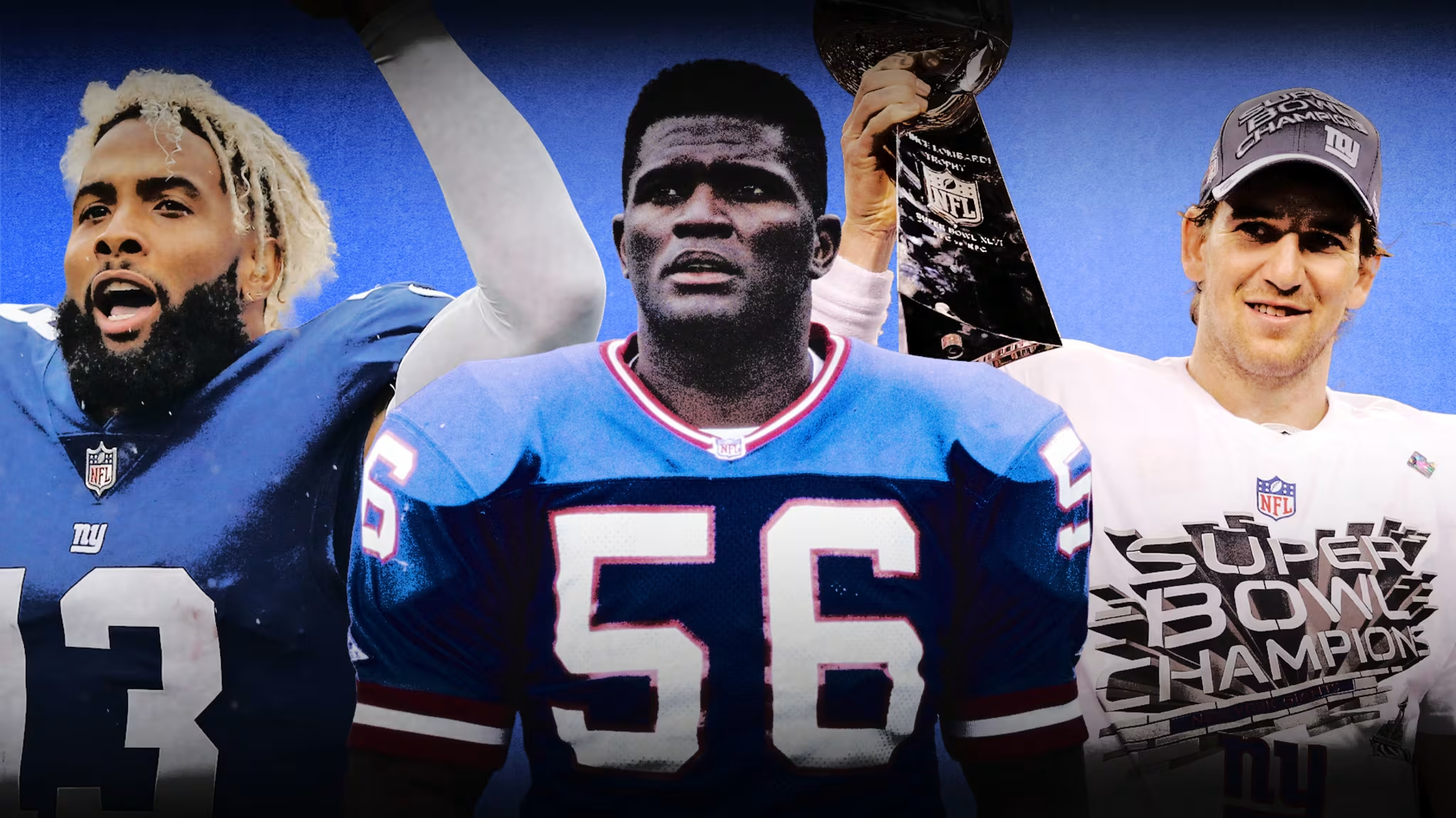
The New York Football Giants are one of the most storied franchises in football history. The team joined the NFL in 1925, and is the fourth oldest team in the league (after the Cardinals, Bears, and Packers). They’ve won eight league championships, including four Super Bowls, one of just seven teams to win that many. Among those four SB titles are two that rank as all-time great championship upsets, including arguably the greatest play in playoff history, in any sport.
But as successful as the G-Men have been over the years, the team has also had its share of embarrassments. In 1978 a botched handoff resulted in possibly the worst loss in NFL history; in 2010, an ill-advised late-game punt led to another inexplicable loss to the same hated rival.
They’ve had a player literally shoot himself in the leg; they once ran back-to-back quarterback sneaks from inside their own 10-yard line during the last game of a lost season (this is called “Peak Joe Judge,” which itself is an oxymoron).
Eight weeks ago, the 2026 season was shaping up as another chapter in the Giants’ sad recent history. In the offseason the team traded its best player, and in Week 2 lost its franchise-ish quarterback for the year. And yet? Don’t look now, but the Giants are in first place in the NFC East, 2.5 games ahead of the second place Dallas Cowboys.
Sure there’s a lot of luck involved, but for a team that’s endured not just the Brian Daboll Era, but also the Joe Judge and Pat Shurmur Eras over the past decade, a little luck is a welcome thing.
With the division-leading New York Giants looking increasingly like the playoff-bound New York Giants, here’s a look at the 30 Best New York Giants of All Time.
David Tyree
Seasons: 2003-2007
Super Bowl Appearances: 1 (XLII)
Super Bowl Wins: 1
Accolades: N/A
How does a career special teams player with 54 receptions and four touchdowns become one of the best New York Giants of all time? He makes what is widely regarded as the best play in Super Bowl history. The background: With 1:15 in the fourth quarter, the Giants, down 13-10, faced a 3rd and 5 from their 44-yard-line. Eli Manning dropped back but immediately felt pressure. He scrambled in the pocket, jostled free from multiple Pats rushers, and then hurled the ball downfield. About 30 yards away, Tyree jumped and eventually secured the ball on his helmet even with Pats safety Rodney Harrison draped all over him. Four plays later, the Giants would score the game-winning touchdown, ending the Pats undefeated season. It was the last catch of Tyree’s NFL career but by then he had already secured his spot in Giants lore.—Thomas Golianopoulos
Saquon Barkley
Seasons: 2018-23
Super Bowl Appearances: 0
Super Bowl Wins: 0
Accolades: 2x Pro Bowl, 2018 Offensive Rookies of the Year
With the second overall pick in the 2018 NFL Draft, the Giants bypassed future Super Bowl champion Sam Darnold and future MVPs Josh Allen and Lamar Jackson to select an electric running back out of Penn State. Barkley did not disappoint, rushing for 1,307 yards, a Giants rookie record, and winning Offensive Rookie of the Year. The rest of his Giants tenure was a bit more fraught. Barkley suffered a torn ACL in 2020 and though he returned to pre-injury form, the front office remained hesitant to sign him to a long-term contract. They slapped the franchise tag on him prior to the 2023 season and then allowed him to leave as a free agent the following spring, a moment immortalized on HBO’s Hard Knocks. Barkley would go on to run for over 2,000 yards for the division rival Eagles and lead them to a Super Bowl title, yet his short time in New York made enough of an impact (Barkley is the fourth leading rusher in Giants history) where he can be considered one of the franchise’s 30 best players.—TG
Jeff Hostetler
Seasons: 1985-86, 1988-92
Super Bowl Appearances: 2 (XXI, XXV)
Super Bowl Wins: 2
Accolades: N/A
New York Giants backup quarterback Jeff Hostetler spent the 1990 season seething on the sidelines. The thought of holding a clipboard for another year had him considering retirement. Then, in Week 15, Giants starter Phil Simms broke his foot, opening the door for Hostetler. The West Virginia alum made the most of his opportunity as he would go on to lead the New York Giants to their second Super Bowl title in five seasons. Hostetler was efficient in a NFC Divisional Round win over the Bears, engineered two late scoring drives on the road in an NFC Championship Game win over the two-time defending Super Bowl champion 49ers, and then completed 20-of-32 passes for 222 yards and 1 touchdown in the Giants 20-19 win over the heavily favored Buffalo Bills in Super Bowl XXV. —TG
Victor Cruz
Seasons: 2010-2014, 2016
Super Bowl Appearances: 1 (XLVI)
Super Bowl Wins: 1
Accolades: 1x Pro Bowl, 1x Second-Team All-Pro
Undrafted out of UMass, Cruz made the Giants as a rookie and shined in the preseason but a hamstring injury ended his season early. When he returned in 2011, he posted one of the best wide receiver seasons in Giants history. Cruz, who began the season as the Giants’ fourth wideout, steadily climbed the depth chart until ascending to starter. Cruz would lead the Super Bowl winning Giants with 82 receptions for 1,536 yards, and nine touchdowns, which he celebrated with a salsa dance in honor of his late grandmother. His career would be cut short though following a torn patellar tendon in 2014. He was never the same player again but he remains one of the most popular players in Giants history. —TG
Rodney Hampton
Seasons: 8 (1990-1997)
Super Bowl Appearances: 1 (XXV)
Super Bowl Wins: 1 (XXV)
Accolades: 2x Pro Bowl
Hampton is one of the leading candidates for the title of “Greatest Giants Running Back Not Named Tiki Barber,” but there’s a definite sense of what might have been with his career. Selected 24th overall out of Georgia in the 1990 draft, Hampton was a solid contributor throughout his rookie season, only to break his leg attempting to recover a Jeff Hostetler fumble in the divisional round of the playoffs. He missed the Giants SB XXV win, but racked up five consecutive 1000-yard rushing seasons beginning in 1991. He ran for 827 yards through the first 15 games of the 1996 season, but sustained a knee injury in the second to last game. He appeared in just two more games for the Giants at the end of the 1997 season, before being forced into retirement at the age of 28. —Jack Erwin
Jeremy Shockey
Seasons: 2002-2007
Super Bowl Appearances: 1 (XLII)
Super Bowl Wins: 1
Accolades: 4x Pro Bowl, 1x First-Team All-Pro
With his combination of size, speed, precise route-running and soft hands, Jeremy Shockey dominated the game from the tight end position as a member of the University of Miami’s 2001 National Championship team. The Giants then made him the 14th pick of the 2002 NFL Draft. The skills immediately translated to the pros. Shockey won Rookie of the Year and made the Pro Bowl in four of his first five seasons with the Giants. His time in New York, however, would be short-lived. Shockey's reputation as a brash, hard-partying, trash-talking, nightlife fixture made him a target for New York’s tabloids and he often clashed with Giants head coach Tom Coughlin and general manager Jerry Reese. Six months after the Giants’ win in Super Bowl XLII, which Shockey missed with injury, he was traded to the New Orleans Saints. —TG
Bart Oates
Seasons: 9 (1985-1993)
Super Bowl Appearances: 2 (XXI, XXV)
Super Bowl Wins: 2 (XXI, XXV)
Accolades: 3x Pro Bowl
Oates was a 26-year-old rookie when the Giants signed him in 1985, having 1.) served a two-year mission for the Church of Jesus Christ of Latter-day Saints while at BYU, and 2.) played three seasons in the USFL. He started his third game for the Giants in 1985, and no one else started at center for the Giants for the next eight years. Phil Simms (and Jeff Hostetler) and the Big Blue Wrecking Crew defense were the most famous members of the Giants teams that won SB XXI and XXV, but Oates was arguably the steadiest, serving as the literal centerpiece of an offense that specialized in grinding down opponents. —JE
Jessie Armstead
Seasons: 9 (1993-2001)
Super Bowl Appearances: 1 (XXXV)
Super Bowl Wins: 0
Accolades: 1x First-Team All Pro; 5x Pro Bowl
Despite winning two national championships at Miami, Armstead fell to the Giants in the 8th round of the 1993 draft over concerns about an ACL tear suffered his sophomore year with the Canes. (NFL scouts were seemingly underwhelmed by Armstead recording 99 tackles for the ‘91 UM championship squad after the injury.) After primarily coming off the bench during his first three seasons with the Giants, Armstead became the starting weakside linebacker for New York in 1996, and started every game for the G-Men for the next six seasons. He made five Pro Bowls and three All Pro teams during that span (two second-team, one first), and was a leader on the team that won division titles in 1997 and 2000 and made the Super Bowl in ‘00. —JE
Joe Morris
Seasons: 1982-1988
Super Bowl Appearances: 1 (XXI)
Super Bowl Wins: 1
Accolades: 2x Pro Bowl, 1x First-Team All-Pro
Morris was just 5-foot-7 but routinely stood out for the Giants. The former Syracuse star scored a touchdown on his first NFL carry, a 4-yard TD against the Packers on Monday Night Football in 1982. One of Morris’ finest games came on December 21, 1985 when he rushed for 202 yards and 3 touchdowns in a 28-10 Giants win over the Steelers. Morris was dominant in the Giants’ march to a Super Bowl XXI win. In the Divisional Round of that season against the 49ers, Morris ran for 159 yards and 2 touchdowns in a resounding 49-3 Giants victory. “I think it was the second quarter, when I handed the ball off to him on the left side, he ran into the end zone, I thought, ‘Wow he’s fast,’” Giants quarterback Phil Simms said of Morris’ big day against San Francisco. “Nobody touched him. I could feel the dominance early in the game.” —Matt Burke
Plaxico Burress
Seasons: 2005-2008
Super Bowl Appearances: 1 (XLII)
Super Bowl Wins: 1 (XLII)
Accolades: N/A
In 2013, Giants.com ranked the top free agent signings in team history and Burress came in at No. 1 on the list. Much of the love stems from his performance in the Giants’ stunning Super Bowl season of 2007. In the Giants’ dramatic 23-20 overtime NFC Championship Game win over the Packers at Lambeau Field that season, Burress had 11 catches for a whopping 151 yards. He then caught the game-winning touchdown in Big Blue’s unforgettable 17-14 Super Bowl XLII victory over the previously undefeated Patriots. Burress had a career-high 12 touchdown receptions during the 2007 regular season, which is tied for second-most during a single-season in Giants history. Of course, it all came to an end suddenly. In November 2008, Burress accidentally shot himself in the thigh in a Manhattan nightclub. He was suspended without pay and later pleaded guilty to attempted criminal possession of a weapon. He would serve 20 months behind bars before resuming his NFL career in 2011 with the New York Jets.—MB
Odell Beckham Jr.
Seasons: 2014-2018
Super Bowl Appearances: 0
Super Bowl Wins: 0
Accolades: 2014 NFL Offensive Rookie of the Year, 2x Second-Team All-Pro, 3x Pro Bowl
OBJ was the King of New York for a brief period in the 2010s. The wide receiver made one of the most memorable plays in NFL history on November 23, 2014 in the Meadowlands against the rival Dallas Cowboys when he caught a 43-yard touchdown pass from Eli Manning with his right hand while falling backward into the end zone. Beckham Jr. made the one-handed stab despite a pass interference penalty being called on Cowboys cornerback Brandon Carr. Beckham Jr.’s top NFL seasons came in a Giants uniform. In his rookie season of 2014, OBJ had 91 catches for 1,305 yards and 12 TDs. In 2015, he had 96 grabs for 1,450 yards and 13 TDs. And in 2016, he had a career-high 101 catches for 1,367 yards and 10 TDs.—MB
Osi Umenyiora
Seasons: 10 (2003-2012)
Super Bowl Appearances: 2 (XLII, XLVI)
Super Bowl Wins: 2 (XLII, XLVI)
Accolades: 1x First-Team All Pro; 2x Pro Bowl
How’s this for a trajectory? Osi Umenyiora moved to the U.S. when he was 14 years old, having spent the first part of his childhood in London and Nigeria. He’d never played American football before, put picked it up as a high school junior, eventually landing at Troy University despite not getting any scholarship offers after high school. Four years later he was a second round pick for the Giants, and two years after that, in 2005, he was an All Pro, not even 10 years after he’d started playing the game. Umenyiora enjoyed his best season in ‘05, but had excellent years in 2007 and 2011 as a mainstay on the Giants dominant defensive line during their two Super Bowl winning runs. —JE
Chris Snee
Seasons: 2004-2013
Super Bowl Appearances: 2 (XLII, XLVI)
Super Bowl Wins: 2
Accolades: 4x Pro Bowl, 1x First-Team All-Pro, 1x Second-Team All-Pro
The Giants drafted Snee in the second round of the 2004 NFL Draft, and that selection immediately paid dividends. In Snee’s first NFL game, he helped Giants running back Tiki Barber rush for 125 yards against the Eagles. By 2007, Snee was firmly entrenched as the Giants’ starting right guard. In that Super Bowl winning season, the Giants were fourth in the NFL in total rushing yardage with 2,148 yards on the ground. Snee’s top season came in 2008 when he earned NFL First-Team All-Pro honors. The Giants finished first in the NFL in rushing yardage that season, with 2,518 yards. Snee is currently a scout with the Giants. The Boston College alum is married to Kate Coughlin, the daughter of former Giants head coach Tom Coughlin. —MB
Amani Toomer
Seasons: 1996-2008
Super Bowl Appearances: 2 (XXXV, XLII)
Super Bowl Wins: 1 (XLII)
Accolades: N/A
A mainstay of the Jim Fassel and Tom Coughlin era Giants, Toomer initially made his bones in the Meadowlands as a punt and kickoff returner. In fact, in his first ever NFL game, he returned a punt 87 yards for a touchdown. Toomer’s career punt return yardage was 1,060 yards. He also had 257 kickoff return yards. Toomer proved to be much more than a special teams ace, however. Starting in 1999, he ripped off five straight 1,000-plus yard receiving seasons. The 2002 season was his best individual season as he posted a career-high 1,343 yards receiving and a career-high 8 receiving touchdowns. Toomer was still one of Eli Manning’s favorite targets in the Giants’ Super Bowl winning season of 2007. Toomer had 80 yards receiving against the Cowboys in the Divisional Round of that postseason, and had 84 yards receiving in the upset Super Bowl win over the Patriots.—MB
Justin Tuck
Seasons: 9 (2005-2013)
Super Bowl Appearances: 2 (XLII, XLVI)
Super Bowl Wins: 2 (XLII, XLVI)
Accolades: 1x First-Team All Pro; 2x Pro Bowl
Eli Manning will probably be elected to the Hall of Fame someday, and his MVPs in Super Bowls XLII and XLVI will play a big role. But connoisseurs of fine football defense will always argue that Justin Tuck deserved both of those awards. An athletically gifted defensive end who was the star of the 2005 draft combine, Tuck fell to the Giants at the 74th pick of the draft due to concerns about a knee injury he’d suffered while at Notre Dame. By his third season he was playing all over the defensive line, forming a fearsome foursome with Michael Strahan, Osi Umenyiora, and Mathias Kiwanuka. In Super Bowl XLII Tuck recorded two sacks, including a strip sack of Tom Brady near the end of the first half that stopped a Patriots drive to extend their lead. In Super Bowl XLVI, Tuck again sacked Tom Brady twice, including one on the Patriots final, failed drive, and also forced Brady into an intentional grounding penalty in the end zone that resulted in a safety for the Giants. —JE
George Martin
Seasons: 14 (1975-1988)
Super Bowl Appearances: 1 (XXI)
Super Bowl Wins: 1 (XXI)
Accolades: None
Martin was a defensive end on the feared Giants defense that powered the team to a championship in Super Bowl XXI, and the author of one of the most important plays in that squad’s run. A South Carolina native like fellow defensive stalwart Harry Carson, Martin was drafted in the 11th round of the 1975 draft, and endured losing seasons in seven of his first eight years in the league before Bill Parcells came on as coach in 1983. Parcells and defensive coordinator Bill Belichick put together a dominant defense with Martin as the feared pass-rushing end. It was Martin’s sack of John Elway in the end zone for a safety in the second quarter of SB XXI that flipped the script on that game, the first of 26 unanswered points the Giants scored on their way to a 39-20 rout. —JE
Mark Bavaro
Seasons: 1985-1990
Super Bowl Appearances: 2 (XXI, XXV)
Super Bowl Wins: 2
Accolades: 2x First-Team All-Pro, 2x Pro Bowl
Bavaro was known for his stoic demeanor, but the great tight end was intensely physical and tough. One of the most legendary plays in Giants history came on Monday Night Football in December of 1986 when Bavaro caught a pass and dragged 49ers Hall of Fame safety—along with several other Niners defenders—down the field for an extra 15 yards after initial contact. The play sparked a furious Giants comeback as they beat the rival 49ers, 21-17. Bavaro, who was nicknamed, “Rambo,” did not miss a game in his first four seasons with the Giants, and played six games in the 1986 season with a broken jaw. “His toughness, his overall complete play as a tight end and blocker, just as a total competitor was just outstanding,” said former Giants defensive coordinator Bill Belichick of Bavaro. “I don’t think Mark has ever gotten the recognition that any of us that coached him or played with him know that he deserves … He blocked Reggie White better than most tackles [did]. That alone should put him in the Hall of Fame.” —MB
Leonard Marshall
Seasons: 10 (1983-1992)
Super Bowl Appearances: 2 (XXI, XXV)
Super Bowl Wins: 2 (XXI, XXV)
Accolades: 2x Pro Bowl
Drafted 37th overall by the Giants in 1983, Marshall was the right defensive end in the Big Blue Wrecking Crew, the dominant defensive unit that powered New York’s late ‘80s teams. Playing on the same side as Lawrence Taylor, Marshall was a feared pass-rusher on right-handed quarterbacks’ blind side. Marshall was the league’s defensive lineman of the year in 1985 and 1986, accumulating 15.5 and 12 sacks, respectively. His dominance continued into the ‘90s, and he was responsible for the hit on Joe Montana in the 1990 NFC Championship that would propel the G-Men to their second Super Bowl title in five seasons and effectively end the 49ers career of the legendary Montana. —JE
Carl Banks
Seasons: 1984-1992
Super Bowl Appearances: 2 (XXI, XXV)
Super Bowl Wins: 2
Accolades: 1987 First-Team All-Pro, 1987 Pro Bowl
Banks was overshadowed by the greatness of Lawrence Taylor on those elite 1980s and early 1990s Giants defenses, but the linebacker is, without a doubt, one of the greatest players in franchise history. The former Michigan State star was a complete defensive player, able to stuff the run, defend the pass, and rush the quarterback. Big Blue took Banks with the third overall pick in the 1984 NFL Draft and it proved to be a wise decision. A member of the NFL’s 1980’s All-Decade Team, Banks was dominant in the Giants’ Super Bowl XXI 39-20 victory over the Denver Broncos as he recorded 14 total tackles. “Carl Banks and Lawrence Taylor were really the two bookends to that defense all through the ’80s and took us to a lot of victories and two Super Bowl championships,” said former Giants defensive coordinator Bill Belichick.—MB
Tiki Barber
Seasons: 1997-2006
Super Bowl Appearances: 1 (XXXV)
Super Bowl Wins: 0
Accolades: 2005 First-Team All-Pro, 3x Pro Bowl
Barber was one of the top running backs in the NFL in the mid-2000s, earning Pro Bowl honors from 2004-06. The Virginia Cavaliers great had a slow start to his pro career as he ran for just 311 yards on average in his first three seasons. In the 2000 season, Barber flipped the switch as he ran for 1,006 yards and 8 touchdowns. Also a tremendous threat in the passing game, Barber had 719 yards receiving that year. He helped lead the Giants to the Super Bowl that season, where they eventually lost to the Baltimore Ravens. One of Barber’s first great games in a Giants uniform came in Week 1 of the 2000 season, when he ran for 144 yards and 2 TDs against the Cardinals. That output paled in comparison to some of the games he had in his First-Team All-Pro season of 2005. Barber had an incredible three games in 2005 in which he ran for over 200 yards. —MB
Sam Huff
Seasons: 1956-1963
NFL Championship Appearances: 6 (1956, 1958, 1959, 1961, 1962, 1963)
NFL Championship Wins: 1 (1956)
Accolades: 2x First-Team All-Pro, 4x Second-Team All-Pro, 4x Pro Bowl
The Giants have a storied history of great defensive players. Huff was the pioneer of the Giants’ reputation of having rugged defensive units. Huff was named the NFL’s top linebacker in 1959 and became just the second football player to be featured on the cover of TIME magazine. “Sam was one of the greatest Giants of all-time,” said Giants President and CEO John Mara. “He was the heart and soul of our defense in his era. He almost single-handedly influenced the first chants of ‘Defense, Defense’ in Yankee Stadium.” Huff gained praise for his ability to at least minimize the damage done by the great running backs of that era, like Jim Brown of the Browns and Alan Ameche of the Colts. —MB
Andy Robustell
Seasons: 9 (1956-1964)
NFL Championship Appearances: 6 (1956, 1958, 1959, 1961, 1962, 1963)
NFL Championship Wins: 1 (1956)
Accolades: 4x First-Team All Pro; 5x Pro Bowl
A defensive end, Robustelli was traded to the Giants from the LA Rams before the 1956 season. Over the next nine seasons he’d start 114 of a possible 116 games for the G-Men, leading a formidable Giants defense that ranked No.1 in points allowed three times in that span, and in the top 4 three more times. An undersized pass rusher, Robustelli averaged 14 sacks per season (in a 14-game season) from 1961-1963, and was elected to the Hall of Fame in 1971. —JE
Y.A. Tittle
Seasons: 1961-1964
NFL Championship Appearances: 3 (1961, 1962, 1963)
NFL Championship Wins: 0
Accolades: 3x Pro Bowl, 2x First-Team All-Pro, 1963 MVP
Yelberton Abraham Tittle was already a legend by the time he arrived in New York, after 13 seasons with the Baltimore Colts and San Francisco 49ers. But he’d go on to have the best years of his career with the Giants. Tittle, nicknamed the Bald Eagle for his receding hairline, had an unorthodox throwing motion but he was incredibly accurate and was excellent at reading defenses. With the Giants, he made three consecutive Pro Bowls, won an MVP, and led the team to three consecutive NFL Championship Games. At the time of his retirement following the 1964 season, Tittle held the NFL records for career passing yards, career passing touchdowns, career completions, career attempts, passing touchdowns in a season, and career games. He was inducted into the Pro Football Hall of Fame in 1971. —TG
Phil Simms
Seasons: 1979-1993
Super Bowl Appearances: 2 (XXI, XXV)
Super Bowl Wins: 2
Accolades: Super Bowl XXI MVP, 2x Pro Bowl
Simms was the quarterback in one of the Giants’ most memorable eras. The sight of Simms and fiery head coach Bill Parcells arguing during a game (oftentimes while they were winning), encapsulates those glory years of Giants football. Labeled a “country bumpkin” by many fans and many in the New York media after being drafted seventh overall in the 1979 NFL Draft, the Kentucky-bred Simms had his work cut out for him in proving his big city skeptics wrong. Simms eventually did just that as he made the Pro Bowl in 1985, and also in 1993. He won most Giants fans over for life on January 25, 1987 in Super Bowl XXI against the Denver Broncos. Simms set a Super Bowl record for completion percentage in the game, connecting on 22-of-25 passes (88 percent). He threw for 268 yards with 3 TDs against Denver and did not throw an interception en route to winning the Super Bowl XXI MVP award. He helped lead the Giants to a 30-point second half and, ultimately, a 39-20 win.—MB
Rosey Brown
Seasons: 1953-1965
NFL Championship Appearances: 6 (1956, 1958, 1959, 1961, 1962, 1963)
NFL Championship Wins: 1 (1956)
Accolades: 9x Pro Bowl 6x First-Team All-Pro
Brown was one of the first great Giants players, as the offensive tackle anchored New York’s O-line in the 1950s and the early portion of the 1960s. In 13 years, the tough-as-nails Brown missed just four games. The Giants would not have won the 1956 NFL Championship had it not been for Brown, as the tackle cleared the way for backs Frank Gifford, Alex Webster, and Mel Triplett. Gifford told the New York Times in 2004 that he “wouldn’t be in the Hall of Fame if it weren't for [Brown].” Brown also played snaps on defense for the Giants, particularly in goal-line situations, as well as special teams. “[Brown] would be the first guy down the field, busting the wedge, making tackles,” said Big Blue Interactive Historian Larry Schmitt. “He was a physical freak when he was 275, and he had these broad shoulders, but he only had a 29-inch waist. So he had a lot of maneuverability. He was athletic, he was agile, and he was fast.”—MB
Harry Carson
Seasons: 13 (1976-1988)
Super Bowl Appearances: 1 (XXI)
Super Bowl Wins: 1 (XXI)
Accolades: 9x Pro Bowl
The Giants defense was the backbone of the team’s run to its Super Bowl XXI win, and Harry Carson was the backbone of that defense. Carson was drafted out of South Carolina State in the fourth round of the 1976 draft, and spent the first half of his career as a very good linebacker on some very bad Giants teams. Defensive statistics were sparsely counted during Carson’s career, and as a middle linebacker, his role focused more on run-stopping than rushing the quarterback, but his reputation as a leader and player is exceptional: Bill Parcells picked Carson as the sole captain to represent the Giants for the coin toss before Super Bowl XXI, and Bill Belichick, the G-Men’s defensive coordinator in the ‘80s, called Carson the best all-around linebacker he ever coached. —JE
Frank Gifford
Seasons: 1952-1960, 1962-1964
NFL Championship Appearances: 5 (1956, 1958, 1959, 1962, 1963)
NFL Championship Wins: 1 (1956)
Accolades: 1956 NFL MVP, 1962 NFL Comeback Player of the Year, 6x All-Pro, 8x Pro Bowl
Before Joe Namath ruled New York, Gifford was Manhattan’s gridiron golden boy. Gifford was the epitome of versatile for the Giants in the 1950s and ’60s, playing halfback, receiver, and defensive back. He was named to the Pro Bowl at three different positions: defensive back, halfback, and flanker. He also threw 14 touchdown passes during his incredible career with Big Blue. Gifford won the 1956 NFL MVP award and led the Giants to the 1956 NFL title. In that season’s championship game against the Chicago Bears, Gifford caught four passes for 131 yards and a touchdown. He became even more of a prominent national figure in his later years as a broadcaster on ABC’s Monday Night Football. —MB
Michael Strahan
Seasons: 1993-2007
Super Bowl Appearances: 2 (XXXV, XLII)
Super Bowl Wins: 1 (XLII)
Accolades: 2001 NFL Defensive Player of the Year, 4x First-Team All-Pro, 2x Second-Team All-Pro, 7x Pro Bowl, 2x NFL Sacks Leader
Giants fans were in mourning following the 1993 season as Lawrence Taylor announced his retirement. As fate would have it, there was a certain future Hall of Fame defensive player already on the Giants’ roster at the time of Taylor’s retirement. Strahan, a second-round pick in 1993, overlapped with Taylor on the Giants roster for one season. Strahan would later go on to break Taylor’s all-time franchise sacks record. In 2001, Strahan would break the NFL’s single-season sacks record as he posted 22.5 in that incredible campaign. His biggest career sack was his last one as he sacked Patriots quarterback Tom Brady in Super Bowl XLII. Strahan was a driving force in the Giants’ 17-14 upset over the previously unbeaten Patriots. —MB
Eli Manning
Seasons: 2004-2019
Super Bowl Appearances: 2 (XLII, XLVI)
Super Bowl Wins: 2
Accolades: 4x Pro Bowl, 2x Super Bowl MVP
Was Eli Manning ever a Top 5 quarterback in the NFL? Better yet, was he ever Top 10? Who cares? Peyton’s baby bro is a two-time Super Bowl champion, a two-time Super Bowl MVP, and, best of all, he thwarted Tom Brady and the 2007 Patriots’ perfect season. Manning’s legend is based on his postseason play. He won three playoff road games in 2007 before upending the Pats in the Super Bowl, an upset punctuated by the game-saving Helmet Catch and Manning’s game-winning touchdown pass to Plaxico Burress in the final minute. In all, he completed 72-of-119 passes (60.5 CMP%) for 854 yards, 6 TD, one interception and a 95.7 rating during the postseason. His Super Bowl run in 2011 was even more impressive. In four games, Manning went 106-for-163 (65 CMP%) for 1,219 yards, 9 touchdowns and 1 interceptions, good for a 103.3 rating. His defining moment: Trailing the Patriots 17-14 in the final minutes of Super Bowl XLVI, Manning made a perfect sideline pass to a streaking Mario Manningham for a 38-yard gain, sparking the Giants game-winning scoring drive. It was the kind of throw only a Hall of Famer could make. —TG
Lawrence Taylor
Seasons: 1981-1993
Super Bowl Appearances: 2 (XXI, XXV)
Super Bowl Wins: 2
Accolades: 10x Pro Bowl, 8x First-Team All-Pro, 2x Second-Team All-Pro, 1986 NFL MVP, 3x Defensive Player of the Year, 1981 Defensive Rookie of the Year
It shouldn’t come as a surprise that the best defensive player in NFL history is also the best New York Giant of all time. Taylor, the second overall pick in the 1981 NFL Draft, made an immediate impact as a rookie with four forced fumbles and 9.5 sacks, becoming the first (and only) rookie to win Defensive Player of the Year. Taylor’s combination of size, strength, speed, intensity, and football IQ would change the game in a myriad of ways. Number 56’s presence on the edge turned the left tackle position into a priority; double teams and blitz pick-ups became more sophisticated; and offensive coaches were now forced to game plan around the destructive force rushing from the edge. Taylor was troubled off the field — drugs, domestic violence, more drugs, hiring prostitutes, hiring underage prostitutes. His legacy is, to be kind, complicated. But he was undeniable as a football player and is the best New York Giant of all time.—TG