When Russell Wilson was 10 years old, his father would drive him to Little League games and pepper him with big questions about his future.
“Russell, when you're 35 years old, you're 45 years old, you're 55 years old—what are you doing? What have you accomplished?” he’d ask his son. Then, Wilson would have to “paint a picture for him,” Wilson tells Complex. “And if that picture wasn't good enough or big enough, my dad was like, ‘I know you can tell me a bigger story.’”
Most of those imagined futures involved athletic greatness—breaking records, hoisting trophies, burnishing a towering legacy. But oftentimes, they involved Wilson as a broadcaster, too. Even as a kid, he could envision himself sitting behind a desk, talking about sports, breaking down games, telling stories about the people who played them.
“I believe that God gave me a voice to be able to express what I feel and what I see and what I know,” he says.
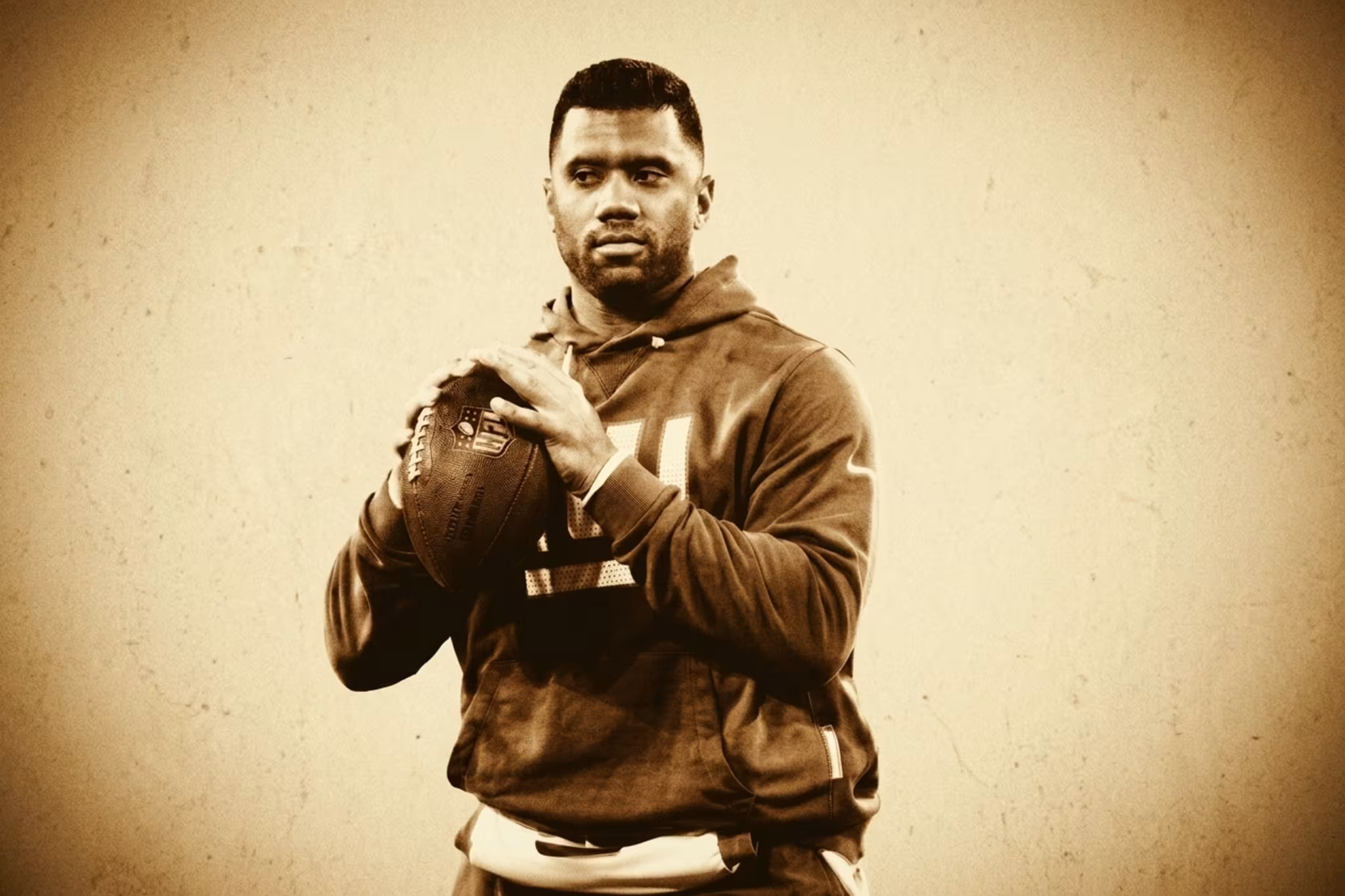
This Sunday, the 37-year-old Wilson will make that once-imagined future his reality, debuting as a full-time studio analyst on CBS's new-look pregame show The NFL Today. The role opened up in January, when Matt Ryan left his analyst perch to join the Atlanta Falcons’ front office, leaving the network with a vacancy beside host James Brown and analysts Bill Cowher and Nate Burleson.
Over the spring, as Wilson mulled an offer from the New York Jets, he felt a new, less physically-taxing career was calling him.
“These seats on the CBS desk don't come often,“ Wilson says. “I love challenges. I love new opportunities. . . and I felt like I was prepared to do this, and to do it with the best in the world.”
Each weekend throughout the fall and winter, Wilson will rely on his 14-year NFL career—a 10-season, Super Bowl-winning stint in Seattle, a disappointing detour to Denver, a brief resurgence with the Steelers, and a more disappointing final season spent mostly on the bench with the Giants—to diagnose that Sunday’s slate of games, trying to translate what viewers at home might not have seen.
“I get to talk about the game that I love,” he says. “I just don't get hit this time.”
For Wilson, the biggest challenge isn't necessarily learning how to talk about football. It’s figuring out how much of the real Russell Wilson to let viewers see. The quarterback has always been particularly polished and deliberate in the way he presents himself, but over the last several years, he’s largely come across as inauthentic.
Which is what makes this new role such a challenge for Wilson. Broadcasting asks him to draw on parts of himself that playing quarterback never necessarily required: vulnerability, strong opinions, and the ability to hold his own in unscripted conversation.
It’s also an opportunity to show audiences a side of himself they haven’t often seen. “Once the season starts rolling and Russell starts talking about teams,” says NFL Today executive producer Drew Kaliski, “I think people will forget about some of the other stuff that might be perceived out there pretty quickly.”
Russell Wilson’s Career Change
In the immediate aftermath of last season, Wilson was adamant that he’d be back on the field in 2026. “I’m not blinking,” he told reporters in early January following the Giants’ last game. But as the offseason progressed, his reality changed. Outside of the Jets, no teams had interest in him. The only place still looking for a veteran was CBS.
As he searched for Ryan’s replacement, Kaliski conceived a shortlist of candidates, including Philip Rivers and Jameis Winston. But Wilson had the most immediate appeal. The quarterback had spent two decades surrounded by cameras. He understood the psychology of the position, the rhythms of a Super Bowl locker room, and the theater of Sundays—not to mention, he had “a personality that can fit the pieces that you already have,” Kaliski says.
Most importantly, Wilson already felt like he was part of the CBS family. He’d made a handful of appearances on the network over the last decade, including a feature at the Wilson Football Factory during its Super Bowl coverage. But he turned network executive heads during the Giants’ bye week in December as a guest analyst on The NFL Today, starting when he walked into the studio without an entourage.
As Brown recalls, CBS leadership liked the fact that Wilson “wasn't a braggadocious type—he wasn't somebody that you're gonna have to pamper,” he says. On set, Brown found Wilson’s personality just as “loving, engaging, and encompassing,” impressed by his preparation and quick answers to questions.
“His on-camera presence is tremendous,” Kaliski says. “He wasn't afraid to tell us stuff in a smart way. I could tell he would have an easy time talking about his experience.”
Wilson could feel it, too. Nothing about the day felt much different from what he’d been doing every week that season on the field or as a backup. “It's just like a huddle,” Wilson says. “You're all communicating together, you're all looking each other in the eye, you're dialoguing, you're having important conversations about the game that we all love.”
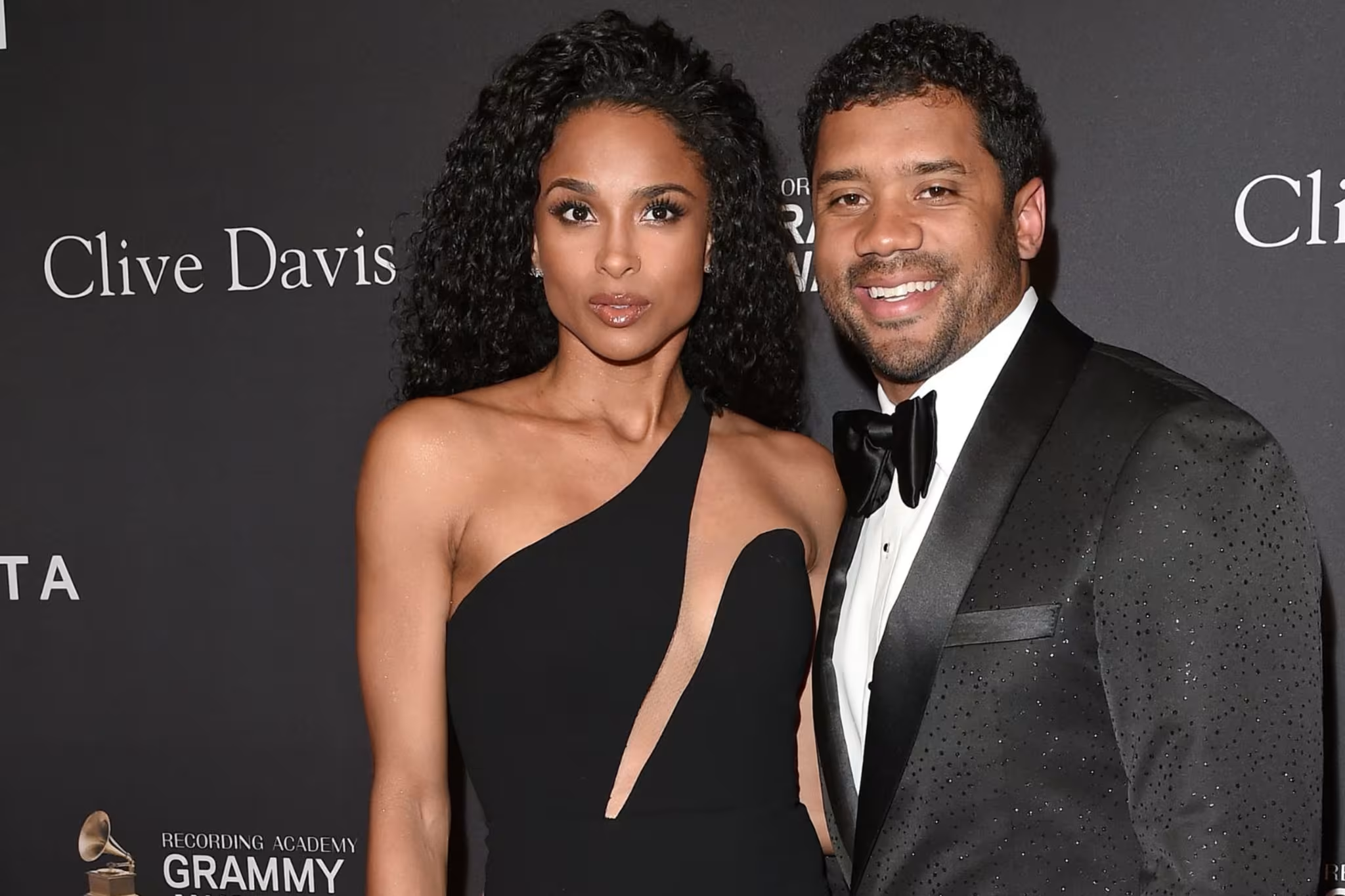
The more Wilson considered his options, the more CBS felt like the opportunity he’d been waiting for. He talked it through with his agent, his family, including his wife Ciara (who recently announced she’s expecting their fourth child together), and a number of Hall of Fame peers. The answer kept leading him back to CBS.
Can Russell Wilson Keep it Real on the Mic?
Since the June decision, Wilson has been treating the summer like NFL training camp. In July, he did a test run of the network’s digital show, The NFL Today+, an opportunity to talk through various topics, feel the heat of the cameras, and reacquaint himself with his new “teammates.” And throughout August, he’s developed a greater rapport with everyone, including other newcomer Kyle Long, the former Chicago Bear and Wilson’s former high school baseball rival.
Thus far, the talent and crew likes what they’ve seen, but Wilson knows he still has things to refine—like translating his insight into compact nuggets that keep that show’s flow and momentum moving.
“The most important thing is us constantly simplifying things in 15 seconds for the fan that knows everything, but also for the fan who is very new to the game,” Wilson says.
The good news for Kaliski? Ex-quarterbacks take direction well. “They're used to headsets and getting communications,” he says. “They're good with chaos and handling a live situation.”
And yet, despite the praise and accolades, the prevailing conversation around Wilson, especially over the last few years, has primarily been negative. The end of his time in Seattle and the disastrous years in Denver made him the constant butt of jokes and memes. Do you remember his “Unliiimited” catchphrase? Or awkwardly repeating the Broncos’ “Let’s Ride” slogan? The cheesiness. The decline on the field. The lack of self-awareness. The plethora of cliches and slogans and ex-teammates questioning whether he deserved credit for his team’s success.
He shrugs it off with a heard-it-all smile, refusing to acknowledge the critics.
“There's a lot more love than hate,” Wilson says when asked about the Russell Wilson discourse. “When you are authentically yourself, you have nothing to prove to anyone else. I think for me it’s about staying focused on the mission to impact people—for young kids to be able to be like, ‘I have a dream to be like him one day and to do something successful.’ That's always been my focus. Anybody else that's trying to deter from that focus is not in my wheelhouse of thought.”
He adds: “Every great story has amazing highs and some lows—some tough moments. And so that piece is the part that I'm looking forward to—it’s part of my journey, part of my story. And when I think about my career, I'm confident that I was able to do a lot that most people have never ever done. That's cool to me. That's cool to me to be able to impact a generation, especially in terms of being a young black quarterback.”
Of course, being authentic on television is its own kind of performance. Quarterbacks spend years learning how to protect themselves, how to answer the same question 15 different ways. But analysis requires opinions. Personality. Vulnerability.
At the very least, Wilson isn’t afraid of levying critiques of his peers when necessary. “I think of myself as somebody that's gonna be up, be positive, and inspirational,” Wilson says. “But also, just like playing quarterback, when you're in the room and you're watching the film and you're in a meeting—’Hey, this is where we should have been better, this is what went wrong, this is why this play didn't work.’ And I think that responsibility as a quarterback is what makes you a winner. It's the same thing that is going to make you a winner in this role.”
In the first few weeks, Kaliski’s goal is less about defining Wilson’s voice than giving him room to find it, fueling camaraderie, and making sure everyone gels together. That process should be aided by some self-deprecation, a little ribbing from his new colleagues, and the chance for Wilson to “be one of the boys” again. After spending so much of his career as the person everyone else in the huddle looked to (and blamed), there’s something liberating about getting to just be part of the group.
“I look forward to watching how quickly he learns to dribble without looking at the basketball,” Long says. “He'll be dunking in no time.”