Across its history, Nike has been home to many great sublines. None may be as good as ACG. Short for All Conditions Gear, it started as Nike’s outdoor line in 1989. The goal was to build footwear and apparel that could handle any terrain in any weather, from alpine climbs to rainy city commutes. But it grew into something bigger than a performance hiking label. Today, it is still a cult favorite that is as much about fashion as it is function. This is the story of how it started, who built it, and why it remains Nike's most underrated line.
Shop for Nike ACG on Complex
What Does Nike ACG Stand For?
ACG stands for All Conditions Gear. The idea was simple: gear for all conditions, whether you were hiking, climbing, trail running, or just trying to stay dry walking to the train.
How a 1978 K2 Climb Sparked Nike ACG
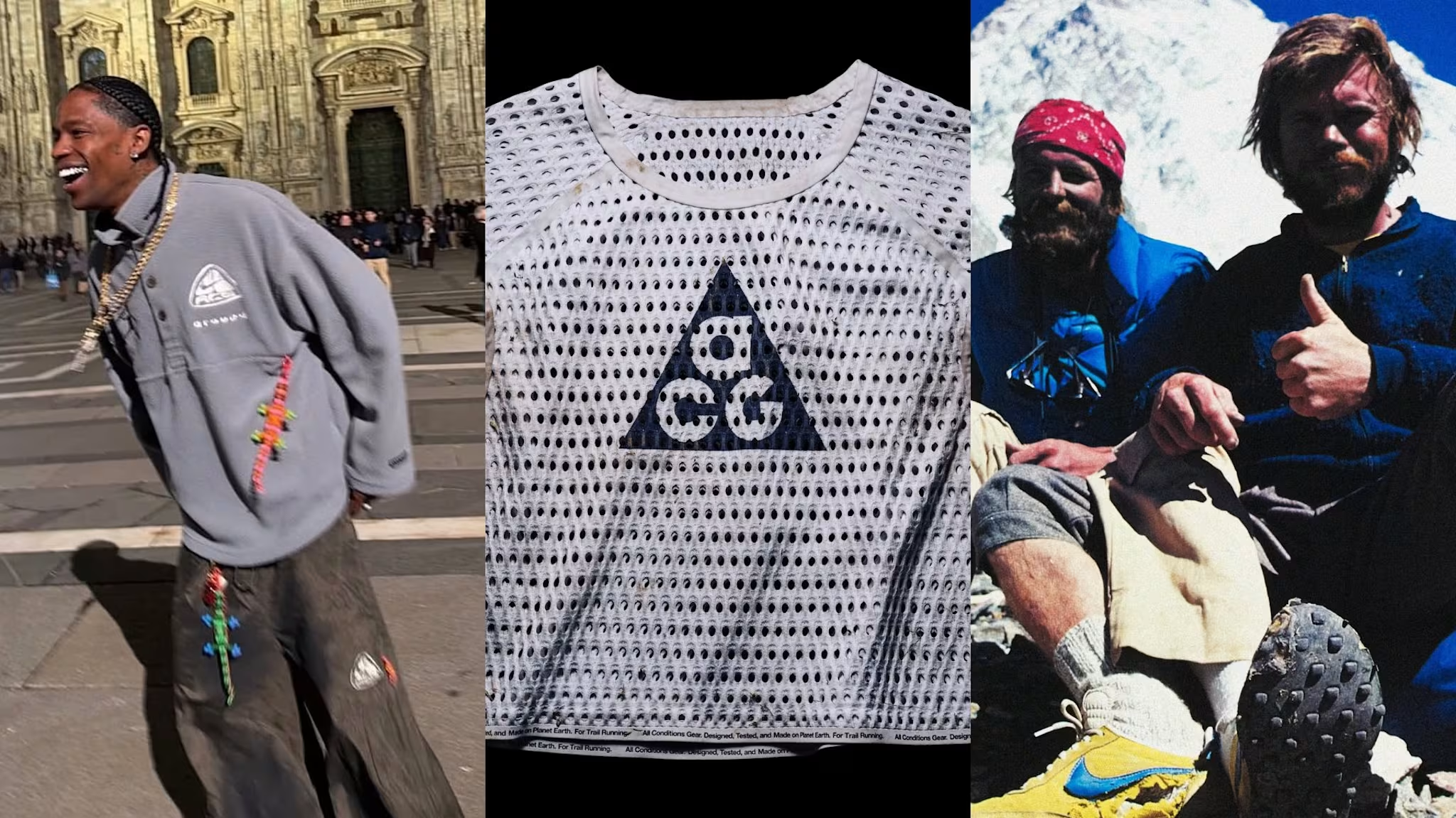
ACG's origin story began on the world's second-highest mountain. In 1978, Nike supplied a pair of American climbers, Rick Ridgeway and John Roskelley, with yellow Long Distance Vectors (Nike ACG LDV), which are lightweight road-running shoes, for the grueling 110-mile approach to K2 base camp. Ridgeway and Roskelley were part of the first American team to summit K2 that year, and a photo of the two of them at base camp, shot by mountaineering photographer Dianne Roberts, would later become the foundation of ACG's mythology.
The Nike shoes they wore were never meant for the mountains, and by the end of the climb they were falling apart. But the climbers found the soft, breathable LDVs far more comfortable than the stiff leather boots that dominated mountaineering at the time. When they got home, they mailed their blown-out sneakers back to Nike with a wish list: a tougher sole and more rugged upper that was still light and flexible. Nike, which had no outdoor business to speak of at the time, took the notes seriously, and the idea of reengineering a running shoe for the trail set the brand on the path towards what we now know as ACG.
Nike's First Hiking Shoes: Lava Dome, Approach, and Magma
By the early 1980s, Nike's first real hiking shoes were designed: the Lava Dome, Approach, and Magma. The Approach became Nike's first GORE-TEX-lined shoe, and its silhouette would even go on to inform the Air Force 1. All three rejected the rigid, heavy European boots of the era in favor of a "light is right" philosophy pulled straight from Nike's running sneakers
In 1984, a young Mark Parker, who would eventually become Nike's CEO, introduced the Escape trail runner. By 1987, a small team in Beaverton, Oregon and Exeter, New Hampshire, set out to unify these scattered outdoor projects under four guiding principles: high performance, durability, versatility, and functional excellence. All Conditions Gear was formally born.
Nike ACG's Official Launch in 1989
ACG became official in 1989, launching as a fully integrated line of footwear and apparel under the leadership of category head Kirk Richardson. It was anchored by shoes like the Air Wildwood and by technical GORE-TEX and fleece outerwear such as the Huascaran jacket. Many of the items were named after real mountains and expeditions.
Nike was adamant that ACG felt authentic to the outdoors community it aimed to assist. It did not start out as an outdoors-inspired lifestyle project, but rather a legitimate performance brand.. Its debut catalog was shot at Castleton Tower, a revered rock spire in Moab, Utah, with a photographer hanging out of a helicopter at sunset to capture climbers as tiny dots on the summit. The marketing was as distinctive as the product, leaning into a tongue-in-cheek tone and slogans like "all conditions gear, and all conditions means all conditions."
The Air Mowabb and ACG's '90s Golden Age
The '90s were ACG's creative peak. In 1991, Tinker Hatfield, the designer behind the Air Max 1 and much of the Jordan line, created the Air Mowabb. Named after Moab, Utah, it fused Hatfield's Air Huarache with the earlier Wildwood, added references to Native American moccasins, and finished it off with a speckled sole and bold color palettes. It remains the definitive ACG silhouette, and its design language echoed across the line for years.
The hits kept coming. The 1993 Air Deschutz reinvented the outdoor sandal with Nike Air cushioning in the heel, and 1994 delivered the Air Moc, a slipper-boot hybrid best described as half slip-on and half sleeping bag, along with the rugged Air Mada. Designers like Peter Fogg, a former aircraft-interior designer, brought an engineer's precision to models such as the Air Humara. This was ACG at its best: a place where Nike's most imaginative designers could go wild, building gear tough enough for the mountains that happened to look incredible on the sidewalk. It quickly became as much a streetwear staple as a trail one.
Errolson Hugh's 2014 Techwear Reboot
In 2014, Nike reintroduced ACG to a new generation. Then-Nike CEO Mark Parker tapped Errolson Hugh, co-founder of the Berlin techwear label ACRONYM, to reimagine the line as NikeLab ACG. Hugh designed for the city rather than the wilderness and swapped the vibrant outdoor color palettes of the ‘90s for all-black palettes, three-layer GORE-TEX, taped seams, and obsessive functional detailing. The goal, as Hugh told Complex in 2014, was to build something no one else could. His technically exceptional, urban-ninja take ran through the Holiday 2018 collection and shaped an entire generation of techwear designers.
Nike ACG's Return to Its Outdoor Roots
After Hugh's departure, Nike steered ACG back toward its heritage. Senior creative director James Arizumi, who came out of Nike SB, pulled the line out of the city and back into the wild, reviving the loud colors and outdoor spirit of the original era.
The timing could not have been better. As gorpcore took over fashion in the 2020s, ACG's back catalog looked more prescient than ever, and Nike leaned in with return of the Air Mada, Torre Mid, Goadome, and Baltoro, plus collaborations like the Comme des Garçons Mountain Fly. By 2025 and 2026, the line committed fully to a return to its roots, recommitting to genuine outdoor performance with new models like the ACG Ultrafly and a dedicated All Conditions Racing Department built for trail athletes.
Nike doubled down in 2025 with its Radical AirFlow innovation, and again at this year's UTMB in Chamonix, France, where it unveiled the ACG Picklejus, a big-mountain ultra shoe built around GOATEK, a new proprietary outsole compound meant to reduce Nike's reliance on Vibram for grip.
Nike ACG's Streetwear and Fashion Crossovers: Supreme, CPFM, and More
ACG's appeal was never confined to the trail, and over the last decade it has become a real fashion force through a run of high-profile collaborations and celebrity co-signs.
Supreme has returned to the ACG well more than once. In 2017, it reworked the Air Humara with a set of loud, neon-tinged colorways, a release Complex argued mattered as much for sneaker culture as for streetwear. The New York label followed with a snakeskin take on the ACG-born Air Max Goadome boot in 2021, then a full Fall 2022 ACG apparel capsule of denim pullovers, fleeces, water-resistant nylon trail shorts, and six-panel caps.
ACG’s streetwear crossover accelerated in 2026, when Nike ACG linked with Cynthia Lu's Cactus Plant Flea Market on a capsule of anoraks, rainbow sherpa balaclava hoodies, and polos. The collection drew serious hype after Travis Scott modeled unreleased pieces in front of Milan's Duomo, and Drake, Lil Yachty, and Yeat were all spotted in it ahead of release.
Why Nike ACG Is Still Underrated
Nearly four decades after two climbers mailed their trashed sneakers back to Oregon, the line is back to its original purpose: building gear for all conditions. For a sub-brand that has been counted out more than once, that staying power is the real story.