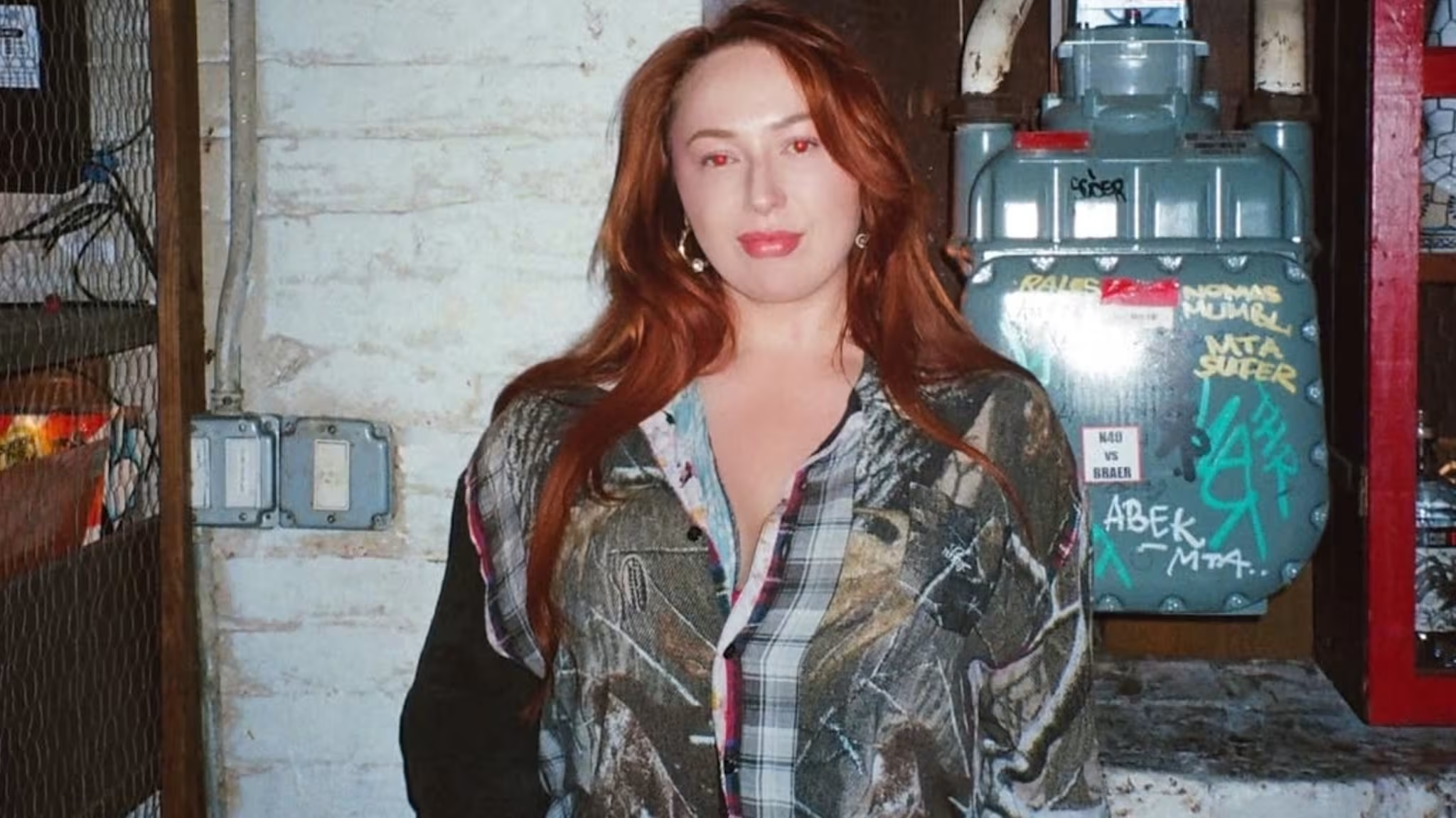
Brittany McGovern is the person most of the fashion industry doesn't know by name, but she’s behind so many important moments. Originally from Perth, Australia, she moved to New York in 2018 and built a career on instinct. From spotting Colm Dílane's potential years before KidSuper became one of the biggest brands in streetwear, to quietly engineering the moments that take over our timelines, McGovern has become one of the industry's most trusted forces behind-the-scenes. She’s bridging PR, marketing, and talent in a way that few others can.
Now, with her own venture, Interlude Communications, she's stepping into a new chapter where she’s not just executing other people's visions, but helping shape them from the beginning.
Shop KidSuper on Complex.
You made the move from Australia to New York, one of the most competitive cities in the world for fashion and PR. What was the moment you realized you actually belonged here?
Honestly, I don't think there was one moment. I still have a hard time processing it sometimes.
I grew up in Perth and was fascinated by this world long before I ever worked in it. I wasn't just interested in fashion or music. I'd end up researching the stylist, then the editor, then the manager. Looking back, I wasn't obsessed with celebrities. I was obsessed with the people around it.
Even now people ask me, "How did a girl from Perth end up here?" The honest answer is I work incredibly hard. I always have. It's something I learned from my parents. But I'm also really instinctive. If I see an opportunity, I don't waste much time.
Belonging happened quietly. An editor called me back, then another. My favourite artist was suddenly sending me tickets to their Madison Square Garden show. People started trusting me with bigger stories and bigger moments, and somewhere along the way I realised I wasn't chasing the industry anymore. I was part of it.
When you first landed in New York, what was the biggest culture shock, personally, and professionally?
I am a millennial. I grew up in the late '90s and early 2000s, and this industry was completely invisible. Today you can open TikTok and watch a day in the life of a publicist, go behind the scenes of a campaign shoot, or watch an artist record an album. None of that existed. There wasn't a roadmap. There wasn't even a glimpse behind the curtain.
So when I got to New York, the biggest culture shock wasn't the fashion industry itself—it was how relationship-driven everything was. I realized people weren't opening doors because of where I'd worked or what my CV looked like. They were opening doors because they liked having me around and trusted me. Looking back, that's probably how my whole career has happened.
You were early to recognize Colm Díllane and what KidSuper could become. What did you see in him that others weren't paying attention to yet?
I met Colm completely out of curiosity in 2019. A stylist friend, Taisha, introduced us after I saw her wearing KidSuper and immediately asked, "Who is this?" She took me to his apartment off Marcy and Broadway. Within an hour of talking, he told me he wanted to do Paris Fashion Week. I told him I did shows in Paris, and a week later brought him into REP, where I was working at the time, to talk it through. Less than three months later, we were in Paris.
What stood out to me wasn't just ambition. Lots of people have big ideas. Colm genuinely doesn't look at the world the way other people do. He wasn't interested in fitting into fashion. He was building his own universe and inviting everyone else into it. He genuinely doesn't stop.
I've realized over the years that I'm usually backing the person before I'm backing the brand. If I believe in someone's instinct and the way they see the world, I'm all in.
You're working with A-list clients and helping them be part of major moments. How do you balance protecting someone's image while also pushing them into spaces that feel unexpected or risky?
Well, I actually don't represent the talent. More often than not, I'm representing the brand or the project they're stepping into.
My job is understanding the person sitting across from me: where they're from, what inspires them, what excites them creatively, and where their boundaries are. Once you understand that, you can usually find the bridge between their world and the project's world.
What does a "big moment" actually look like behind the scenes? What does it take to pull something off that looks effortless on the outside?
It starts long before the event or campaign itself. There are countless conversations, months of planning (if we are lucky) and an enormous amount of coordination. People don't just consume fashion through magazines anymore. It lives across social media, group chats, TikTok, podcasts, YouTube, Reddit, everywhere. And every touchpoint matters.
I've had moments where we've pulled together a MET Gala look in under fifteen hours, and others where I've waited eight months for someone to organically wear a piece we'd sent. The industry lives at both extremes. Sometimes you have fifteen hours; sometimes you have eight months.
People see a celebrity sitting front row or a campaign go live and assume it happened because of one phone call. In reality, it can be months, sometimes years, of relationship building. A lot of the work is invisible. It's connecting people, solving problems, managing personalities and quietly putting out fires before anyone else knows they're happening.
PR in fashion has changed a lot: social media, the 24-hour news cycle, instant reaction culture. How has that changed the way you build strategy for your clients?
Everything moves faster now, but I actually don't think that changes the fundamentals. People still respond to good stories, interesting people and genuine ideas. The difference is they have a thousand more things competing for their attention.
I think brands sometimes panic and feel like they need to react to every trend or every conversation online. Personally, I'd rather spend the time figuring out what actually makes a brand different. That's the part people remember.
Attention is easy to buy; relevance is much harder to earn.
What's the hardest lesson this industry has taught you?
Probably that nobody owes you anything. You can do incredible work, make introductions, solve problems, answer your phone at midnight, and sometimes things still don't work out. That's just the industry.
It taught me not to keep score. The best relationships aren't built because you're expecting something back. They're built because you genuinely enjoy working with people, and sometimes the payoff comes years later.
Is there a move you made early in your career that you'd go back and change?
I'd probably learn to value my own time a little earlier. When I started out, I said yes to everything because, well, I genuinely loved it. But you also convince yourself that this is your only opportunity, and that's just not true.
I've probably done a hundred favours over the years and had one returned. That can be extremely depleting. But I don't actually regret that because it's how I learnt and it's how I built my career. There does come a point where you have to stop proving how hard you'll work and start recognising what your experience is worth. I've never really been tempted to walk away from the industry. I've definitely questioned my sanity a few times, but never whether this was what I wanted to do.
What's been your favorite experience or project so far?
One of my favourite moments was when Colm became the first ever guest designer for Louis Vuitton. We were in Paris producing a KidSuper show that same week, and one of the Louis Vuitton samples he'd designed was randomly hanging in a dressing room. I was not expecting to see it. I remember seeing the Louis Vuitton tag and unexpectedly getting pretty emotional.
A few years earlier we'd been sitting in his apartment talking about getting to Paris. Now he was designing for the biggest fashion house in the world. As I was pulling myself together, of all people, Tyra Banks walked in, saw me crying, gave me a hug and reminded me to stop and appreciate how far we'd all come.
Moments like that are my favourite: watching someone you've believed in for years achieve something they once thought was impossible. I still get excited. I hope I never lose that.
You've helped build other people's brands and moments. How do you think about building your own name and legacy in this space?
Honestly, it's still a little uncomfortable. It does not feel natural, haha. I've spent my entire career trying to put the spotlight on everyone else.
A few years ago I found an old iPad I'd lost pre-New York. I was (and still am) a huge Tumblr girl and had spent years saving photos of fashion shows, magazines, campaigns and creatives I admired. When I opened it, I realised I'd ended up working with many of those people and in many of those places. It was a strange moment. It was like I accidentally built a manifestation board.
Launching Interlude feels similar. It isn't really about building my own profile. It's about creating the kind of company I've always wanted to work for—somewhere ideas, relationships and culture come before noise. I am excited for this new chapter.
What's the next frontier for you? Are there industries, clients, or types of moments you haven't touched yet that you're actively trying to get into?
I'm building Interlude Communications, which is probably the thing I'm most excited about right now.
The longer I've worked in this industry, the less interested I've become in simply executing ideas, and the more interested I've become in helping shape them. For years I've been handed assets and asked to push them out. After seeing what lands, what doesn't, and why, I'd rather cut to the chase. I love being involved right at the beginning, figuring out what the idea actually is, why it should exist, and whether anyone is genuinely going to care about it.
I've realized over the years that I'm naturally drawn to connecting dots other people haven't connected yet. Whether that's people, brands, artists or opportunities, that's where I think I bring the most value.
I'd love Interlude to become the first call when someone has an idea but doesn't quite know what to do with it yet. That's the part of the process I love most: the beginning.