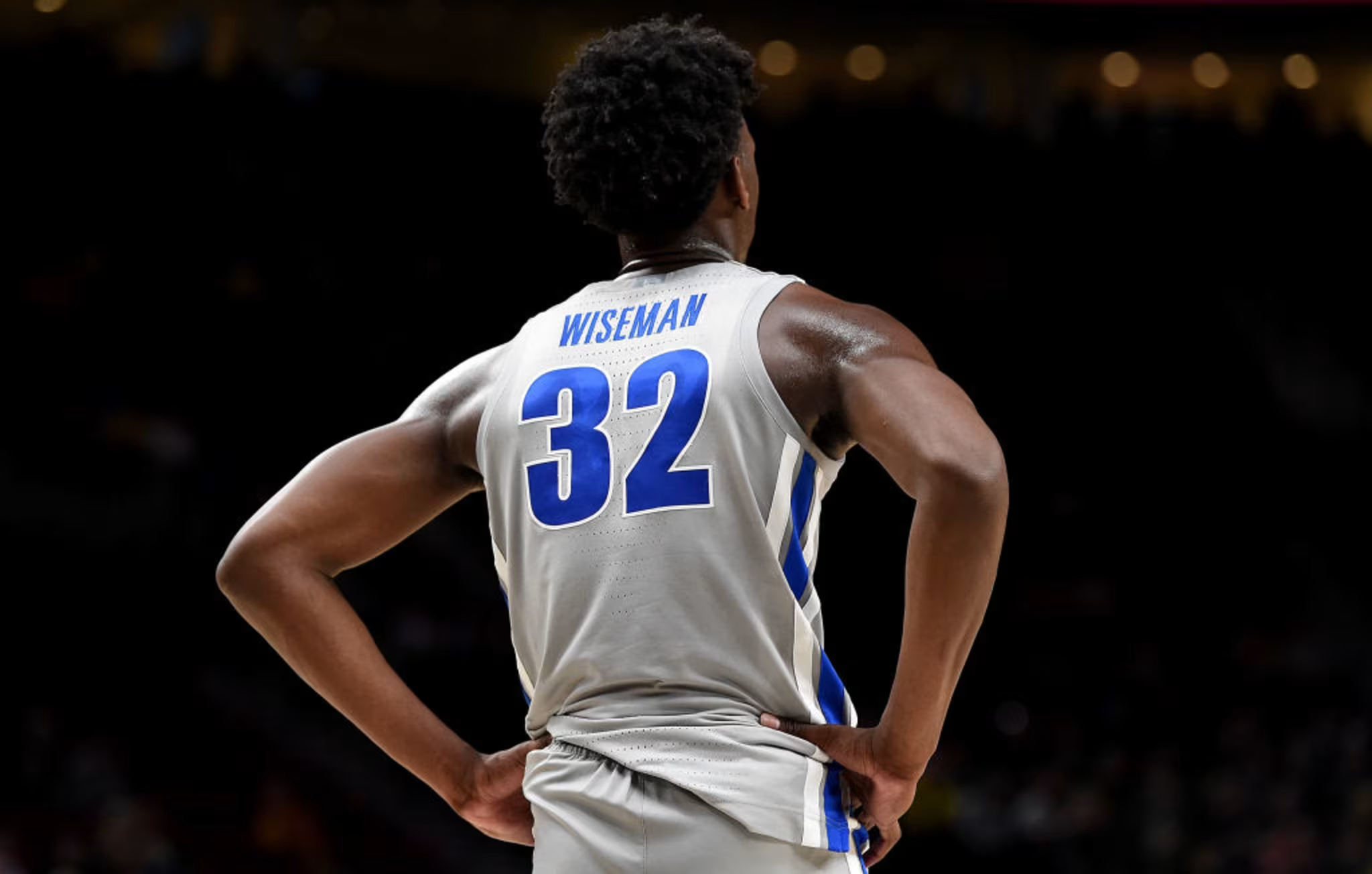
PORTLAND, OREGON - NOVEMBER 12: James Wiseman #32 of the Memphis Tigers waits on the court during a timeout during the second half of the game against the Oregon Ducks at Moda Center on November 12, 2019 in Portland, Oregon. Oregon won the game 82-74. (Photo by Steve Dykes/Getty Images)
It’s an understatement to say this has been a weird year for the NBA. The Lakers won a championship in October. Next season will already tip off in one month.
And now it’s time to talk about the draft. Instead of its usual scheduling in late June, this year’s iteration will take place Nov. 18. So after months of anticipation and waiting, it's finally draft week. Everyone has an opinion on this draft class, with the consensus being that it's one of the weaker ones in recent years. However, there's still star power at the top, led by LaMelo Ball and Anthony Edwards.
There was already a lot of hype around this year’s top prospects, and the prolonged wait for the draft has only heightened it. Nobody really knows who's going to pan out from this class and that just adds to the intrigue. If you’re wondering who is likely to go where, check out our latest mock draft. And if you’re wondering who those players might look like when they enter the league, read on...
Anthony Edwards
Best-Case Comparison: Victor Oladipo
We’re calling this the Tom Crean Connection. Oladipo was the No. 2 overall pick in 2013, and we currently project Edwards to go No. 1 to Minnesota.
If the T-Wolves do take the 19-year-old from Atlanta, they’ll get a powerful athlete with explosive scoring skills. Edwards’ hops and strength are something to behold.
Further, during his lone season in the SEC, Edwards showed just how skilled he is. He was an isolation nightmare and filled up the stat sheet, putting up 19.1 PPG, 5.2 RPG, 2.8 APG, and 1.3 SPG.
The SEC Freshman of the Year isn’t exactly a lockdown defender like Oladipo, but he’s still quite good on that end of the court, and he has superior offensive potential. There isn’t a glaring weakness in Edwards’ game, though he does need to refine his outside shooting, as he connected on only 29.4 percent of his 3-point attempts at Georgia. Nonetheless, Edwards is a generational athlete and the cream of the 2020 crop.
James Wiseman
Best-Case Comparison: DeAndre Jordan
Wiseman was the No. 1 player in his high school class, and he’s consistently been in the top three of mock drafts over the past few years. Though his stock somewhat dipped earlier this year, it’s back up, and we have him going No. 2 in our latest mock.
The 19-year-old is 7’1” with a 7’6” wingspan and has potential to become a dominant big man. He’s impactful around the rim. Though he only played three games for Memphis as a freshman (due to an impermissible benefits suspension), he averaged 3.0 BPG in addition to 19.7 PPG and 10.7 RPG.
The 19-year-old from Nashville isn’t just big, though—he’s also an athlete. The kid can jump out of the gym. He isn’t totally developed on the offensive end, and his post moves could use some work. Evaluators have also been critical of his leadership ability.
However, given his size and athleticism, he has massive potential. He reminds us a lot of Jordan, though Wiseman is a much better shooter—so his ceiling is higher.
LaMelo Ball
Best-Case Comparison: Penny Hardaway
When you hear the name, you probably think of his pops, his reality-show adolescence, his time in Lithuania, or his jaw-dropping high school numbers (92 points in a game?!). But there’s much more to LaMelo Ball.
Whichever team gets its hands on the youngest Ball brother—in our latest mock, he’s slated No. 3 to the Hornets—will inherit a dynamic playmaker. He’s silky smooth, with tremendous handles and passing reminiscent of a young Jason Williams.
Though Ball is somewhat limited athletically (we’re really squinting to find a weakness in his game), he has phenomenal size at 6’9”. The kid from Chino Hills is built like—and plays like—Penny Hardaway. Ball has special instincts and simply knows how to play. Penny, now the Memphis coach, was a four-time All-Star and could’ve been so much more if injuries hadn’t thwarted his career. Perhaps Ball could show us what could have been.
Tyrese Maxey
Best-Case Comparison: Bradley Beal
Maxey isn’t currently in the caliber of the guys above him on this list. He’s been knocked for his size (6’3”, 200 pounds) and outside shooting (29.2 percent on 3-pointers at Kentucky), but the 6-3 shooting guard from Kentucky is a work in progress who could become special.
Maxey may need a couple years to come into his own, yet he already has terrific intangibles and does a little bit of everything. The 20-year-old Texas native is strong and quick, an excellent defender. He’ll be an impactful player on D from Day 1.
Though he hasn’t always been consistent offensively, Maxey has the potential to light it up. He’s a crafty scorer who excels at hitting runners and difficult shots in the lane and has an efficient release. He torched Louisville for 27 points in their rivalry game last year.
Beal wasn’t always the player he is today. He’s developed quite a bit since his time at Florida and his rookie year with Washington. He didn’t crack 20 PPG until his fifth pro season. If he lands in the right situation and isn’t expected to fill it up immediately, Maxey could follow a similar trajectory.
Tyrese Haliburton
Best-Case Comparison: Lonzo Ball
Haliburton and Ball didn’t come up similarly. Ball was Mr. Basketball USA and a highly touted prospect when he arrived at UCLA. Haliburton was a three-star recruit. But the Wisconsin native came into his own during his two years at Iowa State and is now drawing comparisons to the Pelicans guard, who was the No. 2 overall pick in 2017.
A 6’5” PG with long arms, Haliburton has ideal size for a floor general. He showed promise for the Cyclones immediately and really became a factor as a sophomore, putting up 15.2 PPG, 5.9 RPG, 6.5 APG, and 2.5 SPG. His size, court sense, and passing differentiate him. He and Lonzo’s younger brother (LaMelo) might be the two best passers in this class.
Haliburton is not a sure thing—which Ball was considered to be when the Lakers selected him—and has been knocked for his somewhat limited athleticism and narrow frame. He needs to hit the weights and shovel in some calories. However, Haliburton has more versatility than Ball. He hit 43.4 percent of his threes as a freshman two seasons ago. Like Maxey, he might need a couple years to develop, but he has potential to be special.
Obi Toppin
Best-Case Comparison: Shawn Marion
THE MATRIX!
Shawn Marion was a four-time All-Star and one of the great unappreciated NBA players of all time. And Obi Tobbin could be the second coming.
Tobbin should be an impact player from Day 1. He’s been billed as the “most polished” player in the Class of 2020.
And he really flexed during his sophomore campaign with Dayton. He averaged 20.0 PPG, 7.5 RPG, 2.2 APG, 1.0 SPG, and 1.2 BPG. His efforts for the Flyers led him to earning consensus National Player of the Year honors this season.
Toppin is on the older side (almost 23) but has tremendous size (6’9”, 2020), athleticism (he set a school record for dunks), and intangibles. He’s a smart player who should carve out a long NBA career.
Deni Avdija
Best-Case Comparison: Hedo Turkoglu
The 2008 Most Improved Player was crucial to the dynamic small-ball Orlando Magic teams of the early 2010s, and Avdija is an Israeli-Serbian prospect destined to make a similar impact on the NBA. He was the youngest player ever to debut for Maccabi Tel Aviv (he played for the senior team in 2017 at age 16) and also the youngest to win Israeli League MVP (at 18).
Avdija isn't the most athletic wing, but he’s a phenomenal passer and ball handler—reminiscent of skilled Euro bigs like Turkoglu.
Avdija can play any spot from the 2-through-4 and simply knows how to play the game. He’s one of those guys with feel, on both ends of the court.
He’s dynamic with the rock in his hands and can create in iso situations, but he also has skills in the post. At 6’9”, he could be a matchup nightmare for opponents.
Onyeka Okongwu
Best-Case Comparison: Bam Adebayo
Adebayo really came into his own for the Heat this season, with the 23-year-old showing his versatility in helping lead the Heat to the NBA Finals. (Remember that block on Jayson Tatum? Sheesh!)
Okongwu is a 6’9”, 235-pound power forward who showed a similar ability to impact the game during his lone year at USC, averaging 16.2 PPG, 8.6 RPG, 2.7 BPG, and 1.2 SPG.. Prior to that, he played at Chino Hills with LaMelo Ball. Okongwu is a special athlete who can really clean the boards, and despite being only 19, he’s built powerfully.
He has room to improve on the offensive end, with his post skills, ball handling, and shooting somewhat lacking, but his rim protection is elite. His game also brings to mind Tristan Thompson and John Collins.
Patrick Williams
Best-Case Comparison: Kawhi Leonard
OK, we can hear the haters now. Of course, we don’t think Williams will actually be Leonard 2.0. Kawhi is a 1-of-1.
But Williams, a Charlotte native who spent one year at Florida State, does have a similar frame and game. At 6’8” and 225 pounds, he can play multiple positions. He’s an unbelievable athlete and defender, and he’s a more polished shooter than Leonard was coming out of San Diego State.
That said, Williams has some of the same deficiencies Leonard had. The former Seminole isn’t viewed as NBA-ready, with critics saying he’s too passive and doesn’t have the "it" factor.