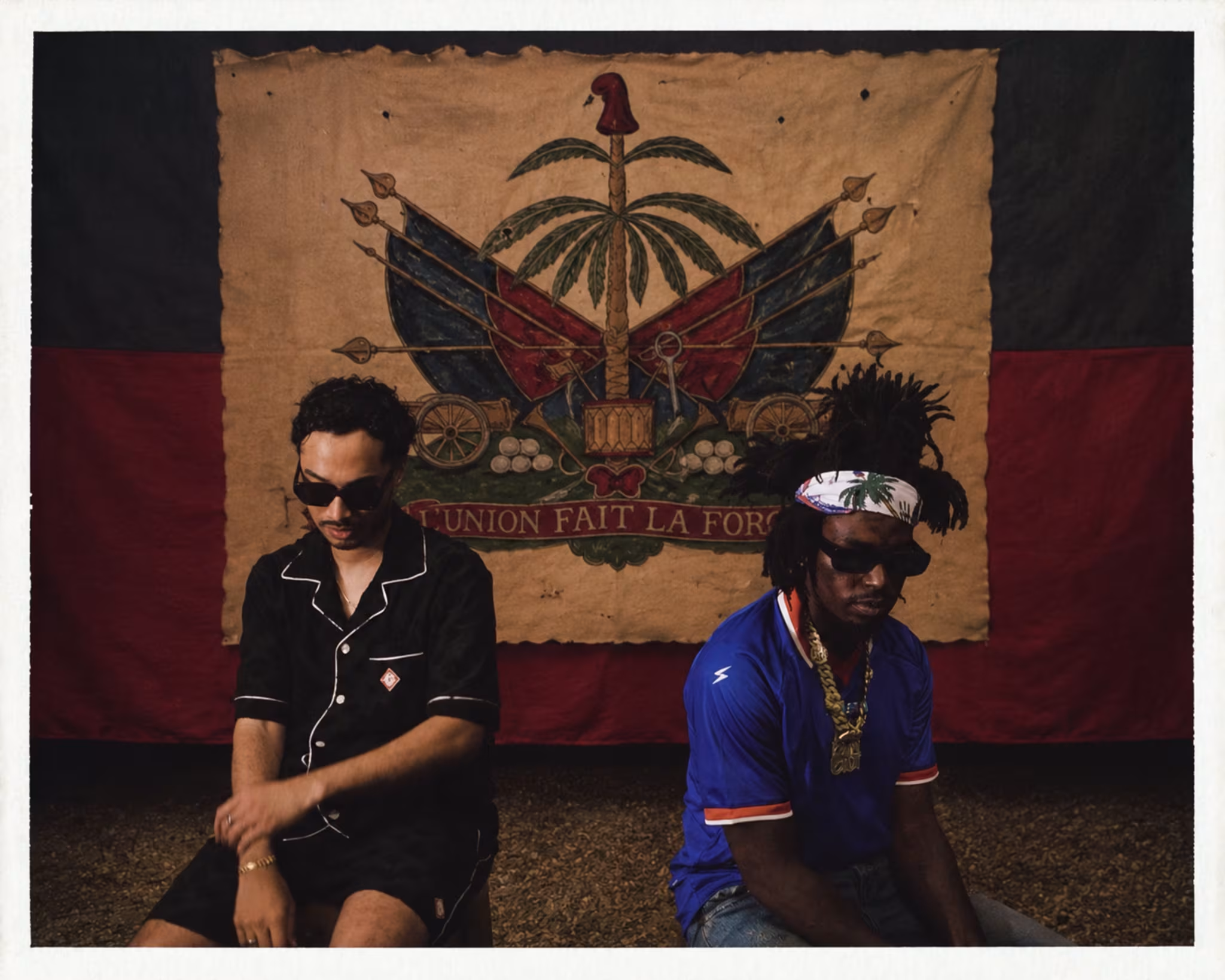
Walking around Miami during the release of GTA VI felt like WWE taking over a city during WrestleMania season. From massive, company-sponsored events (like Rockstar Games’ GTA VI music festival) to random lunch spots featuring GTA-inspired chicken sandwiches, the city was drenched in the spirit of Vice City. What’s dope about that is when the culture that Rockstar captures in-game—as it did with the Haitian citizens in Leonida—is brought to life, and for that, you have to give it up to Michaël Brun, who celebrated the work he did within GTA VI and a decade of his event series, BAYO, bringing the block party series back where it started: Little Haiti, which is also featured in GTA VI as La Perle. Brun’s work on the game included creating the mix for The Sniper of La Perle, the Kodak Black-centered missions in GTA VI.
Needless to say, BAYO’s 2026 return to Miami was a real homecoming.
“This is second home for me,” the 34-year-old Brun told Complex, hours before taking the BAYO stage. “I was born in Haiti, but I spent a lot of time out here growing up, and I think the significance is even deeper than I realized. I just found out that our first BAYO show 10 years ago was actually the exact time period where Little Haiti as an official district was named.” That’s right: while the area known as Lemon City has long been called Little Haiti, it wasn’t until May 2016 that the City of Miami approved the legal boundaries that make up the area to bear that distinction on record. “So Little Haiti is 10 years old, too,” Brun reflected.

That distinction alone holds significance for Brun; he’s always seen BAYO as a platform to build community for Haitian people and Caribbean culture in general. “The show started out as something that was for the community; we did it at the Cultural Center, which is an institution down here for Little Haiti. And it started out relatively small, a couple hundred people, and then we just kept coming back year over year, building it out.
“Eventually,” Brun continues, “the show became a tour around many cities. Recently, I did Barclays Center,” referring to his June 2025 BAYO takeover, which had 19,000 rocking to the sounds of kompa, racine, and even got an appearance from current NYC mayor Zohran Mamdani.
“We met around that time,” Brun remembers, “and I'd seen what he was doing, and especially I think speaking to the Haitian community and speaking to immigrant communities, it felt really authentic.” Brun said that after mentioning BAYO’s Barclay’s event to Mamdani, he showed up on the side of the stage. “It just felt like a really special moment,”’ which included Mamdani speaking to the audience. “So I invited him up, and he spoke in Creole. Nothing was planned. It wasn't like a scripted thing, but I think that's the core of the show: we have not just Haitians in the crowd; we have people from all around the world, and it's a celebration of Haitian culture. But at the same time, I think it's diasporas across the world that can come together and enjoy the different genres, the different styles that are there.”
That’s felt when you hit BAYO; with 7,500 people touching down in Little Haiti for this 10-year anniversary block party, you can feel it in the queue. (You know a DJ’s set is a banger when the security can’t stop dancing.) The energy was lively, with attendees of all ages there to see the likes of J Perry and AndyBeatz doing what they do at BAYO, which also paid tribute to Florida legends like Black Dada, who came through with a rousing performance of his classic “Imma Zoe.” Emeline Miche showed up (and showed out!), as did Naïka, who made her debut at BAYO with a crowd-pleasing performance. When you add the Barikad Crew, Anie Alerte, Top Adlerman, Alan Cavé, and 5LAN, the Haitian representation was sky-high that night in Little Haiti, all before we even get to Kodak Black.
Brun, who’s been releasing music for over 15 years, was one of Haiti’s first electronic music artists. His father, Patrick Brun, was a member of Skandal and loved ‘80s acts like Tears for Fears and Art of Noise; it was through his father’s collection of synthesizers that Brun first started making music, although his first musical forays were more Swedish House Mafia than Skandal. “I just remember reading stories of bedroom DJs, that that was possible,” Brun explains, starting with FL Studio around “12 or 13.” Like many of us, Burn was online. “I'd go to forums. I was on the Swedish House Mafia forums, I was on Laidback Luke forums. A lot of contemporaries actually ended up being massive stars.” By the age of 16, Brun says he was a full-time DJ in Haiti, playing house parties and clubs, eventually balancing his pre-med studies in college with a budding career as a DJ and producer, leading to being noticed by the likes of Swedish House Mafia and Hardwell, major figures in the EDM scene.
His success led Brun to play Coachella, the Ultra Music Festival, and other highlights of a growing EDM artist. Brun even remembers opening for Avicii in Haiti, although at the time, his sound was more Swedish House Mafia than what you may hear today. “I didn't even mix Haitian music into what I was doing,” Brun admits. “I wanted [incorporating Haitian culture] to feel really special, really authentic.” After running the EDM gamut, Brun found himself wanting to take things back to the essence. “Around 2015, 2016, I was like, ‘all right, I'm ready. I want to go back to Haiti, work with all these artists in Haiti, work with these bands, do these block parties, start from zero,’ basically.” That became the first BAYO, followed by his J Balvin collaboration “Positivo,” which became a 2018 World Cup theme, as well as work with Mr. Eazi, Major Lazer, and others, making Brun a true worldwide force.
Brun has become a true ambassador for Haiti and the Haitian community through his work with BAYO, which shines the brightest spotlight on the Haitian community and the artists working within it, while keeping its show free to the community. That’s right: while BAYO Miami was an official Rockstar activation, tickets were free to the public, with tickets specifically earmarked for the local and Haitian communities. “I think that might be the easiest part of this,” Brun says with a smile. Why? “Because everybody who's been around since the beginning is still here. So it's like little by little, the show expanded, and I'm so grateful the team is the same team. I literally went to elementary school with the creative director of the stage, and our dance choreographer was also in our elementary school in Haiti.”
When you put all of these pieces together—Rockstar’s love of music in GTA games, GTA VI taking place “in Florida,” the Haitian communities featured in the game—it feels almost inevitable that Brun would be a part of GTA VI, which led to him not only working with Kodak Black, the Pompano Beach, Florida native who has always shown pride in his Haitian heritage, but creating a mix of music that’s featured in the game...you just have to find it.
For those unaware, Kodak Black plays himself in GTA VI, and hosts a radio station in Leonida, one of several waiting for you to unlock in the game. It’s presented by Brun, who says the project started a few years ago. “I think that in terms of the actual process, it was really brainstorming. It was like, ‘Let's see what we can do together.’” Brun says that while being “secretive” Rockstar let him know that they wanted him to do a station in the game, and that they felt it was important to pay homage to the area parts of the game take place in. “I took it really seriously,” Brun says proudly. “I played the games over the years. It's a huge inspiration to me. I think they have the best music creation.“
Brun actually called being able to work on this game an honor. “One, in terms of just the historical excellence that they've had when it comes to music creation, but then also representation-wise for Haitian music and Haitian culture, because I think that BAYO has been the physical embodiment of curation for me. We've had 140-plus artists from not just Haiti, but all around the world. And I think every artist that I've ever brought on stage has been really thought out in terms of ‘how does it fit into the story of BAYO.’ And in the same way with this mixtape, I really wanted to make sure that the fullness of Haitian music and culture could shine through.” And because of that, Brun’s mix for GTA VI had to represent the full spectrum of Haitian music. “I wanted it to be as expansive as possible, still coherent, still fluid,” while recognizing “that it was something that Kodak and me together had this moment of a Haitian-American and a Haitian from Haiti coming together. We've come from different places, but we have all this in common, and everybody can enjoy it.”
That moment became “Tèt Kale Bobis,” their official collaboration for GTA VI and the song that closed out BAYO Miami 2026. It was a huge moment, highlighting just how far Brun has come with his work as an artist and as an ambassador for Haiti.
One thing you learn about Rockstar Games and the music they curated for GTA VI, it’s that they prefer to make the connections that make sense. “Kodak and me linked through them. That link-up was really organic; I forgot when it first came up, but there were some people in Kodak’s team that knew about me already. I know Kodak had reposted some stuff I've done in the past. And of course, I played a bunch of music in my show, so it was a mutual respect. And then I think that's what [Rockstar’s] really good at. And even in their radio shows, if you look, the pairings that they've done with all these different people is really, really well thought out, really tasteful. In retrospect, I feel like it's a perfect mix, and I'm so happy we did it. But honestly, I would've never thought to do that just off the rip. It came up through just us connecting, and it was just exciting.”
The distribution of the music also excited Brun. “They wanted people to organically discover it in the game, but I think the way they did the mission is really cool. You have to scan these different posters. So you basically walk around Little Haiti—La Perle—to discover it. And I think that the fact that it then unlocks the station, and then we also have an original song we made for it, that's crazy.” What’s been dope is that Brun, a child of the internet, has been seeing the reactions to the station online.
“There's people that just posted clips of walking around Little Haiti,” Brun says. “There's a tiny little five-second snippet of kompa playing out of a car in the background of the scene. It's not even their radio. It's like another NPC in the game playing a kompa song from the tape.”
Brun says this was exactly what he wanted from this collaboration. “I hope that by having a really amazing group of artists and legends in this mix, that people would feel like that. And as soon as I saw three or four of those, I'm like, ‘oh my God, this is so fire. I think a lot of people will discover Haitian music through this, too.”
When asked what he was thinking going into the first BAYO, Brun said he wasn’t thinking 10 years ahead as he was trying to keep the first one going smoothly. However, a decade in, Brun has a different outlook. “Making it to 10 years, I'm really aware that the success of today is because of everyone that's been involved. And I really think it's a very communal thing. If I look back at the 10 years and I look back at the team and everybody that's been a part of it and how much it's grown in all these different ways, I really value everybody's contribution. And I think that I've seen people grow. When I started, I was the one growing. I learned from people who mentored me and gave me opportunities and opened my eyes to just experiences.
“Now,” Brun says, “I feel like I'm in that role now to give people opportunities and give them a shot. And so I really want to continue for the next 10, 20 years. Hopefully it lasts 50 years, even past me. I really want to continue to create opportunities. I think by creating opportunities, it's giving people more responsibility, giving people more opportunity to try things, new artists to come up, new creatives to get involved and create. Hopefully, through everything we just did with the game, it opens people's eyes to more things that can happen with Haitian music.”