Key Takeaways
- Insomniac’s PS5-exclusive Marvel’s Wolverine trades Spider-Man’s lighthearted energy for a grim, linear 20-hour campaign built around graphic violence and mutant persecution.
- Momentum-driven, parry-heavy combat captures Logan at his best, while Jean Grey’s capable partnership, varied enemies, endurance trials, and boss fights keep the action compelling.
On September 15, Insomniac Games will release Marvel's Wolverine, exclusively for the PlayStation 5. Insomniac is one of PlayStation Studios' in-house developers, acclaimed for its three Marvel's Spider-Man games. But whereas the Spider-Man games were relatively lighthearted jaunts—filled with the relatable antics of Peter Parker and Miles Morales to counterbalance the drama—Wolverine is a grimdark, bumpy ride that never lets up.
Shop the Comics Collection on Complex
A bloody rampage
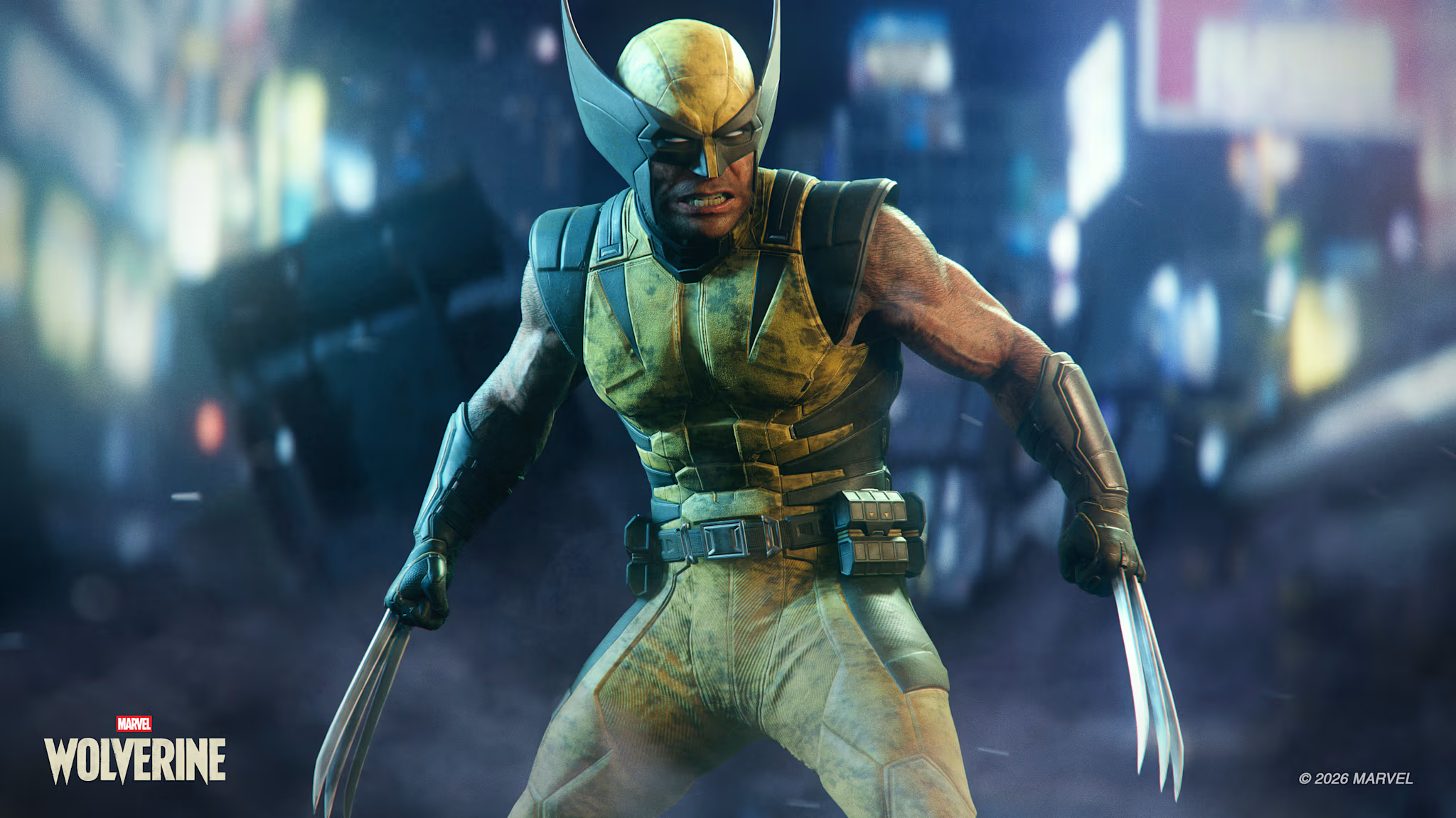
Let's start with the violence, which lives at the heart of this game. We see humans enact violence against mutants in numerous contexts: as innocent bystanders, as weapons against other mutants, as dehumanized lab experiments. And Wolverine is there to repay blood with blood. A superhero like Spider-Man invariably takes the high road, choosing mercy for people who may not deserve it. Wolverine is not that guy, and the game makes no attempt to mold him into a "proper" superhero. He feels some guilt for his actions, but never enough to stop committing them or take pleasure in them—lucky for us players.
Blood flows freely in Marvel's Wolverine. The developers punctuate every slash, every gunshot, with a generous spurt of the red stuff. We see adamantium claws driven through torsos and into and out of people's faces. We see numerous, multiple stab wounds for each enemy; Wolverine quadruple-taps to ensure that the dead victim stays dead.
Wolverine visibly takes damage; we see his flesh ripped away and burned away, sometimes all the way down to his adamantium skeleton. And thanks to his healing factor, we then see the muscles and sinews knitting themselves over the bones, followed by the skin forming over that. It's vivid, and if you have a weak stomach, it's bracing.
It's so explicit, in fact, that the developers created a gore option in the accessibility menu. You can individually toggle the blood, the dismemberments, and the damage on Wolverine's body to suit your threshold. The game will then pixelate the particularly gory bits in the cutscenes, such as when Sabretooth rips a guy's head off with his bare hands. But don't get it twisted; this game is not for children, even with those guardrails in place. A claw through the middle of someone's face, regardless of whether there's accompanying blood, remains exactly that.
A cautionary tale
[Ed Note: This portion of the review contains mild spoilers for Marvel’s Wolverine. You have been warned.]
The game never offers a realistic counterpoint to the “fight fire with fire” approach. At the time this story takes place, mutants are rare and unknown to the general public, and there's no Charles Xavier around to propose a less bloody path. Only in the game’s closing moments do we see the possibility of a more civilized, measured approach.
The X-Men have always been a thinly veiled allegory against the persecution of the “other"—ethnic minorities, people of color, the LGBTQ community, immigrants, refugees. This game leans into those political allegories; at one point, Wolverine even arms the town’s civilians to overthrow an oppressive militia.
We're going to hear lots of bad-faith arguments over the next several weeks—that this game is "woke" in the pejorative sense—too preachy, too political, and too on-the-nose for its own good. But the X-Men have never been subtle about their intentions, and neither is this game.
On a macro level, Marvel's Wolverine does an excellent job of showing how fear of the Other takes root and becomes government policy. Bolivar Trask, who veils his hatred of mutants behind a thin veneer of scientific legitimacy, is the perfect villain for this tale. Then there's Nathaniel Essex, better known as Mister Sinister to comic book fans. We meet him as a trusted, beloved mentor to Wolverine. But over 20 hours, we learn he's a malevolent, manipulative fraud. There's no enemy as dangerous as the one who calls himself your friend.
[Ed Note: Spoilers for Marvel’s Wolverine end here.]
Partner in mayhem
On a micro level, this is the story of Logan and Jean Grey; there's no Cyclops, which means there's no love triangle: just simmering sexual tension between the two of them. Wisely, the developers build this tension through gameplay rather than cutscenes. Jean Grey is your computer-controlled partner for about 80% of the game, and she can more than take care of herself; you're never in the position of having to babysit her like Ashley in Resident Evil 4 or Ellie in The Last of Us.
Jean helps in many ways. Occasionally, she'll disorient snipers during a stealth sequence or build a staircase of rocks to aid traversal. She'll give hints if you're dying or stuck, which feels more immersive and less jarring than in most games, which break the 4th wall to tell you what's next.
But mainly, Jean has your back during the combat sequences, against the tsunami of enemies that the game throws at you. So when the script tells us these two people care for each other, we believe it on a tangible level. We've fought side-by-side for hours at that point.
Up close and personal
The combat is free-flowing and parry-heavy; it's the same sort of combat popularized in Batman: Arkham Asylum (2009) and refined in Marvel's Spider-Man (2018). But unlike those games, which give you ranged projectiles to stun and snipe enemies from afar, Marvel's Wolverine does not, and Logan's one ranged attack is upgrade-locked until the very end of the game. True to the title character, you have to get in close to do any damage.
You close the distance by deflecting projectiles with your claws and by lunging, blades extended, with a deadly tackle. You can dodge and roll to the side as well. But there's so much going on, at any given moment, that it's nearly impossible to remain unscathed. And when you do get in close, you have to make it count.
You claw at opponents by pressing Square, and you combine that with pressing Triangle to create unique combos. You parry a melee attack by tapping L1, which makes a satisfying "ping sound" when you successfully pull it off. Parrying leaves your opponent open for even more damaging attacks, and "staggering" your opponent can make them vulnerable to a final, finishing blow.
Do this enough, and you trigger Wolverine's Rage Meter. Depending on how far you fill it, you gain access to even more damaging move variants. Push the Rage Meter high enough, and you can survive a fatal wound. Push it even higher, and you enter a one-hit-kill mode that you can stay in indefinitely, so long as you keep killing at a steady clip.
Keep fighting, Bub!
What defines Wolverine's combat is how momentum-based it is. To take the best advantage of its mechanics, you have to continually be on the offensive. Stealth exists, but it is minimal and serves as the opening salvo for the massive fight, not a viable alternative.
Your healing factor means you're slowly recovering stamina at all times, but it's slow, and hiding and recuperating is not a viable strategy, especially in the later levels. But after you're upgraded, you can get large health boosts for perfect dodges and finishers, which means that when you're close to death, your best option is to launch yourself into the mayhem and take a chance. Thus, any time you survive, it's against crazy odds. And any time you die, it's in a noble blaze of glory. I love it.
Conventional gaming strategy teaches us to keep our enemies on one side, to avoid being flanked and surrounded. But Marvel's Wolverine actually feels best when you're surrounded on all sides by multiple enemies. You have special moves like the tornado spin designed specifically for that scenario. And it's fun to live dangerously—to parry seven or eight blows on all sides and then summarily turn the tables on your opponents, executing them all.
That this game is linear rather than open world complements its intensity. Wolverine has no time for lollygagging on side quests or hunting down obscure collectibles; he is a mutant on a mission. Again, the game captures the idea of being Wolverine not through the script, but through the gameplay. We are shown, rather than told, who he is.
In our preview of the game, I expressed concern that the combat would be too repetitive over a long playthrough. Thankfully, that wasn’t the case. The enemy variety meant I had to change up my strategy, and the upgrade tree steadily added new, interesting moves to my arsenal. I learned to throw my enemy into other enemies as a form of crowd control. I learned a rising knee special move, which could stagger a powerful opponent long enough to attempt a killing blow.
Exposition dumps
This is a game that is very, very good at being a game. It drags a bit when it tries to be an interactive movie. Several times during the game, the action completely stops, and the characters all sit around and discuss The Plot. You have to walk over here and talk to this guy, and then you have to walk over here and talk to that guy. And then you have to walk back around and talk to the first guy again.
The entire time, you're helping other characters accomplish menial tasks; you're helping one guy find a vinyl record he likes, or you're hunting down another kid's artwork. These playable cutscenes are tedious because they don't feel in-character, and they aren't narratively load-bearing; they repeat the same information and character motivations that we already learned through the visceral gameplay. The game tells its story through action so well that it renders many of the cinematic cutscenes redundant. It's not a dealbreaker by any means; it's just an observation that the game can stand on its own without the extra roleplaying flourishes, which look nice but ultimately feel tacked on.
Explorable trauma
Another narrative misstep is the Nightmare Doors—a series of traversal and combat trials scattered throughout the game. Complete one successfully (you can earn bronze, silver, gold, or adamantium), and you unlock physical upgrades, along with traumatic memories from Logan's past.
The endurance rounds, which require you to outlast 25 waves of enemies, are some of the game's most unadulterated pleasures, because they distill the game's core strength—its combat—to its purest form. In Marvel's Spider-Man, you could spend hours web-slinging across Manhattan just for the hell of it. The endurance trials in Marvel's Wolverine offer the same sort of untethered-from-the-main-story, kinetic enjoyment. Out of everything you can do once the story is complete, I find myself coming back to these endurance rounds the most.
Unfortunately, the memories you unlock as rewards aren’t presented in an artful, interesting way. They're just audio recordings of Logan narrating a vague story from his past. There are no visuals, no sound, and no art to illustrate what's actually happening. It's a cool idea, but the developers did not follow through on its potential. We expect to see something, especially since the trials have bizarre, abstract imagery that appears to tease it.
Epic boss fights and final thoughts
You can skip through the chapters you've already completed to replay your favorite bits. Aside from the endurance trials, I also find myself revisiting the boss fights, which are these epic action setpieces that test your twitch reflexes. It's sort of like playing Punch-Out!! back in the day; you watch for physical tells, you track the patterns, and eventually, you learn which moves counter best. I died many times fighting Omega Red, Lady Deathstrike, a massive Sentinel, and more. But once you do it once, you can do it again and take the time to really enjoy the experience.
You can also backtrack to collect any material crates you missed, which you use to unlock numerous alternate costumes. They cover the entire gamut of Wolverine's history across television, comics, and movies. For most of the game, you're allowed to switch your clothes at any time, but on your first playthrough, the game does lock you into the default costumes near the end; it's a bit too cognitively dissonant, perhaps, to place Saturday morning cartoon Wolverine side-by-side with the insane, traumatic events in the game's closing hour.
We recommend this game to just about anyone with one caveat: Despite its superficial similarities, this is not Marvel's Spider-Man, nor should it be. This is Wolverine. And although what he does isn’t nice, he's the best in the world at doing it.