Key Takeaways
- This feature explains how Martin Scorsese’s 1990 classic Goodfellas traded The Godfather’s glamorous Mafia elite for a documentary-style portrait of working-class mobsters in Queens and Brooklyn.
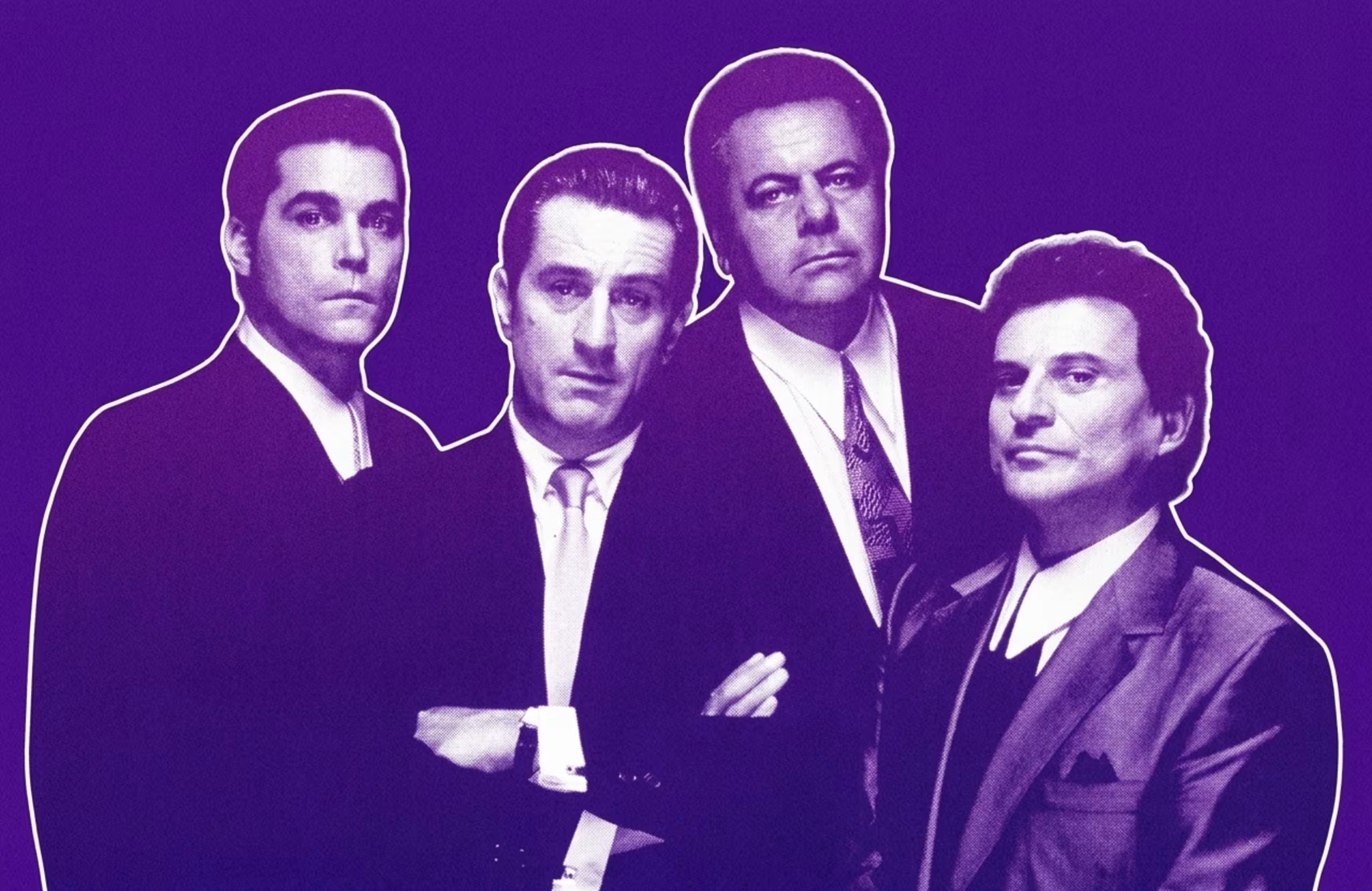
- Based on Nicholas Pileggi’s Wiseguy and real informant Henry Hill, the film transformed Lucchese associates Paul Vario, James Burke, and Tommy DeSimone into characters played by Paul Sorvino, Robert De Niro, and Joe Pesci.
When The Godfather hit theaters in 1972, it defined, for many people, the trials and tribulations of the Mafia elite. In well-to-do mansions with shadowy rooms, mobsters negotiated business deals and contract killings. The Corleones were at the top of their food chain; they were the men who gave orders to keep their hands clean.
That said, when Goodfellas came out in 1990, it was a revelation. The film's characters weren’t mythic figures, cloistered behind iron gates and trimmed bushes. These were the working-class, blue-collar, street-level guys, doing all the dirty work in the outer NYC boroughs of Queens and Brooklyn. This was the Mafia, stripped of its glamour. There were no morally good people in this universe—just criminals with varying levels of decency and scruples.
Director Martin Scorsese envisioned this film as a documentary-style production covering three decades in the mob; it even has a voiceover to elaborate on the action unfolding before you. This is everything you need to know about Goodfellas.
Shop for WWE on Complex Shop
Henry Hill was a real person
The movie Goodfellas is based on the biographical book Wiseguy, written by Nicholas Pileggi. The book is based on the account of Henry Hill, an associate of the Luchese crime family before he became an FBI informant.
The main characters were all based on real people in Hill's life. Paul Vario, a caporegime for the family, became Paul Cicero (Paul Sorvino). James Burke, another Lucchese associate, became Jimmy Conway (Robert De Niro). And Tommy DeSimone, another Luchese associate, became Tommy DeVito (Joe Pesci).
The film’s events were broadly true. The Billy Batts killing happened almost exactly the way it was portrayed in the film, although the events, which actually took place over two nights, were condensed into a single evening for the film. The Lufthansa Heist was also a real jewelry robbery, where nearly $6 million were stolen from JFK Airport.
Scorsese had to negotiate the number of times Batts got stabbed
During a test screening, audience members walked out during the very first scene, when Pesci's character stabbed Billy Batts seven times with a kitchen knife. Scorsese eventually cut the seven stabs on-screen down to four stabs on-screen. Three additional stabs occurred off-screen, although you can still hear the sound of them.
Scorsese already had the soundtrack in his head
The soundtrack for Goodfellas is iconic: a rich sampling of popular music spanning three decades. According to music editor Christopher Brooks, Scorsese had already planned out the songs he wanted three years before production began. Goodfellas was, at the time, one of the most expensive soundtracks ever made because of the necessary licensing; even if Scorsese only used thirty seconds of a song, as he did with the Rolling Stones' "Gimme Shelter," he had to pay for it.
Scorsese used his own experiences for the movie Henry's childhood
At the beginning of the movie, we see a young Henry looking down from his window at the gangsters hanging out on the street. Scorsese could relate to that. Scorsese was a frail kid growing up in Little Italy; he suffered from chronic asthma, which forced him to stay inside his apartment a lot and watch life passing by around him. However, there was a silver lining: staying inside nurtured an intense love of film. Scorsese credits his asthma with saving him from a life of crime.
Scorsese cast real mobsters in the film
Many of the extras were connected, in one way or another, to organized crime; many actually knew the main characters in real life, and one of the extras would later be convicted of carrying out hits for the mob. This casting blurred real life with Hollywood; Scorsese warned the cast ahead of time about who these people were so they would be shown proper deference and respect.
De Niro had the real Henry Hill on speed dial
Robert De Niro is a dedicated actor—so much so that when he was developing the Jimmy Conway character, he called the real Henry Hill up to eight times a day to get every detail right about him, from the way he walked to the way he poured ketchup.
De Niro comboed his accessories
The mobsters in Goodfellas were full of excess, and the costume department went overboard to make De Niro seem particularly decadent. Every single suit was accessorized with its own pinky ring and watch. De Niro also used real money; he carried $5,000 of cash in his pocket on set.
Scorsese had to properly tie Ray Liotta's tie
Scorsese was concerned with accurate detail. He wanted his mobsters to appear and act like the ones he knew from real life. Ray Liotta, who played the main character Henry Hill, recalled that Scorsese would tie his tie for him to make sure it looked just right.
The "How the f*ck am I funny?" scene happened to Pesci in real life
The famous "How am I funny?" scene comes from a real event: actor Joe Pesci used to be a waiter. While waiting on a mobster, Pesci told him he was funny, and he got a less-than-enthusiastic response to his sass. Scorsese loved the anecdote so much that he decided to shoot it, even though it wasn't in the script. Pesci and Liotta both knew what would happen in the scene; they had improvised and rehearsed it beforehand. But Scorsese deliberately didn't inform the other actors on set during the actual shoot to elicit natural reactions.
Scorsese gave his actors conflicting directions to create tension
During the scene where Sonny begs Paulie to take control of the restaurant, Scorsese told Sonny's actor, Tony Darrow, to improvise more, but didn't tell Paul Sorvino, Paulie's actor, about the change. This elicited real anger and confusion from Sorvino, who brought those emotions into the finished scene.
It took eight takes to capture the Copacabana tracking shot
The long Steadicam shot, where Henry takes Karen on a date to the Copacabana to see Henny Youngman, is still studied in film classes as a classic filmmaking moment. It's a bit of seduction on Henry's part—that he's able to show this woman that he knows people and commands respect. The crew took eight takes to capture the final footage.
Ray Liotta's mother died during production of the film
Liotta's mother died from breast cancer during the production of the film, and Liotta used the anger over her death to drive his performance—most notably, during the scene where he pistol-whips Karen's neighbor Bruce. According to Mark Evan Jacobs, the actor who plays Bruce, he was legitimately hit on one take.
De Niro really put the boots to Frank Vincent
During the scene where De Niro's character is kicking Billy Batts, the kicks were real. The actor who played Batts, Frank Vincent, wore padding, but he still woke up with bruises the next day.
Scorsese's mom made a memorable cameo
Scorsese's mother, Catherine, played Tommy’s mother; in the scene where they stop by her house to pick up a shovel, she shows them a painting she made. Nearly the entire scene was improvised, and it was almost cut from the finished film for pacing. Test screenings, however, saved the scene; almost every audience member liked it, even if they hated the film overall.
You can thank Thelma Schoonmaker for that cocaine sequence
Scorsese's longtime editor, Thelma Schoonmaker, began working with him on his first film in 1967. She's responsible for the infamous cocaine sequence in the second half of the movie, where Henry Hill spends a hectic day, snorting cocaine, trying to sell guns, and worrying about the helicopters in the sky.
“We wanted it to be jagged and raw and driving, frenetic,” said Schoonmaker in an interview. “We kept saying we could make it faster, we could make it faster, faster, faster. And I think, in a way, it sort of started this whole jump cut idea of cutting now that’s taken over a little bit too much.”
While Schoonmaker was nominated for a Best Editing Oscar for Goodfellas, she did not take the Academy Award home, although she has won for three Scorsese films: Raging Bull (1980), The Aviator (2004), and The Departed (2006).
There was a real U.S. Attorney in the film
Ed McDonald plays himself at the end of the film; he was the prosecutor who brought down the real-life Henry Hill and later placed him and his family in witness protection.
There's a classic reference in the film's final scene
One of the final shots is of Joe Pesci shooting directly at the camera. This directly callbacks to the revolutionary 1903 silent film The Great Train Robbery. It also ends with a criminal shooting a gun directly at the camera. To an early 1900s audience, this was a startling, thrilling way to end a film.
'Goodfellas' had a massive F-bomb count
There are 300 usages of the word f*ck in Goodfellas, which, for a time, made it the record holder for most usages in a film. Many of these usages were ad-libbed by Joe Pesci; the original script had fewer than 100. Scorsese actually topped his own benchmark with 2010's The Wolf of Wall Street, which had 506 usages of f*ck.
The test screenings were a disaster
After the test screenings (which, as mentioned before, people walked out on during the first scene), the studio thought it had a flop on its hands. Scorsese fought Warner Bros. executives to release the film to the general public as he intended. It turns out Scorsese's instincts were correct; the critics loved the film, and it was nominated for six Academy Awards.
Joe Pesci gave the perfect Academy Award acceptance speech
Pesci won the film's only Academy Award for Best Supporting Actor. His acceptance speech was notable for its brevity: "It's my privilege. Thank you." We're surprised he didn't drop an f-bomb for good measure.