The business world can be cutthroat; more often than not, every industry is affected by company politics, backstabbing, gaslighting, and deception in any company’s drive to be the best. One particular business in which you may not have originally expected this sort of behavior is the video game industry.
When one thinks of the video game business, you think of a bunch of like-minded gaming experts creating fantasy worlds for all of us to enjoy, a common goal that you think would be shared worldwide. Unfortunately, whenever money, and in this case, large sums of money, comes into play, everything is off the table; promises will be broken, plans will be manipulated, all for the chase of the mighty dollar. One of the most infamous cases of such a betrayal is the story of Nintendo and Sony, which vicariously led to the invention of the premier gaming console series in gaming history, the PlayStation.
Throughout the late ‘80s into the ‘90s, Nintendo was the leader in the home gaming console business. Reviving the video game industry with the release of the Nintendo Entertainment System (NES) tightened an iron grip on the industry. The development of Sega’s Master System was a solid alternative, but it still couldn’t match the NES’s library of quality games. That was until the Sega Genesis debuted, toting better graphics, an improved game library, and an edgier marketing campaign. Nintendo eventually fired back with the release of the Super Nintendo. While both systems enjoyed great success, Sega couldn’t topple the library of games, including the Mario and Zelda franchises, Donkey Kong Country, and the early Final Fantasy games.
As technology improved and demand for faster, higher-res hardware increased, Nintendo was looking for the next evolution of its console series; enter Sony.
Previously, Sony had never touched gaming. They made pretty much everything else when it came to entertainment: cameras, VCR’s, Walkmans, you name it, but they left the gaming world largely, if not completely, untouched. An engineer from Sony named Ken Kuturagi thought that it would only make sense to enter the console business. Kuturagi was a big fan of video games and took it upon himself to reach out to Nintendo (without Sony's approval) to help develop the SNES’s sound chip, which made its audio far superior to that of other consoles on the market. Secrets in business don’t stay secrets for long, and as soon as the higher-ups found out Kuturagi’s actions, they were furious, and he nearly lost his job if not for Sony CEO Norio Ohga. Admiring his passion, Ohga promoted Kuturagi.
In the early 1990s, it became apparent that CD-ROM technology would be the future of entertainment. CDs held more data, were cheaper to make, and could contain actual music and full-motion video. Nintendo wanted to add a CD-ROM feature to the Super Nintendo, and Sony was more than happy to partner with Nintendo to build the machine. This new console variation would still play SNES cartridges but also be capable of playing games on the new CD format. This all sounded great, and both parties were very excited, but when it came time to formulate the deal, things got a bit hairy…
Sony first came to the table with a contract that was very favorable to their company. The contract stated that the majority of control over game licensing, software publishing, and royalties would be given to Sony, which was the one creating the technology. Nintendo, which was and still is famous for its desire to have majority control over all aspects of its business, did not align with these ideals whatsoever. So, without signing the contract, without contacting anyone in the media or even Sony for that matter, Nintendo acquired a deal with the electronics company Philips. What would happen next would change the landscape of the gaming business for all time.
At the 1991 Consumer Electronics Show that June, Sony was up first to present the next innovation in gaming: The Nintendo PlayStation. They held a big press conference, showcased the console, and the audience seemed pleased; all seemed well. The next day, Nintendo would pull the biggest betrayal in gaming history. Without any warning whatsoever, to Sony, to the media, to anyone, Nintendo held its own press conference announcing that they would not be working with Sony, but with Philips instead. Sony found this news out at the same time as the entire world, and the proverbial egg was all over every single Sony executive’s face.
Sony had just been embarrassed in front of the entire world. The project they had dedicated their entire company to died right before their eyes. Sony was definitely reeling from this moment, but it was decided that they wouldn’t lay down and die in the business of home consoles. If Nintendo didn’t want their technology, Sony would build their own console and compete with them directly.
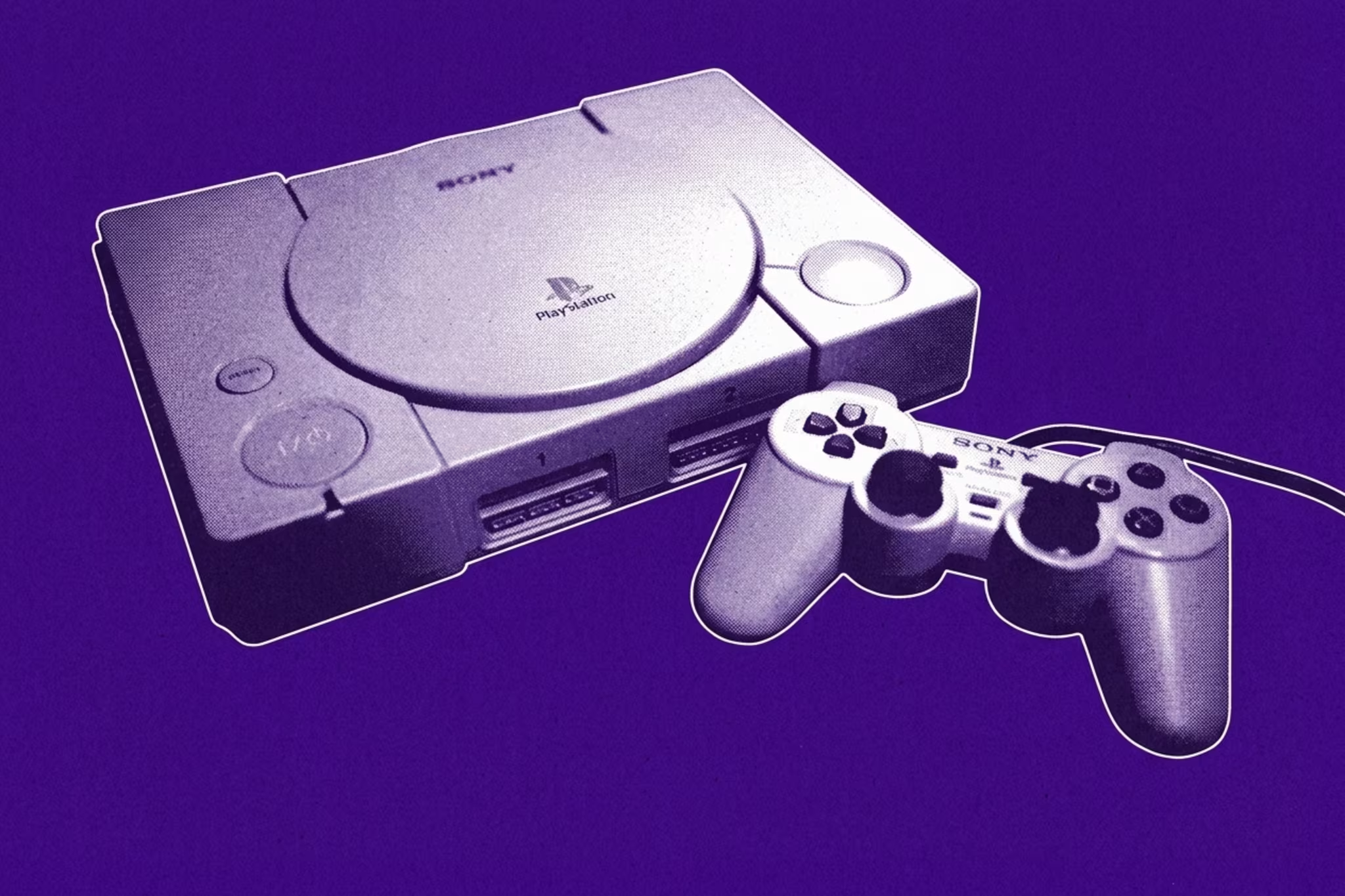
A few years later, using solely the CD format, which had come a long way since 1991, Sony released the PlayStation in Japan in 1994 and then internationally in 1995. Sony emphasized 3D graphics, real audio, developer-friendly tools, and lower manufacturing costs. During that time, Nintendo developed and released the N64; this is where Nintendo made its first big mistake. Instead of switching to disks like everyone else, Nintendo decided to stick with the more archaic cartridge format. While there were some perks to doing so, the cons outweighed the pros. Cartridges held less memory, they cost more to make, and they needed longer production lead times.
In the end, while both the Nintendo 64 and the PlayStation enjoyed varying levels of success in sales and game libraries, the PlayStation greatly outsold the N64, 102 million units to 33 million. Both companies are still going strong, but the PlayStation and its future incarnations became the leading piece of gaming technology for years to come. Nintendo wouldn’t catch up until the advent of the Nintendo Switch, which still can’t match the PS5's gaming power.