By Christopher Turner
In 2001, a lanky 14-year-old named Aubrey Graham walked into an audition room in Toronto hoping to land his first acting job. Producers of Degrassi: The Next Generation had already seen hundreds of school-aged actors as they searched for the young cast of their revival of the beloved Canadian teen franchise, but there was one role they were having particular difficulty filling: Jimmy Brooks, a popular basketball player from a wealthy family. They were having trouble finding someone who had enough confidence to convincingly be one of the cool kids, but also enough warmth and vulnerability to become something much more complicated. “We couldn’t find somebody who had the right charisma, warmth and vulnerability that we were looking for,” Degrassi co-creator Linda Schuyler told CBC in 2023, more than two decades after the audition.
Then Aubrey Graham sat down to read.
He finished reading the scene and was met with silence, which seemed to terrify the inexperienced teenager. “He looked around—it was his first audition—and he said, ‘Oh, I’m sorry, did I do something wrong? Can I do it again?’” Schuyler recalled. “And we said, ‘No, no, it’s fine. That’s good, thank you very much.’”
Things got even more awkward when Graham stood up to leave and accidentally snagged a light stand, causing it to wobble before a production assistant managed to grab it. He shook everyone’s hands, repeatedly thanked them for having him and politely backed his way out of the audition room before closing the door behind him. “There were four of us behind the table,” Schuyler remembered. “We all looked at each other and said, ‘We have just found our Jimmy Brooks.’”
Nobody sitting in that room could have understood exactly what they had just found.
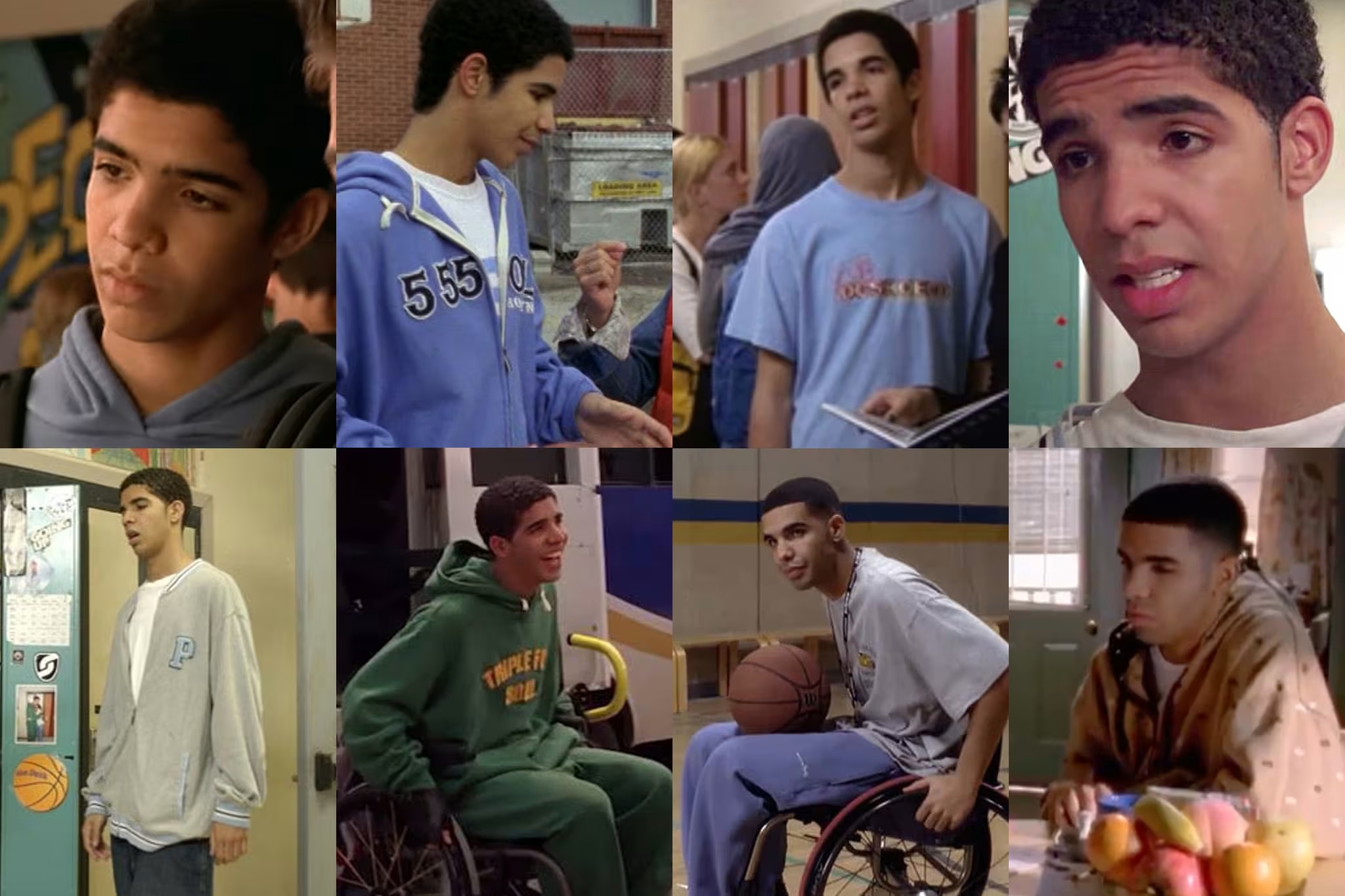
Over the next eight years, millions of viewers would watch Graham grow up as Jimmy Brooks on Degrassi: The Next Generation, the Canadian teen drama that specialized in awkward moments, difficult conversations and storylines that other television shows aimed at young audiences were often afraid to touch. Jimmy would evolve from a wealthy and popular Grade 8 basketball player into one of the show’s most beloved characters, surviving a school shooting that left him paralyzed and then navigating the complicated reality of everything that came after it.
At the same time, the teenager playing him was quietly beginning to construct another identity. During the day, Graham was filming Degrassi in Toronto; at night, he was writing songs, recording music, making mixtapes and trying to convince people to take an aspiring rapper named Drake seriously. Today, his eventual rise can feel almost inevitable, but there was nothing inevitable about the nervous teenager sitting in that Toronto audition room in 2001.
Before OVO, the Grammys, sold-out arenas, rap beefs, Billboard records and global superstardom, there was Jimmy Brooks. And in many ways, Jimmy Brooks prepared Drake for Drake.
Before Jimmy, there was Degrassi
By the time Aubrey Graham auditioned for Degrassi: The Next Generation in 2001, he was walking into a Canadian television institution with a history stretching back more than two decades.
The Degrassi franchise was created by middle school teacher Linda Schuyler and her producing partner Kit Hood, beginning with a collection of standalone short television films that included Ida Makes a Movie, which premiered on CBC on December 8, 1979. Those films eventually evolved into The Kids of Degrassi Street, but the franchise truly became a cultural phenomenon with Degrassi Junior High, which premiered on CBC in January 1987.
Unlike the glossy American teen dramas that would eventually dominate television, Degrassi Junior High looked like the schools its young audience actually attended. Its amateur teenage actors looked and dressed like real kids, while its characters dealt with difficult subjects—puberty, peer pressure, teenage pregnancy, abortion, suicide—with a realism that rarely slipped into the exaggerated moralizing common to youth television at the time. The approach resonated with viewers: Canadian audiences reportedly climbed as high as 1.6 million, the series eventually aired in more than 40 countries, and it won eight Gemini Awards during its run. The franchise continued with Degrassi High (1989–1991), followed by the post-graduation television film School’s Out (1992) and the non-fiction docuseries Degrassi Talks (1992), before going quiet in the early 1990s.
Almost a decade later, while Schuyler and longtime Degrassi writer Yan Moore were discussing the possibility of a reunion special, they realized that Emma—the daughter of Christine “Spike” Nelson, whose teenage pregnancy had been one of the original show’s landmark storylines—would now be old enough to enter junior high herself.
Rather than simply revisiting the past, Schuyler and Moore saw an opportunity to introduce an entirely new generation of students while also allowing characters from the earlier series to return as adults. The idea became Degrassi: The Next Generation, which CTV greenlit in 2000 before producers began searching Toronto for the young actors who would populate the fictional Degrassi Community School.
More than 600 school-aged children would eventually audition for the series, including a teenager named Aubrey Graham.
Casting Jimmy
Aubrey Graham was raised primarily by his mother, Sandi Graham, after his parents separated when he was five. He spent parts of his childhood in Toronto’s west end and later Forest Hill, where he attended Forest Hill Collegiate Institute before eventually transferring to Vaughan Road Academy. His father, Dennis Graham, was a drummer who had played alongside Jerry Lee Lewis, which meant music was already present in Aubrey’s life, but it was television that would give him his first real opportunity in entertainment.
Actor Stephen Brogren, already familiar to generations of Degrassi viewers as Archie “Snake” Simpson, helped connect young Graham with the show’s casting team. Graham had no professional acting credits to his name, but Schuyler has repeatedly recalled that there was something immediately compelling about him. “There was a charisma and a warmth to that face and that beautiful smile,” she once said, while in another interview she described the quality even more simply: “There was a vulnerability about him; the camera adored him.”
More than 20 years later, Drake would reveal there was another side to the story of his now-famous first audition. In a 2023 voice memo shared on Instagram, he admitted that he had gotten high shortly before walking into the room, after succumbing to peer pressure while hanging out with other kids. “I go back to this day when I was like 13 or 14. I had an audition for a TV show that ultimately shaped my life,” he explained. “Before my audition, I went to this kid’s house. And I, out of, I guess, a desire to be accepted, I would succumb to peer pressure, and I got high with these kids right before my audition.”
The memory stayed with him in a surprisingly existential way, with Drake admitting that he had occasionally wondered whether something had actually gone wrong that day and whether the extraordinary life that followed could somehow be imagined. “Maybe I’m still high, maybe I’m in some coma. And this is just, like, me playing out my ideal life,” he said. “That concept has stuck with me for a lot of years.”
The two recollections offer strangely complementary versions of the same life-changing afternoon. Schuyler remembers discovering a teenager with exactly the charisma, warmth and vulnerability the producers needed, while Drake remembers being an insecure kid desperate enough to fit in that he got high before the first major audition of his life.
Whatever was happening inside Graham’s head that day, the producers had found their Jimmy Brooks.
Becoming Jimmy Brooks
“I didn’t have a great time in high school—I just didn’t really fit in,” Drake recalled in Lisa Rideout’s 2025 documentary Degrassi: Whatever It Takes. “And then, one day, my mom called me and told me, ‘You got the role.’ And I just grabbed my bag and left. What a wild journey that started.”
Degrassi: The Next Generation premiered on CTV on October 14, 2001, introducing audiences to a new ensemble of young students navigating adolescence at Degrassi Community School. Graham made his first appearance as Jimmy Brooks a few weeks later, in the Season 1 episode “Family Politics.” Initially, he appeared to fit neatly into one of television’s most familiar high-school archetypes: he was handsome, athletic, popular and wealthy, played basketball, dated popular yet insecure overachiever Ashley Kerwin and spent much of his time hanging around with his best friend, Spinner Mason.
Of course, this was Degrassi, where familiar archetypes rarely remained uncomplicated for long. Throughout his first three seasons, Jimmy slowly emerged as much more than the stereotypical high-school jock: viewers saw his seemingly privileged home life complicated by frequently absent parents, watched his relationship with Ashley become increasingly messy and saw his friendship with the more impulsive Spinner repeatedly tested. Underneath the confidence of the popular basketball player was someone sensitive and creative, with growing interests in art and music as well as insecurities about the expectations other people had placed on him. That emotional complexity helped make Jimmy an important part of the show’s ensemble. Unlike Spinner, whose impulsiveness frequently got him into trouble, Jimmy often became the more grounded presence in their friendship, and while he could be stubborn, jealous and occasionally immature, there was an underlying decency to the character that made viewers trust him and root for him.
As Degrassi: The Next Generation grew from a Canadian revival into an international success, Jimmy Brooks became one of the show’s most recognizable characters. Then, during the fourth season, Degrassi fundamentally changed his life.
The gunshot that changed everything
To many fans, no episode of Degrassi: The Next Generation remains more unforgettable than “Time Stands Still,” the two-part episode that aired in October 2004 and tackled school violence with a seriousness rarely seen on television aimed at young audiences.
Schuyler has said she began thinking about incorporating a school-shooting storyline following the 1999 Columbine High School massacre, but it would take several years before the writers felt prepared to tackle the subject. When the cast finally gathered for the read-through, Schuyler recalled a stillness in the room and said she herself felt physically sick as everyone discovered where the story was heading.
The episodes centred on Rick Murray, a troubled student who had previously physically abused his girlfriend before returning to Degrassi, where he became the target of relentless bullying and humiliation. After a cruel prank was played on him in front of the entire school, Spinner andschool bully Jay Hogart manipulated Rick into believing Jimmy had been responsible, despite the fact that Jimmy had actually been one of the few students to show him kindness. Rick returned to school with a gun, confronted Jimmy in a hallway and shot him in the back before he himself was killed during a struggle with another student.
The shooting permanently changed one of the show’s most popular characters, and Graham himself had no idea it was coming. “I didn’t know about the end of ‘Time Stands Still’ until I was in the read-through,” Drake recalled in Degrassi: Whatever It Takes. “Somebody told me to mentally prepare for today’s script, but they didn’t tell me there was going to be a shooting at the school and that it was me.”
As the young cast realized what was going to happen, the read-through became intensely emotional. “There was shock and sadness. We were holding hands and crying in the read-through,” Drake said. “It was dark. It was intense.”
Jimmy survived the shooting, but the writers made the consequential decision not to give the character an easy recovery or eventually return him to the life viewers had previously known. The shooting left Jimmy paralyzed, and rather than treating his disability as the subject of a single “very special episode” before moving on, Degrassi committed to exploring the consequences of the shooting over the seasons that followed.
In the following seasons, viewers watched Jimmy navigate rehabilitation, anger, frustration, depression, relationships and, eventually, a degree of acceptance as he learned to live his life in a wheelchair. His disability became part of his character without becoming the entirety of his character; Jimmy was still allowed to date, joke, paint, fall in love, fight with his friends and imagine a future for himself.
For Graham, however, the storyline initially raised difficult questions about what playing Jimmy would now require. “My question was ‘What now? I don’t want to spend the rest of my years in a wheelchair,’” Drake recalled. “‘I want to be with everyone else, what do you mean?’ Unfortunately, that’s not how life goes.”
The storyline also forced the young actor to stretch dramatically. “A lot more went into playing Jimmy after I got shot, for sure,” he explained. “It gave me something to study. It gave me homework.” Looking back on the uncompromising nature of the storyline, Drake credited exactly the quality that had made Degrassidistinctive from the beginning: “I think that was why I think that show’s so good, because life is fucked up and they weren’t afraid to let you know that.”
Yet behind the scenes, Graham’s complicated feelings about Jimmy’s wheelchair apparently didn’t disappear entirely, particularly as the other career he had begun pursuing started to become increasingly important.
The wheelchair controversy
In 2021, as Degrassi: The Next Generation celebrated the 20th anniversary of its premiere, writer James Hurst made a remarkable claim about Graham’s relationship with Jimmy’s wheelchair during an oral history published by The A.V. Club. According to Hurst, the production once received a letter from a Toronto law firm stating that Graham would not return for Season 6 unless Jimmy’s injury was healed and the character was allowed to walk again.
“There was a letter from a law firm in Toronto, and it was from Aubrey,” Hurst recalled. “It was an odd letter that said, ‘Aubrey Graham will not return to Degrassi season six as Jimmy Brooks unless his injury is healed, and he’s out of the wheelchair.’”
Hurst said he asked Graham to come into the production office, where the actor denied knowing about the letter. Rather than dwelling on where it had come from, Hurst asked him directly how he felt about continuing to play Jimmy in a wheelchair, and Graham’s reported answer revealed just how conscious he had already become of the way Jimmy Brooks, and particularly the character’s wheelchair, was perceived by the people around him in hip-hop.
“All my friends in the rap game say I’m soft because I’m in a wheelchair,” Hurst recalled Graham telling him. Hurst’s response has since become legendary among Degrassi fans: “Well, tell your friends in the rap game that you got shot. How much harder can you get? You got shot, and you’re in a wheelchair.”
Graham ultimately stayed on the show and Jimmy remained in his wheelchair, but Hurst’s recollection is fascinating when viewed through the lens of everything that came next. The character that had given Graham his first taste of fame was apparently beginning to collide with the identity he was trying to establish in music as Drake; Jimmy Brooks had given him a career, but Graham was already wondering whether Jimmy Brooks might make it harder for people to believe in Drake.
Double life
By the mid-2000s, Graham was effectively leading two professional lives, spending his days filming Degrassi in Toronto as Jimmy Brooks while devoting his nights to writing, recording and trying to build a completely separate career as Drake. The distinction between the two identities became increasingly visible to the people around him as music evolved from a side project into an increasingly serious pursuit that consumed virtually every hour he wasn’t working on the show.
According to Degrassi: The Next Generation executive producer Stephen Stohn, Graham sometimes slept in his dressing room because he had spent the entire night making music before returning to set the following morning. He used money earned from acting to help finance his recordings and manufacture physical CDs, and rather than waiting for a record company to discover him, he began distributing the music himself as he tried to create enough local momentum to force people to pay attention.
Perhaps most revealingly, Graham seemed determined to keep those two identities separate. Even as Degrassi producers recognized his musical ambitions and looked for opportunities to incorporate them into Jimmy’s storyline, Graham resisted allowing the show that had made him famous to become a vehicle for introducing Drake.
“He would play us mixtapes and we really tried to talk him into letting us use some of his music in the show and getting him to rap and sing,” Stohn told Page Six in 2021. Producers eventually pushed to make music a larger part of Jimmy’s storyline, but according to Stohn, Graham initially stood “firm.”
“His music side was one side of his career and the acting was another,” Stohn said. “We did manage to get him to do some rap, but it did take some convincing.”
In 2006, Drake released his first mixtape, Room for Improvement, reportedly pressing and distributing thousands of physical copies while using his own money to help fund the project. Radio stations and major labels weren’t suddenly clamouring to sign him and, to much of the public, Aubrey Graham remained far better known as the kid from Degrassi, but he continued recording.
The following year, Comeback Season arrived and began to change the trajectory. The music video for “Replacement Girl,” featuring Trey Songz, became the first from an unsigned Canadian rapper to appear on BET, giving Drake a level of exposure that suggested his ambitions might not be as improbable as they had once seemed.
What makes this period especially fascinating in hindsight is that there was never a clean moment when Aubrey Graham stopped being an actor and suddenly became a rapper. For several years, Jimmy Brooks and Drake existed simultaneously, with one identity providing Graham with a steady career and a recognizable face while the other represented the future he was increasingly determined to pursue.
Eventually, those two lives became impossible to balance.
The end of Jimmy Brooks
By 2008, Graham’s music career was becoming increasingly difficult to contain within the life he had built on television. Jimmy graduated from Degrassi at the end of Season 7—later than many of his original classmates because his rehabilitation from the shooting had forced him to repeat a year—and Graham’s time as a regular cast member was coming to an end as well. He would return once more as a guest star during Season 8, appearing alongside Jimmy’s longtime best friend, Spinner Mason, to bring the character’s story to a close.
His final appearance as Jimmy Brooks came in the Season 8 episode “Lost in Love: Part 2,” which aired in Canada on January 18, 2009. There was no dramatic farewell or elaborate sendoff for the future superstar; Jimmy simply moved forward with his life, while the actor who had played him for most of his adolescence prepared to do exactly the same thing.
In retrospect, the timing seems almost impossibly cinematic. Less than a month after Graham’s final Degrassi episode aired in Canada, Drake released So Far Gone, the mixtape that would dramatically alter the trajectory of his career. “Best I Ever Had” became a massive hit, while “Successful,” featuring Trey Songz and Lil Wayne, helped push him further into the centre of hip-hop as Lil Wayne and Young Money entered the picture.
For eight years, Aubrey Graham had been recognizable to millions of television viewers as Jimmy Brooks, but within an extraordinarily short period of time, Drake began to eclipse the character who had made him famous. The transformation looks almost seamless when compressed into a career retrospective, yet Graham was leaving behind a steady television job that had shaped much of his adolescence for a music industry that had given him no guarantee that his ambitions would work.
The gamble paid off spectacularly, but one part of his old identity proved considerably harder to leave behind.
Could hip-hop take Drake seriously?
Drake’s acting career inevitably followed him into hip-hop, where his years playing Jimmy Brooks—and particularly his years playing him in a wheelchair—became an easy way for critics to question whether a former Canadian teen actor could possess the kind of authenticity traditionally demanded by rap. His years as “Wheelchair Jimmy” became an obvious reference point for anyone looking to question Drake’s credibility, which makes Hurst’s recollection of how Graham had worried years earlier about what his rapper friends thought of Jimmy’s wheelchair seem almost prophetic. His relationship with Degrassi, however, appeared to evolve as his success grew. Rather than trying to erase Jimmy Brooks from his biography, Drake seemed increasingly comfortable allowing the character to become part of his mythology, referencing the show in interviews, laughing along with the jokes and occasionally reminding people that the global rap superstar they were watching had once spent his days filming a Canadian teen drama.
In July 2017, he even posted an $8.25 residual cheque from the series on Instagram, joking, “Degrassi money still coming in don’t sleeeeeeeep,” alongside emojis of money bags and flying cash. By that point, Drake had little left to prove about whether a former Degrassi actor could succeed in hip-hop, and the part of his history that had once complicated his attempts to be taken seriously could finally be treated with affection.
The following year, he made that reconciliation impossible to miss.
Jimmy Brooks never left
In June 2018, Drake released the music video for “I’m Upset,” turning what had received a somewhat mixed reaction as a song into one of the most memorable celebrations of his Degrassi past.
Directed by Karena Evans, the video was essentially a Degrassi: The Next Generation reunion disguised as a Drake video, bringing together a long list of familiar faces including Shane Kippel, Nina Dobrev, Stacey Farber, Jake Epstein, A.J. Saudin, Adamo Ruggiero, Lauren Collins, Cassie Steele, Ephraim Ellis and Stefan Brogren, along with Jason Mewes and Kevin Smith. Drake and his former castmates returned to the halls of Degrassi Community School for a reunion party filled with inside jokes and references to the series before the closing credits paired original footage from The Next Generation with new clips of the cast as the show’s familiar theme song played.
For millennials who had grown up watching Degrassi, the video felt like much more than a nostalgic class reunion. Drake had become one of the biggest stars on the planet and could have constructed a music video around virtually any fantasy or chapter of his life, yet he chose to return to the fictional high school where millions of viewers had first met him.
There was also something fitting about the fact that the same chapter of his life that had once complicated his attempts to establish credibility as a rapper had become something he could now celebrate completely on his own terms. Years earlier, Graham had resisted allowing Degrassi to become a vehicle for his music; now, as one of the biggest artists in the world, Drake was bringing Degrassi into his music himself. Jimmy Brooks wasn’t an embarrassing footnote that needed to be hidden from Drake’s history; he had become part of the origin story.
Jimmy Brooks prepared Drake For Drake
Nobody’s post-Degrassi life has looked anything like Aubrey Graham’s. As Drake, he became one of the most commercially successful recording artists of his generation, building a global brand while becoming deeply intertwined with the modern cultural identity of Toronto. Yet after all the records, awards, tours, feuds, memes and accolades, Jimmy Brooks has never completely disappeared from the story—and that doesn’t diminish Drake’s extraordinary success so much as make the route he took to get there even more unusual.
It would be too simple to argue that Degrassi somehow created Drake, or that the sensitivity and vulnerability that later became signatures of his music can be directly traced back to Jimmy Brooks. What can be said is that before Drake built a career around translating heartbreak, insecurity, ambition and complicated relationships into entertainment, Aubrey Graham spent eight formative years performing complicated emotions in front of a television camera. Before millions of fans began dissecting his relationships through his lyrics, viewers watched every week as Jimmy navigated breakups, friendship, jealousy, trauma and uncertainty.
Degrassi gave Graham his first audience, years of experience in front of a camera and an unusually early education in what it meant to be recognized by strangers. It also gave him an identity powerful enough that he would spend part of his early music career worrying about whether he could escape it, only to eventually realize that he didn’t need to escape it at all.
In many ways, Jimmy Brooks prepared Drake for Drake.
The funny thing about origin stories is that they tend to look obvious once you already know how they end, which makes it tempting to look back at the charismatic teenager Linda Schuyler remembers auditioning in Toronto and imagine that everyone must have seen something extraordinary coming. Of course the kid became Drake; of course the camera adored him; of course he eventually became one of the most recognizable musicians in the world.
Except nobody knew any of that in 2001. There was no OVO, no “6 God,” no Grammys, stadium tours, Billboard records or billions of streams; there was simply an awkward 14-year-old at his first audition, worried that the silence following his reading meant he had done something wrong. When he finally left the room, nearly knocking over a light stand on his way out, the four people sitting behind the table looked at one another and agreed that they had found Jimmy Brooks.
It would be years before the rest of the world discovered Drake.