If you were around in the mid-to-late ‘00s, specifically if you were of clubbing age, there was a special kind of magic around the nascent dubstep scene. It didn’t happen in a vacuum—it drew from grime, garage, dub (of course), even a touch of jungle—but it sounded like nothing else on earth. I vividly remember talking to a friend of mine who was around for the rise of acid house in the late ‘80s and he said it sounded like it had come from space. I didn’t know what he meant at the time, not until I heard dubstep for the first time. I’m sure every generation feels like that with some new sound or other, but dubstep truly felt different.
For Lauren Martin, former Features Editor at DJ Mag and author of Aftershock: The Seismic Impact Of Dubstep, it was different. Her take is that dubstep was the last time we were excited about the future. “We used to be excited about what the future would sound like and look like and feel like to live in,” she says. “And now. I think we don’t want the future because it doesn’t seem appealing anymore, and that is why there is so much overt nostalgia.” That, Martin explains, is why nostalgia—which has always been part of the cycle of musical trends—is now the dominant force.
With Aftershock, Martin speaks to 28 of the key figures who came together to draw up the blueprints of dubstep and the infrastructure that supported it. One thing she says she hoped to correct with this book was the way the stories were told at the time. In making it an oral history, Lauren Martin’s role is more facilitator than narrator, writing only the intro, outro and glossary. The rest was in the editing. This, she’s keen to point out, is their story and one that over the years has been unevenly told and, in some cases, lost to the deleted websites and blogs paved over by platform capitalism.
We spoke with Lauren Martin about the painstaking work that went into compiling the book, revisionism, storytelling, archiving and more.
Aftershock: The Seismic Impact Of Dubstep is out now on Velocity Press.
COMPLEX: You’ve spoken before about the lack of coverage of dubstep during its peak, and how even the coverage that did exist was often niche and sporadic. Why do you think that was?
Lauren Martin: It’s a good question. I’ll take it from two angles: from how the press act, and then the general population fandom side. So, when that [VICE feature, The Oral History of Dubstep] got published in 2015, the popular thing was really this new era of post-dubstep and house was just huge. So, granted, it’s a few years after the Joy Orbisons and Hessle Audios were the kings of this scene and everything. Culture had moved past caring about dubstep in many respects. Also, because by the 2010s into 2015, when I did publish it, it had gone through five years or so of being in the cultural doldrums. So yes, there has always been a very committed international underground circuit that the OGs and new people played on. You get parties in the UK, across Europe, even as far as Japan, and a reasonably healthy scene in the U.S., but it wasn’t really getting press coverage because of the Skrillexes of the world arriving in 2010. I feel like it lost its edge and its cool, and other things were coming to the forefront and just were more interesting to the young music fandom at the time.
It’s interesting that you bring up the American perspective, because I was curious about how that would factor into the story. In the introduction, you mention that your own views have softened, and you also speak to people like Joe Nice and Rusko, which I thought brought a really good balance. What kind of internal conversation did you have with yourself around that? Did you go into the book with a particular perspective or angle that changed as you worked on it?
So on the American point, people like Joe Nice—who is American and truly launched dubstep in the United States—he is the OG of that. Massive props to him. Then you have the Brits that took off in the States quite quickly, like Rusko. In terms of tackling the American side of it, I was more interested in covering the actual genesis of the sound in as much granular detail as humanly possible. To do that, I had to just focus on the UK and the people that genuinely interacted with the UK in those years, like Joe Nice. So that’s why he’s the sole American, really. I wanted to make it quite clear that this is a British sound first. It’s not to the same degree of social and political intensity, but in the same way that Black Americans feel correctly aggrieved that people think techno is white and German, I wanted to gently correct any misconceptions that this is an American genre. It’s very much not. So it’s more about focusing on the origin story in much greater detail. And to do that, I couldn’t possibly take it in a direction where it also goes to the States and have it in one book. So it’s 340 pages or something and it barely goes to the States. There is such a wealth of British storytelling to do, and I am not close enough to the changes that were happening in the States to give a fair account of that. Somebody in the U.S. who was part of that explosion and that experience would be better placed to cover that.
Yeah, I really appreciated that, because the idea that Americans “ruined” dubstep was such a prevailing narrative. I never felt that was particularly fair, so it was good to see the book offer a counterpoint to that.
I would day that something that I also wanted to get across is not to have an overt disrespect or disregard for people who have taken it in a different direction. I think there is a broad misconception that “The Americans ruined dubstep,” which I’m sure some of the OGs to this day perhaps privately feel and just don’t say. I’m not going to discount that they might sincerely feel that. As the book takes quite a bit of time to show, especially towards the latter part, there’s actually a lot within British culture that engenders those changes. I think it’s Martin Clark that says the very, very early seeds of what would be considered brostep now was already present in the early FWD>> years of the more breaks-led sound. If you listen to old Caspa tunes under his Quiet Storm alias or [production duo] Search & Destroy, these kinds of sounds are very mid-range technical, with a really quick, piercing sound. I wanted to tease that out and say it’s not as simple as saying the Americans came and changed it. Those changes are very much also coming from the British side.
What’s interesting to me about that time is that, certainly in the 2000s, a lot of the coverage was on blogs and forums. Presumably, quite a lot of it’s gone. How did you tackle that when researching?
Martin Clark’s blog, Blackdown Soundboy. His blog is absolutely invaluable—it’s still up in full. I think I actually sat and read the entire blog from start to finish to refresh myself because Martin Clark was there at the time; he was the live reporter from the FWD>> DMZ dancefloor. A lot of the people were being interviewed on Martin Clark’s blog long before they had any sort of media training, so you’re getting some very raw, real answers from people and also very, very nerdy, specific nuggets of information that I otherwise would not have known from other retrospective pieces. So Martin Clark’s blog is invaluable. I would say the Dubstep Forum on the Wayback Machine is also interesting in its own regard, but there are also sections of the forum, which [Dubstep Forum founder] Ivan Dubway admits in the book to some degree, where it’s completely devoid of the actual subject of dubstep and became its own beast. I also wanted to show that the music industry and underground music used to be very different. This is physically how they made it happen. I was interested in that kind of granular detail because I feel like most young music fans would be completely unaware of how that comes to pass.
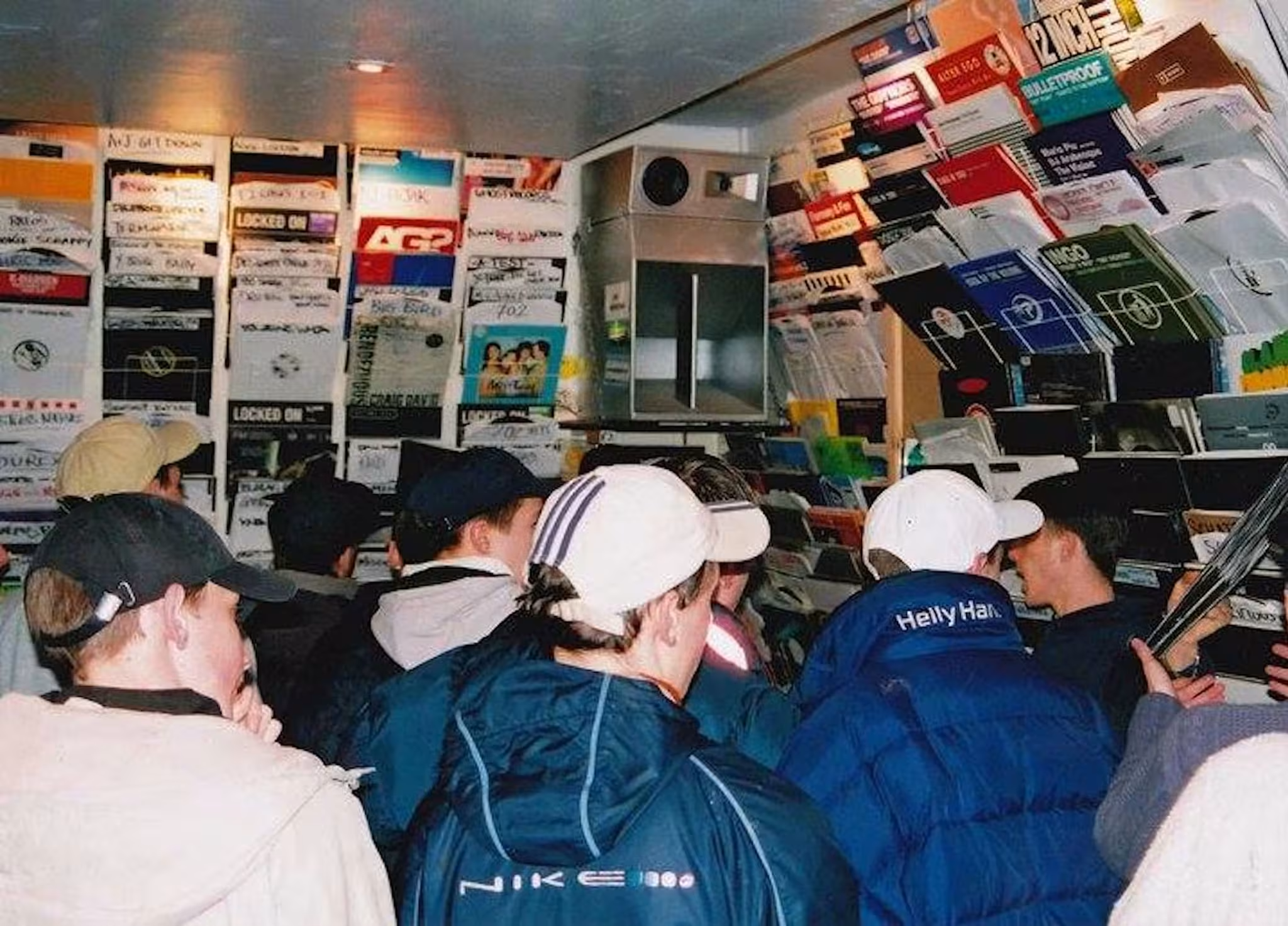
Also, one of the most fundamental questions that ever gets asked is: how does something start? Where does it come from? So to tell the origin story, you have to tell the story of the infrastructure of London. I cannot for the life of me remember who said this, and possibly you know because they were talking about grime. So if I can remember who said this, I’d love to credit them. But somebody said that, “grime is not just the name of a genre of music”. Grime is also the description of a very specific culture in a time and place. Grime is nothing without Jammer’s Basement, without the Déjà Vu roof, pirate radio, Sidewinder cassettes, PlayStations and the mobile phones at the time. All this stuff is grime. So yes, technically, you can make grime music today, but the reason it doesn’t feel like Dizzee and Wiley on Sidewinder is because grime was also the conditions of the moment. I wanted to do something similar with dubstep. Technically, you can make bassy music today, no problem, and say that you love dubstep. I wanted to give dubstep that same gravitas. It was a moment in a culture and a physical infrastructure that in many respects does not exist today, and that’s what also makes it special.
Do you think it was the presence of all that infrastructure—which you now suggest is missing, or perhaps no longer needed—that made dubstep the last truly future-facing movement?
See, that’s quite a deep question. In terms of true future-shock, new genre genesis chat, I would say part of the reason is that we used to be excited about what the future would sound like and look like and feel like to live in. Now, I think we don’t want the future because it doesn’t seem appealing anymore, and that is why there is so much overt nostalgia. That is why the biggest pop star to break through in the last five years is Charli xcx—she’s basically referencing Uffie and indie sleaze. If anything, indie sleaze is a really good example of this because it’s the opposite of grime and dubstep in that regard. Dubstep was named by the people in the scene, grime was named by the press, and grime took the slur and made it their own. It’s the same with jungle: jungle was originally a racist term from the press, and the junglists took it to themselves. Whereas indie sleaze was coined as a retrospective naming of basically blog house. So even the stuff that we think is cool, new, edgy stuff is basically very nostalgic. I think, broadly, there is a malaise about the future that it trickles down into music culture and music curation.
Something I’ve been thinking about lately is the digital versus physical way of storing things. As someone whose work exists in both worlds, what’s your take on how best to preserve these things? Have you lost any particularly cherished pieces to the mists of the internet?
What’s really come to pass in the last five years is that platform capitalism has completely transformed the digital space and how things are archived. Nothing makes my gut sink than writing for a culture website for years, being proud of that work, and then going on the URL and it’s dead because the publication was bought out and they just deleted the archive. That is really disheartening. They used to say the internet is forever and it’s absolutely not forever. We have to be very, very proactive about how we archive things. We need to come up with new, independent systems for archiving that circumvent the excesses of platform capitalism. Are you physically building your own website? How are you hosting that website? You need to get quite nerdy about that.
More broadly, I wanted to try and make something that was as physical as possible, that people could hold in their hands. There’s also so much imagery in the book. It’s not just about beautiful photographs; it’s the rave flyers, too, which are such an important part of the story. I got them professionally scanned and I left them in there, in the book, with their torn edges and their creases, because I want people to see that these were physical items. That’s why I’ve scanned demo CDs and tracklist inserts, because I want the physical media that goes with the physical infrastructure that I talked about. I wanted to be able to put that across in the book as well.
One thing I was curious about as well is whether, as you were asking these questions and gathering all these stories, there was anything that really changed your perception or took the book in a different direction that you weren’t expecting?
Good question. Something that shocked me would be how few people actually operated the dubstep scene. When you think about the amount of music that’s become popular, you just assume this is a large group of people. Actually, it really comes down to Neil Jolliffe and Sarah Lockhart who started Ammunition. I thought it was very striking how straight out the gate Neil Jolliffe and Sarah Lockhart built an actual infinite loop ecosystem to play, release, manufacture, and distribute music. And they did it completely together. I was so struck by how visionary they were, doing that and how they did it basically for zero financial gain. They were just devoted to the music.
Do you think that’s another reason there was perhaps a bit of bitterness towards the end, when things had started to get away from them?
Yeah, I wouldn’t deny that some people probably do feel a bit bitter—and that’s fine, people are entitled to their feelings—but I’d say there was more of a melancholy or a shock. These were people making music with zero interest in being famous, and there are so many examples throughout the book of people turning things down or just not functioning in a way that feels like they want to brand whatever they’re doing. They were truly not thinking of this as being even a career. There are examples throughout the book of people who worked in carpentry, or put ads on the side of black cabs. This was not their absolute bread and butter. The way I describe it is the sound became famous when they didn’t want to be or didn’t want to move in that direction. So something that they made went off and became famous without them would have felt like it was a bit of a personal betrayal. I can imagine that that stirs up some quite sincere feelings.
I completely agree. And honestly, I could have a whole conversation with you about grime MCs on techno and electro, but I’m aware that time is an issue and that could easily derail it. Is there anything you want to add?
I hope that this book puts across the power of the fact that not even 50 people did this. I interviewed 28, but at a push, the early dubstep scene was like 50, 60 people, right? There wouldn’t have been more than that. If I can at least have half of that scene on the page, to talk very sincerely about just how fucking good they are, then I’ve done my job. I want other people to read this book and see that too. I want those 50 or 60 people to be treated with the gravitas that they deserve. We talk about Wiley as this unbelievable sonic innovator, right? And he imagined grime in his head and put it out there. Mala is the same, Coki’s the same—all these people should be spoken about in the same breath. That’s what I hope to do.