Key Takeaways
- This ranking traces Chicago rap from early hip-house and rapid-fire pioneers through the global rise of drill and today’s melodic underground.
- Kanye West. tops the list as the GOAT of Chicago rap. Also near the top are legends like Chief Keef, Lil Durk, Common and Juice WRLD.
- The 50-artist countdown weighs technical skill, catalog strength, commercial impact, and influence, placing platinum stars beside cult heroes across generations and neighborhoods.
Going as far back as the Great Migration, Chicago has been an epicenter of much of Black music, from gospel to blues to house and hip-hop.
In fact, Chicago's connection to hip-hop predates its official "birth" in the Bronx in 1973. Five years prior, the legendary Chess Records released "Here Comes the Judge" by Pigmeat Markham, a comedy record now regarded as one of the earliest precursors to rap. When hip-hop did emerge nationally in the late '70s, Chicago found its own foothold through Lord Cashus D, who led the city's chapter of the Universal Zulu Nation.
The foundations of the Chicago hip-hop scene we know today were built on the backs of a litany of unsung heroes. On the South Side, the group Ten Tray, led by the rapper Jitu the Jugganaut, became the first Chicago crew to sign with a major label in 1991. On the West Side, rapper JD Walker emerged as an early champion, influencing acts like Crucial Conflict and Lupe Fiasco, while a young Twista—also repping the West Side—was developing the rapid-fire style that would earn him a Guinness World Record for fastest English-speaking rapper in 1992. College radio stations like WKKC and WHPK gave local MCs a consistent platform.
Women from Chicago have been just as instrumental in shaping the city's sound. Originally from Joliet, IL, Da Brat became the first female solo rapper to go platinum, when 1994's Funkdafied sold over a million copies. She and Shawnna, who got her start with Infamous Syndicate, held Chicago down with sharp, technical flows at a time when local artists mostly had to go through labels in the south or on the east coast to get real shine.
By the early 2000s Chicago hip-hop no longer needed coastal co-signers to get the music industry's attention, and credit is due to Kanye West. The rise of Ye, combined with his G.O.O.D. Music imprint, allowed Chicago hip-hop to dominate the spotlight. He revitalized Common and Twista, producing on two of the best albums of their careers in Be and Kamikaze, respectively, and introduced the world to another generation of all-time-great Windy City MCs: Lupe, Rhymefest, and GLC. He continued ushering in new generations of Chicago talent,lending an early co-sign to a teenage Chief Keef and mentoring Chance the Rapper, whose SaveMoney collective became its own launching pad for the city's next wave.
Speaking of Keef and Chance, these two sparked adjacent waves that would go on to define Chicago forever. Drill music—invented by rapper Pac Man—rose from the ashes of the demolished project buildings throughout the city. As gang violence increased in these desperate areas, the music changed. King Louie helped establish the lingo; DJ L and Young Chop came with the sound; and Chief Keef and Lil Durk became the stars. They, among many others, elevated Chicago to become one of the most influential hip-hop cities of the past decade, with drill’s influence going global, from the UK to Ghana.
For every Chicago rapper who broke on a national level, there are two or three greats who remained cult favorites, and thus don't have the commercial footprint that has become a crucial part of the calculus of success. So when putting together a ranking of the rappers from the third-largest city in the United States, you'll find an artist with a platinum plaque sitting right next to a smaller artist who never officially put out an album. So we wanted to be clear about the metrics we considered when debating the 50 greatest Chicago rappers of all time.
1. Skill as an artist; that is, how talented someone is as a technical rapper.
2. Strength of catalog—how artistically successful is the music.In the context of this list, mixtapes and commercial albums were weighted similarly.
3. Commercial impact and influence.
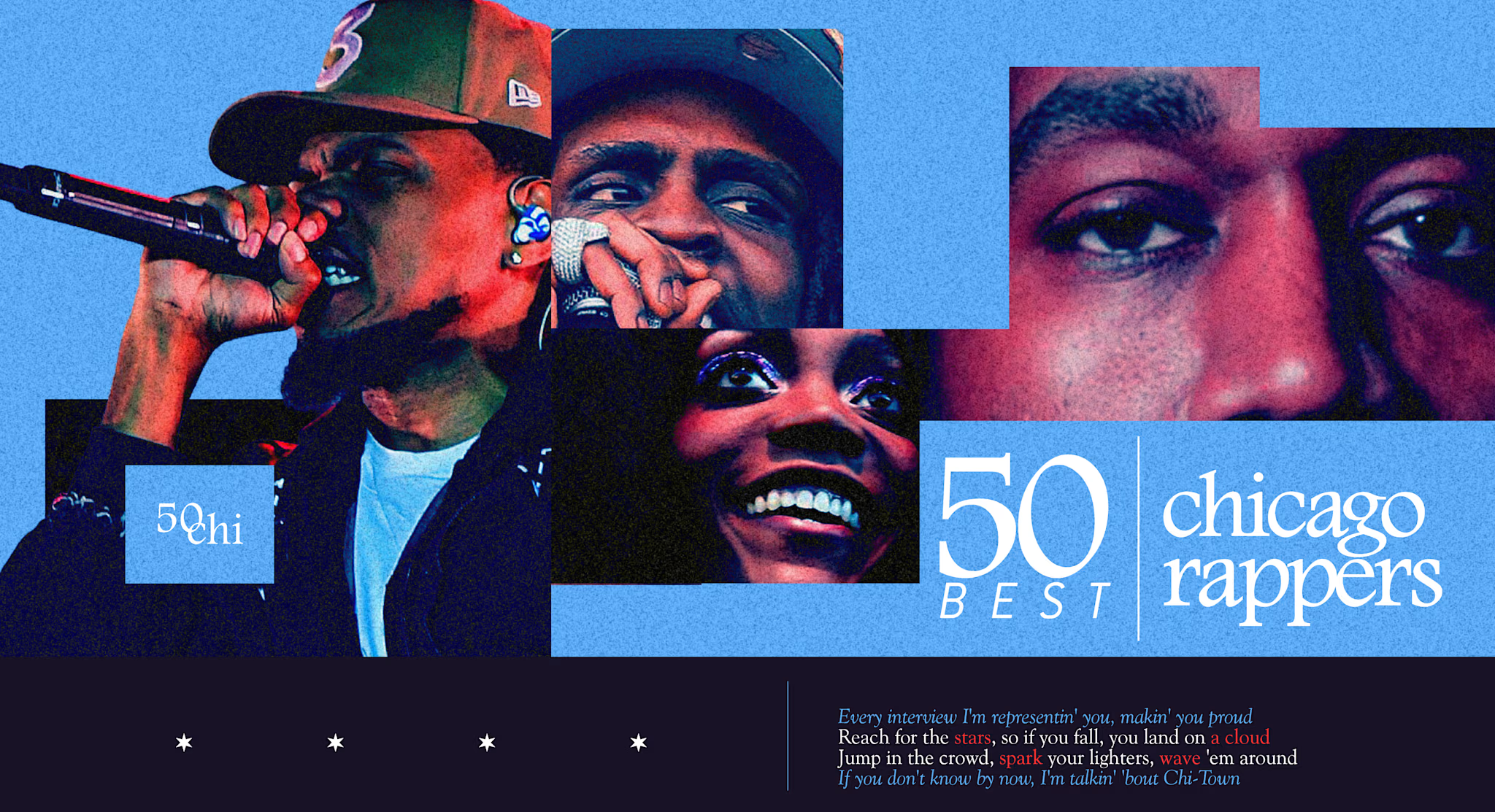
Here are the 50 best Chicago rappers of all time
Shop the Chi-Town Sounds Collection Here
BabyChiefDoIt
Why They Belong: One of the few under-20 rappers today to land a charting song on the Hot 100
Start With These Songs: “Ghetto Love Story”; “Went West”; “Drowned”
Even before he caught his viral hit "Ghetto Love Story," BabyChiefDoIt demonstrated that he had the potential to become the next Chicago rap star. His debut album Zoo Life harnesses the raw Chi-Town energy of a young Chief Keef but dials back the violence. In its place: childlike sensibilities and humor, filtered through the perspective of a kid who got out before the streets got him. —Jordan Rose
CupcakKe
Why They Belong: Made viral sex raps before TikTok
Start With These Songs: “Vagina”; “Deepthroat”; “LGBT”
CupcakKe didn't invent absurdist sex raps, but before Sexyy Red took us to "Pound Town" she used a wild ass imagination and sharp technique to elevate horny bars into comic art. On "Vagina," she served up TMI raps about why being horny meant changing her thongs twice a day. On "Duck Duck Goose," she stacked sharp syntax with punchlines that'll actually induce a screwface. Her raps were gluttonous and, well, a little gross—but the blush-inducing songs were always more than shock value. "CPR" and "Deepthroat" were TikTok anthems before TikTok existed, with 200 million combined Spotify streams to prove it. —Peter A. Berry
Chris Crack
Why They Belong: A rapper who literally cannot stop rapping, dropping songs at a relentless pace
Start With These Songs: “Master P Raised Me”; “Jealousy in Jokes”; “Hoes at Trader Joe’s”
Within the indie rap underground, few have been as prolific or as consistently funny as Chris Crack. The MC came up alongside local indie spitters like Tree and Vic Spencer, though Crack and the latter have since had a public falling out. Still, he’s built a cult following on the strength of his album titles alone. Standouts include 2025's White People Think God Left Them In Charge, 2021's Might Delete Later, and 2020's Haters Forget They Were Fans First. —Will Schube
Dreezy
Why They Belong: One of the most technically adept rappers to come out of Chicago
Start With These Songs: “Body” feat. Jeremih; “Close To You” feat. T-Pain; “Wasted”
Dreezy was already buzzing when she remixed Nicki Minaj and Lil Herbo's "Chiraq" in 2014, creating a verse-of-the-year contender. That freestyle showed she was a pure lyricist, pushing back on the idea that drill rappers couldn't spit. The rest of her career proved more multifaceted, maybe to her detriment. Her 2016 debut album No Hard Feelings saw her play the major-label game, to sometimes mixed results. Even if the early hype never quite delivered, "Body" with Jeremih is still a Chicago classic. —Rashad Alexander
GLC
Why They Belong: Chicago's greatest sidekick, providing a grounded alternative to Kanye's brashness
Start With These Songs: “The End” with Kid Cudi, King Chip & Lady Wray; “Drive Slow” with Kanye West and Paul Wall; “Poe Mans Dreams (His Vice)” with Kendrick Lamar
There's something about Chicago that just churns out Hall of Fame sidekicks, and GLC has made an entire career out of being Scottie Pippen—providing a grounded, blue-collar ethos on classic Ye songs. There’s a chicken or egg scenario at play. Are songs like "Spaceship" and "Drive Slow" great because GLC hopped on? Or did GLC hop on because those songs were already great? Either way, the chemistry worked. His solo career never took off. But as a featured artist, few in Chicago rap left a bigger mark. —Will Schube
Pac Man
Why They Belong: The true inventor of Chicago drill music
Start With These Songs: "Dro Style" feat. Boss Woo; "It's a Drill"; "Beast Over East"
Pac Man was only 25 when he was killed on June 21, 2010. At the time of his death, he was unknown nationally—maybe you knew his hook on L.E.P. Bogus Boys' "Street Money" if you were tapped in. But as pioneering producer DJ L put it in an interview with Complex: "Pac Man invented drill music." He was the first rapper to use the term in a song—albeit as a catch-all that could mean anything from shooting to flossing. Pac Man's online catalog is thin, made up of a few loosies and tapes, but you can't tell the story of Chicago rap without him. —Dimas Sanfiorenzo
Kool Rock Steady
Why They Belong: A hip-house pioneer
Start With These Songs: “Turn Up The Bass” with Tyree; “You Ain't Nobody”; “Back by Popular Demand”
Kool Rock Steady deserves credit for being the first Chicago rapper with a sound that was all Chicago. With the release of "Turn Up the Bass" in 1988, his commanding, confident vocals broke the sound of hip-house globally, and his catalog after transcends the kitsch of his imitators. (For the next few years no rap single escaped a house remix on the flip.) Highlights: Cocky enough to diss the other KRS—KRS-One on “You Ain’t Nobody”; comfortably complimenting the menacing future-primitive sonics of Chicago's acid-house sound on “I’ll Make You Dance”; celebrating his collaboration with producer/DJ Bad Boy Bill as Reality on "Yolanda,” a gold standard piano house anthem to this day. Kool Rock Steady passed away in 1996 at only 28 years of age, but his impact was meteoric. —David Drake
Rhymefest
Why They Belong: There was a moment there where he looked like the one to carry Kanye's torch
Start With These Songs: “Brand New” feat. Kanye West; “Devil’s Pie”; “Build Me Up” feat. O.D.B.
When Rhymefest emerged with his debut album, Blue Collar, in 2006, he was a year removed from earning a Grammy for his work as a writer on "Jesus Walks." So the heir-apparent comparisons made sense—the album featured a spoken interlude from Q-Tip, multiple features from Ye, and beats from No I.D., Just Blaze, and Mark Ronson. The album wasn't quite the moment he was hoping for—it debuted at No. 61 on the Billboard 200—but if anything, it showed the charisma, wit, and deft rapping that Ye would lean into with his own music. —Will Schube
Z Money
Why They Belong: Despite hurdles, had a run of non-drill street classics in the 2010s
Start With These Songs: “Two 16's” with Valee; “Everything”; “Regular”
In a lot of ways, the Z Money story is one of pump fakes. In 2013, he came out the gate gunning with dual tapes, Heroin Muzik and Rich B4 Rap; here was a more swagged-out rapper coming from the West Side, channeling Gucci Mane's charisma and charm—countering the blunt force of the drill shit coming from the South Side. And then, just as things were taking off, he got locked up. The moment exemplifies the stop-and-go cadence that would haunt his career. Really, the biggest break he got was in 2017, when he caught the attention of Gucci, who signed him. That relationship would eventually end unceremoniously—with the exception of one tape, Shawty Paid. Again, there's a pattern here. —Dimas Sanfiorenzo
AK-47
Why They Belong: Founding member of one of the great Chicago rap groups
Start With These Songs: "Po Pimp" as part of Do or Die feat. Johnny P and Twista; "Higher" as part of Do or Die feat. Kanye West; "Gettin' Money" feat. Too Big Mafia
Ninety-six is a landmark, blockbuster year for rap, and one of the biggest songs that year came from a little-known trio of rappers from Chicago.. The speed at which "Po Pimp" went from a local hit to a Rap-A-Lot-released, Top-40 sensation was astounding. Right after the iconic hook comes the lead-off verse from rapper AK-47, brother of fellow group member Nard. Do or Die were always better as a unit—and if this were a list of acts, they'd be much higher—but AK-47 was a master of the double-time flow, riding some of the most grooved-out production of '90s rap. —Dimas Sanfiorenzo
Tink
Why They Belong: The 2015 XXL Freshman graduate was a true double threat as a singer and rapper
Start With These Songs: "Don't Tell Nobody" feat. Jeremih; "Bonnie"; "Bottom Bitch"
In 2015, Timbaland told a story about Aaliyah appearing in a dream and telling him that Chicago rapper and singer Tink "was the one." The words might have been hyperbolic, and ultimately their creative partnership didn't manifest in the ways it was supposed to, but if you were there for Tink's early years, you saw the hype. A good amount of her fans probably know her best as a singer, but she's a real spitter; her pre-Timbo years were just her smoking beat after beat, from the Notorious B.I.G.'s "Ten Crack Commandments" to Meek Mill's "Burn." Her career would end up more blue-collar than superstar—she's got a few gold plaques, the cult-classic Winter's Diary series, and R&B chemistry with fellow Chicago talent Hitmaka (which eventually flamed out). —Dimas Sanfiorenzo
L'A Capone
Why They Belong: Pioneering drill figure
Start With These Songs: “Play For Keeps” feat. RondoNumbaNine; “Brothers” feat. Lil Durk & RondoNumbaNine; “600 Barz”
The only L'A Capone tape, Separate Myself, was released four months after he was killed. The 17-year-old Capone was a rising figure in the nascent drill scene; he was homies with Durk but found a kinship with RondoNumbaNine, who actually ended up being an inspiration for 6ix9ine. (RondoNumbaNine is currently serving 39 years for murder.)
Ultimately, it's "Play for Keeps" where his musical impact is felt most—a street classic that started to take off on the strength of one of the great early drill lead off verses, where Capone raps: "If he can't break bread he fake, I had one more buck on my plate / It was me and bro, we was in the store and both of us got 50 Cent cake." —Dimas Sanfiorenzo
Chuck Inglish
Why They Belong: He helped bring blog culture to the mainstream as one half of the Cool Kids
Start With These Songs: "Black Mags" as part of the Cool Kids; "What It Is" as part of The Cool Kids; "Gold and a Pager" as part of the Cool Kids
The Cool Kids dressed like the only place they shopped was the sports section of your local Goodwill, unearthing gems like '90s Charlotte Hornets jerseys and—as Chuck Inglish put it on "Black Mags"—an "'’89/’90 Pistons Champ flat bill Black starter cap with the hologram tags." Inglish, Detroit-bred and Chicago-adopted, brought that eye for detail and a laid-back, soulful production style that made the group's sound instantly recognizable. Chuck and Sir Michael Rocks were unfairly pegged as a blog-era nostalgia play, but no one else did their sound nearly as well. —Will Schube
Katie Got Bandz
Why They Belong: A leader in the drill scene, who helped shape the genre
Start With These Songs: "Pop Out" feat. King Louie; "I Need a Hitta"; "Lil' Bitch"
Katie Got Bandz, alongside earlier figures like Shady and Sasha Go Hard, broke the glass ceiling for women in drill by refusing to soften herself. "I Need a Hitta" and "Pop Out" with King Louie were early drill classics, while "Lil' Bitch" showed she could hold her own in the genre's rowdiest lane. Her hooks were exclamatory, packed with slang and ad-libs—"Katieeeeeeee"—that were unmistakably her own. Her initial hits predated the streaming era: this is a real you-had-to-be-there story, one that played out on YouTube and in the city’s local scene. —Tara Mahadevan
FBG Duck
Why They Belong: One of the most infamous figures in drill history, with "Slide" being a local classic
Start With These Songs: "Slide"; "Exposing Me Remix" feat. Rooga; “Chicago Legends"
The late FBG Duck was known as much for his feud with O'Block and brazen disrespect as for his music. His audacity, combined with a loud presence on the mic and a knack for street anthems like "Slide," made him stand out amid increased scrutiny of drill. In 2020, months before he was killed, he released "Dead Bitches," a bleak song built around naming opps who'd already died. It's dark, even for drill, and a 180 from "Chicago Legends," where he begrudgingly showed respect for rivals. —Rashad Alexander
Joey Purp
Why They Belong: Aco-founder of SaveMoney, who helped mold the mid-2010s wave of Chicago rap
Start With These Songs: "Girls @" feat. Chance the Rapper; "Elastic"; "Morning Sex"; "CORNERSTORE" feat. Saba and theMIND
Joey Purp is SaveMoney's most adaptable rapper. He proved that much with his critically acclaimed 2016 mixtape iiiDrops, which emphasized his stream-of-consciousness lyrical style and ability to ride a beat, switch pockets, and change his cadence on the fly. He went on to drop Quarterthing two years later, which further showcased his versatility and his capacity to dig into Chicago's musical history, with production etched in house, juke, soul, and hip-hop. His eagerness and flair for experimentation come without losing sight of his identity, setting him apart from his fellow SaveMoney artists and crafting a sound that isn't just a Vic Mensa and Chance the Rapper spinoff. —Tara Mahadevan
Open Mike Eagle
Why They Belong: Chicago underground rap's most inventive mind, mining nerdy conceits for real emotional weight
Start With These Songs: “Death Parade”; “ok but I’m the phone screen”; "(How Could Anybody) Feel at Home"
Between Kanye West and Chief Keef, Chicago rap in the 2010s left its mark by either being over the top or overpowering. Open Mike Eagle made his mark via understatement. Dating back to his time in the rap trio Thirsty Fish, Mike pairs rhyming fundamentals with a clear-eyed self-awareness, making raps as poetic as they are funny. On 2020's Anime, Trauma and Divorce, his incisive, playful songwriting makes generational trauma as legible as a children's rhyme. (Reminder: this is someone who once made an album about fusing his body with his own project building.) On Neighborhood Gods Unlimited, he finds tragedy in broken phones and copping back pieces of his soul—ones he usually leaves in his albums—from his weed dealer. —Peter A. Berry
Valee
Why They Belong: Had one of the most influential flows of the 2010s
Start With These Songs: “Womp Womp” feat. Jeremih, “Miami” with Pusha T, “Shell”
Zack Fox said it best: "Valee rap like he a burglar trying not to wake up the dog." Valee became known for his signature "tiptoe" style, a whisper-like, stealth delivery built on fragmented flows. Where his Chicago peers leaned into drill's aggression and bravado, Valee opted out entirely, trading force for something quieter and more assured. His sound crystallized on Z Money's 2017 "Two 16's," where he delivered a verse so audacious yet controlled that it would be bitten countless times—sometimes with very unfortunate results. —Tara Mahadevan
Famous Dex
Why They Belong: Integral to the city's sound during the SoundCloud era
Start With These Songs: "Drip From My Walk"; "JAPAN"; "Pick It Up" feat. A$AP Rocky
If you were a high school student in Chicago in the mid-2010s, you couldn't walk the halls without hearing someone blurting out "Dexterrr." His 2016 "Hit Em With It" video was an important pivot point where Chicago rap started to transition from the street-centric drill sound to a more melodic, and admittedly, "viral" one. That video was directed by Cole Bennett, and one reason the Lyrical Lemonade brand exists as it does is because of Bennett and Dex's close bond; their rise was almost synergistic. And despite allegations of abuse and substance issues, Dex's impact on the city can't be denied. —Jon Barlas
Lud Foe
Why They Belong: One of the most relentless rappers from the drill scene
Start With These Songs: "Cuttin Up"; "Recuperate"; "In and Out"
Back in May, Lud Foe went to Instagram and explained why he retired from making music: "I was tired of poisoning the youth," he said. It's a stark admission from a rapper who had a major impact on the drill scene from 2016 to 2018. Whenever a Lud Foe track opened with the Kid Wond3r tagline you knew you were about to hear some of the hottest shit out there. But really, it was his tenacious rap style that carried the songs; albums like No Hooks II and Boochie Gang were true barfests that painted a vivid picture of life on the West Side. —Rashad Alexander
Fredo Santana
Why They Belong: Your favorite drill rapper's favorite rapper
Start With These Songs: "Jealous" feat. Kendrick Lamar; "Go Live" feat. Chief Keef, Ball Out and Tadoe; "My Lil' Niggaz" feat. Chief Keef and Lil Reese
When Fredo Santana died in 2018 at the age of 27, he had already found fame. He left the cold Chicago streets that informed his particular strand of drill for Los Angeles, and was co-signed by everyone from Kendrick Lamar to Kodak Black. But really, he was Chicago's favorite son—the older cousin and spiritual linchpin of Chief Keef, less a best-kept secret than the sort of artist you'd name-check to show you knew ball. Fredo was never in a hurry, preferring to deliberate over his words and let them land on his opps like an anvil. He loved heavy 808s and tinny hi-hats, but above all, he loved a really fucking menacing threat. —Will Schube
Kilo
Why They Belong: Founding member of Crucial Conflict who helped originate the group's rapid-fire, sing-song flow
Start With These Songs: "Ride the Rodeo"; "Scummy"; “Ghetto Queen” feat. R. Kelly
In the summer of 1996, you had "Po Pimp," but you also had another hit to come from the city that you were guaranteed to catch in the first 10 minutes of Rap City: "Hay," the breakout single from the foursome Crucial Conflict, which would become one of the biggest groups in the city. Discovered by Fab 5 Freddy, Kilo was a founding member of Crucial Conflict and helped shape the group's signature rapid-fire “rodeo style” sing-song flow. That style would become a point of contention with Bone Thugs-n-Harmony, who took aim at the group (as well as Do or Die and Twista) on their Art of War album. —Dimas Sanfiorenzo
G Count
Why They Belong: Made hardened street rap before drill took over the scene
Start With These Songs: "Commas" as part of L.E.P. Bogus Boys feat. Lil Wayne and Mase; "Chicago Niggas" as part of L.E.P. Bogus Boys; "Goin' In For The Kill" as part of L.E.P. Bogus Boys
Moonie and G Count, aka L.E.P. Bogus Boys, were already locked in for more than a decade when they started becoming minor blog favorites right before drill 1.0's explosion. Part of the appeal was their videos—voluminous and cinematic despite limited budgets. But also, this was just flat-out good, fundamentals-based street rap. Moonie was cool but G Count was the Prodigy of the group, a sharp lyricist with a gravelly voice reminiscent of P. “Commas," which featured Mase and a slightly-past-his-prime Lil Wayne, was the closest they got to a mainstream hit, but the song was a diversion from the street style that was their bread and butter. —Dimas Sanfiorenzo
Buk
Why They Belong: A master lyricist, part of the underground fave Psychodrama
Start With These Songs: “Lethal Weapon” as part of Psychodrama; “Adrenaline” with Cam’ron and Twista; “Magic”
In 2024, Cam'ron said Chicago birthed the best lyricists in rap. He then mentioned Yung Buk, who made “Adrenaline” with Cam. Alongside Psyde Fx and NewSense, Buk was one third of Psychodrama , and he was the most gifted of the three, with a deep voice paired with a multi-syllable, complex Midwest style. The group mostly lived in the underground, with their stints with Rap-A-Lot and Suave House never producing an official album. Their long-awaited and much-publicized album Time Verses Life is on the "what if" list for lost rap records.—Dimas Sanfiorenzo
Mick Jenkins
Why They Belong: A conceptual storyteller who pairs depth and jazz instrumentation with commanding vocals
Start With These Songs: "Carefree"; "Jazz"; "Understood"
Hailing from Huntsville, Alabama, Mick Jenkins moved to Chicago as a child, where he came up through the city's open-mic circuit. His breakthrough came in 2014 with the release of his landmark mixtape The Waters, cementing his soul-influenced, jazz-heavy sound and introducing the thematic motifs—hydration and truth chief among them—that would resurface on his 2015 EP Waves.
Those same threads carried into his writing on race, systemic injustice, and spirituality, which he examined through a contemplative, often self-critical lens. Rather than relying on chart dominance to build influence, Jenkins showed just how expansive Chicago rap could sound at the height of the city's mid-2010s hip-hop renaissance. —Tara Mahadevan
Sir Michael Rocks
Why They Belong: The swaggiest rapper before calling someone swaggy became lame
Start With These Songs: “Mikey Rocks” as part of The Cool Kids; “HIBACHI feat. KEY! and Nikki Sweets”; “Connect Four”
Chuck Inglish was on production, and Mikey Rocks—fine, Sir Michael Rocks—was on the mic. That’s mostly how The Cool Kids functioned during their peak in the late 2000s and early 2010s, but the duo was always at their best when they fed off each other’s creative energy. Chuck was sly and mischievous, Mikey was unrelentingly cool and laidback. They were a perfect duo, but Mikey Rocks also made his mark as a solo artist. He’ll always be associated with his work as a Cool Kid, but what’s most impressive about Sir Michael Rocks is how he insisted on defining his scope as an artist. —Will Schube
Saba
Why They Belong: The Pivot Gang co-founder helped usher in a new era of conscious rap
Start With These Songs: “LIFE”; “Everybody’s Something”; “Ziplock”
In the post-Chance era, few have sustained success quite like Saba. He first found an audience off the success of his 2018 LP CARE FOR ME and has been a frequent collaborator of fellow Chicago stars like Noname and Smino, as well as crews further afield, like Dreamville. There are only three rappers who have a full-length collaborative album with No I.D.: Common, Jay-Z, and Saba. And on From the Private Collection of Saba and No I.D., they provide a merging of generations—Saba and his empathetic raps holding their own over a batch of beats brewed in classic neo-soul production mixed with modern flourishes. —Will Schube
Lil Reese
Why They Belong: First drill rapper to sign a major label deal; his "Us" flow took over the rap game
Start With These Songs: "Beef" feat. Lil Durk & Fredo Santana; "Us"; "Traffic" feat. Chief Keef
There's a photo from 2012, of No I.D., then Executive VP of A&R at Def Jam, standing behind Lil Reese and Lil Durk after they just signed a deal. No I.D. is cheesing; Durk and Reese are not.
While Keef was blowing up and becoming the face of drill, Reese and Durk were really the first to sign with a major. The influence of early songs like "Us" and the posse cut "Beef" is hard to overstate—Reese popping out with a novel chanting, stop-and-go flow so contagious that rappers from Future to Drake to Jay-Z would go on to use it. The year 2012 was a flurry of activity for drill—there was music, yes, but also tweets mocking the dead, older rappers lecturing, and mainstream publications trying to get their arms around a youth-run movement in sloppy ways—all tangled up with news coverage of escalating violence in the city.
Reese, and his reputation outside of music, was at the center, and that fall a video of Reese assaulting a young woman went viral. He was soon dropped and never released an official album, instead building a catalog of cult mixtapes—embracing the role of a more mythical figure in Chicago rap than a traditional star. —Dimas Sanfiorenzo
Cold Hard
Why They Belong: The unofficial leader of Crucial Conflict, one of the greatest Chicago rap groups
Start With These Songs: "Hay" as part of Crucial Conflict; "To the Left" as part of Crucial Conflict; "I'm Bout to Explode" as part of Crucial Conflict
Cold Hard wasn't in the group's original lineup when they debuted in 1993. But when the goofy, western-themed "Hay" became a Billboard charts sensation in the summer of 1996, Cold Hard was the first verse you heard setting shit off—with an animated, Pastor Troy-light style. Despite joining a little later than founding members Kilo and Wildstyle, Cold Hard has stepped up as the ambassador for the group's legacy (although, suspiciously missing from the Belly cameo the group made.) —Diimas Sanfiorenzo
Shawnna
Why They Belong: A local legend who became the first lady of Disturbing tha Peace
Start With These Songs: "Gettin' Some"; "Here I Go" as part of Infamous Syndicate; "Let's Go"
Even before she was the first lady of Ludacris' Disturbing tha Peace, Shawnna had a rap rep. In the late '90s she was the A-side of the duo Infamous Syndicate (alongside Teefa), whose Rap City staple "Here I Go" featured Shawnna's father Buddy Guy—yes, that Buddy Guy—playing guitar in the video.
At DTP, she developed a knack for making hits, from "What's Your Fantasy" to "Stand Up." She also became a master at juggling mean-mugging raps (believable enough to make her a playable character on Def Jam: Fight for NY) and sexually explicit ones (getting her Akinyele on with her biggest solo hit, "Gettin' Some"). —Dimas Sanfiorenzo
Young Pappy
Why They Belong: An inextricable core of Chicago’s drill peak, proving that the sound could come from the city’s North Side
Start With These Songs: “Killa”; “2 Cups”; “Savages”
It's a familiar but tragic story: a talented local artist gaining traction, killed before he could really make waves. Left behind is a collection of loosies and lo-fi videos that become far more consequential as time goes by.
Born Shaquon Thomas, Young Pappy grew up on the North Side, which was not really a hotbed for drill rappers. He was murdered in 2015 at just 20 years old. At the time of his death, his breakout song—the frantic, Queen-sampling "Killa"—had crossed north of 250,000 streams on YouTube, while his freestyle over "Faneto" and "2 Cups" were also picking up steam—all songs that appeared on 2 Cups: Part 2. Listening to Pappy's music after his death, it became impossible not to interrogate what these young artists go through to create music that entertains so many. —Will Schube
Lil Bibby
Why They Belong: Early drill legend turned talent scout
Start With These Songs: "Kill Shit" with G Herbo; "We Are Strong" feat. Kevin Gates; "For the Low"
Before he started managing Juice WRLD, Lil Bibby was one of the biggest emerging artists from Chicago. With a deep ass voice that belies his baby face, his first-person street raps were embedded with details you couldn't fake in the booth, and that helped make him a face of what the world came to understand as drill music. In 2013, he began cultivating a buzz with his debut mixtape, Free Crack. By 2014, he was named an XXL Freshman. By early 2017, he was largely out of the rap game, leaving fans with occasional teases of Free Crack 4 before eventually founding his record label, Grade A Productions, and signing Juice and The Kid LAROI in quick succession. —Peter A. Berry
Vic Mensa
Why They Belong: Virtuosic founding member of Chicago’s SaveMoney movement
Start With These Songs: “Down on My Luck,” “U Mad” feat. Kanye West; “Tweakin” with Chance the Rapper
Vic Mensa was one of the 2010s' masters—an MC who could obliterate a Hot 97 freestyle, make a club record and lead a punk band. Emerging as a member of the SaveMoney collective with Chance the Rapper, Mensa blended lithe vocals with nimble, autobiographical rhymes on projects like 2013's Innanetape, which helped get the attention of Jay-Z and Kanye West. These days, Vic's become better known for his social commentary, but that only underscores a gift that's always been there: an artist with a lot to say and even more ways to say it. —Peter A. Berry
Belo
Why They Belong: Charismatic engine behind the greatest Chicago rap group of all time
Start With These Songs: "Do U?" as part of Do or Die feat. Johnny P and Twista; "Still Po Pimpin'" as part of Do or Die feat. Johnny P and Twista; "Fantasy" as part of Do or Die
One of the great producer-rap act pairings is Do or Die and the Legendary Traxster, who not only helped develop that smokey, slightly futuristic groove on "Po Pimp'" but produced the majority of Do or Die's classic debut Picture This.
In fact, the two entities remained a constant into the early 2000s, churning out albums under the Rap-A-Lot label that were more cult fascinations than star-making vehicles. This is one of the reasons why Do or Die is remembered as a unit. Still, Belo was the unofficial frontman—the charismatic, pimp-like figure and double-time maestro. In the mid-2000s, they freed themselves from the shackles of Rap-A-Lot and dropped their first indie release, D.O.D. But it had all the makings of a blockbuster, with appearances from Kanye West, R. Kelly, Scott Storch, DJ Quik, Shawnna, and of course the Legendary Traxster.
If anything, that lineup speaks to their impact—which even 30 years later pops up in the most random ways. The trancelike "Do U?" went viral in 2025, to the point where the group shot a video for it—Belo of course at the center. —Dimas Sanfiorenzo
King Louie
Why They Belong: A mainstay from the early days of drill to Kanye West’s Yeezus
Start With These Songs: “B.O.N.;” “Live and Die in Chicago”; “Winnin’” with Chief Keef
Standing between Pac Man inventing drill and Chief Keef taking it to the mainstream is the bridge: King Louie, an integral part—both artistically and influentially—of Chicago's rap takeover. When the scene was blowing up with teenagers in 2011, King Louie was already a 23-year-old vet who had been hustling CDs around the city since the mid-2000s. By the time Kanye was shouting him out on “Don’t Like” he was already a hood legend, having coined "Chiraq" and helped develop that rattling sound. He signed with Epic, but the major-label thing never really took off. Still, those post-co-sign years gave us some of his best work—Drillmatic and Tony, both street classics, the latter home to the all-time great "B.O.N." —Will Schube
Noname
Why They Belong: Blends spoken-word poetry and fearless social commentary with jazz and neo-soul
Start With These Songs: “Diddy Bop” feat. Raury and Cam O’bi; “Shadow Man” feat. Smino, Saba and Phoelix; “Self”
Noname’s music is rooted in spoken-word poetry; during her youth, she competed in local open mics and slam-poetry competitions. However, it wasn’t until her first recorded appearance on Chance the Rapper’s 2013 Acid Rap, “Lost,” that she moved from poetry to rap.
Her proper introduction came in 2016, with the release of her classic debut mixtape, Telefone. While her music releases have been sporadic since—she’s upfront about her issues with fame and celebrity culture and its impact on her creative process—she remains relevant for her unique ability to fuse wordplay with warm, syncopated instrumentation. She’s also recognized for her community-focused project, Noname Book Club, which uplifts Black and marginalized authors. —Tara Mahadevan
Lucki
Why They Belong: A vet who transitioned from street rap to the hazy, codeine-soaked melodic style that is part of the modern underground
Start With These Songs: “More Than Ever”; “Do You Want”; “Sunset”
Tune, DeadBoy, or whatever you want to call him, is a paradox in himself. Press play on "RIP" or "Randomly" and Lucki's flows are so laid-back you may wonder if he’s even trying. Yet he carved out his own lane in a crowded Chicago landscape.
Over the last five years, Lucki blew up in a way that you can almost forget he made his debut more than 13 years ago, as a 16-year-old rapping as Lucki Eck$ and releasing the cult-classic Alternative Trap. In his early music, Lucki was a more traditional lyricist, a vivid hustler with a merciless, clear-eyed worldview and a knack for sharp lines. But as the years went on, his style got muddier, slower, more codeine-influenced. In the process, he became a connection between the streets and the modern rap underground, with the DNA of his sound apparent in figures like Chicago upstart Chuckyy. — Antonio Johri
Polo G
Why They Belong: A modern-day star who reached commercial heights without sacrificing substance, riding his emotional and lyrical range straight to the top of the charts
Start With These Songs: "Deep Wounds"; "Pop Out" feat. Lil Tjay; "Rapstar"
At a young age, Polo G developed a reputation for delivering songs that were as technically sharp as they were emotionally translucent, combining the outright viciousness of his city's drill scene with a first-person vulnerability he could move between at will. On "Pop Out," he shifted from wounded-yet-perservering rapper to the blockboy menace inflicting the wounds in the first place. Like Tupac before him, he was convincing from both perspectives. By the time he dropped his easygoing, eight-times-platinum single "Rapstar" in 2021, he'd become an artist who could dominate the cypher and the charts. —Peter A. Berry
Bump J
Why They Belong: The original Chicago street rapper who is respected universally
Start With These Songs: "Move Around"; "No New Niggaz"; "Good 2 Be Home"
The lore around Bump is so crazy you could tell his story in bullet points:
- During a time when Chicago was making a dent embracing the soul of Kanye and the social consciousness of Common, there stood Bump J: an unabashedly street rapper taking aim at “opps” before the term “opps” existed. He made a song so addictive, the Ye-produced "Move Around," it ended up on NBA Live, Entourage, and a McDonald's commercial.
- Even before that, the street buzz around Bump J was crazy; Lyor Cohen personally went to his house in Chicago to sign him, giving him a $3 million record deal—$2 million more than what 50 Cent got a couple of years before.
- Lyrically, he was a beast; he gave Jay-Z the line "I'm from the murder capital, where we murder for capital" for "Lucifer," in exchange for "A nigga can't tell me I ain't livin' / Birds on the table, now that's a thanksgiving" on "Welcome to Chicago 2K11."
- Bump was versatile—he was the last artist to collaborate with Rick James before he died.
- Ultimately, despite his talent, influence, and hype, he was pinched for a bank robbery in 2008. In 2017, he was released from prison, graduating to hood emeritus status—the OG everyone salutes as a pioneer. —Dimas Sanfiorenzo
King Von
Why They Belong: The best pure storyteller in modern Chicago hip-hop
Start With These Songs: "Crazy Story, Pt. 3"; "3 A.M."; "Took Her To The O"
When you factor in Reddit posts, YouTube videos, and IG Reels, King Von might be the most covered Chicago rapper outside of Kanye West. Most of that coverage has nothing to do with his musical ability, and is instead about his notorious off-record activities.
As a rapper, King Von was incredible. He's drill's best storyteller. "Crazy Story, Pt. 3," "3 A.M.," "Took Her to the O"—these are all-timers, laced with eerily specific detail describing running drills in the street. He drops lines like "Bullets get to comin', my heart get to thumpin' / I feel something, my left shoulder hot, blood just get to gushing." That storytelling only tells half of it, though—there was also a ferocity in his voice and an ability to craft anthemic hooks that made Von—mostly introverted and shy off the mic—one of the most energetic rappers from the Chi. — Antonio Johri
Da Brat
Why They Belong: The first solo female rapper to get a platinum plaque
Start With These Songs: “Funkdafied”; “Sittin' on Top of the World"; ” “Give It 2 You”
Da Brat was Chicago's first commercial rap star. With her debut Funkdafied, the First Lady of So So Def became the first Windy City MC to go platinum—and the first solo female rapper to do it, period. Jermaine Dupri himself said he signed Da Brat to be a female Snoop Dogg, and he mostly succeeded, taking Da Brat's laidback, slightly over-enunciated HBIC raps and blending them with G-Funk soundscapes. The formula expanded and evolved—by 1999, she'd shifted from tomboy to more overtly sexual raps and aesthetics. But her commercial success stayed consistent, with albums Anuthatantrum and Unrestricted going gold and platinum, respectively. —Peter A. Berry
G Herbo
Why They Belong: G Herbo was one of the few rappers who legitimized drill music among hip-hop purists
Start With These Songs: “PTSD” feat. Juice WRLD, Chance The Rapper, and Lil Uzi Vert; “Who Run It” (Freestyle); “Went Legit”
Lil Herb was only 16 when he popped up on the scene, Lil Bibby by his side, on the game-changing, DJ L-produced "Kill Shit." From the jump he brought something that was seemingly missing from the drill scene: the raw, unflinching storytelling seen in Chicago street rap, mixed with a rugged lyrical gift and hunger that made him a natural on the mic. In short: the young South Shore native was a beast. And his debut, Welcome to Fazoland, would become one of the most anticipated in drill's history, coming almost two years after it was teased by Herb.
Herb, who later changed his name to G Herbo, became Chicago's most essential voice. Instead of chasing hits like Lil Durk, or going deeper into a more experimental bag like Sosa, or transitioning into a more behind-the-scenes role like Lil Bibby, Herbo stayed grounded in his set of reality rap, embracing a truth-telling, self-excavating style that pulls listeners into a world most people only read about in headlines.
Really, it's the consistency that makes him one of Chi-town's greatest rappers, dropping more than a dozen projects since his debut. Now, at age 30, he's beloved as a rapper, from younger rappers like Rob49 to veterans like Jadakiss. In 2024 he dropped “Went Legit,” his first genuine solo hit. The best part: it just sounded like another G Herbo song. —Mark Braboy
Juice WRLD
Why They Belong: Generational chart-topper gone too soon
Start With These Songs: “Lucid Dreams,” “Robbery,” “All Girls Are The Same”
Juice WRLD's legacy extends far beyond his undeniable talent, epic (and seemingly endless) freestyles, and ability to create an album's worth of songs in one take—he was the voice of a generation.
As emo-rap took shape during the SoundCloud era, artists like XXXTENTACION, Trippie Redd, and Lil Peep helped lay the groundwork for the genre's heart-on-your-sleeve approach. But no one did it quite like Juice. His willingness to let listeners completely into his psyche—no matter how dark or painful—made his music resonate so deeply, creating a safe haven for fans battling many of the same struggles he faced.
And in Chicago, the arrival of the "All Girls Are the Same" Lyrical Lemonade video felt like a canon event for hip-hop. From there, Juice became a global superstar, collaborating with idols like Eminem, Future, and Young Thug while building one of the most successful catalogs of his generation. With over 100 million RIAA-certified units (second to only Kanye West in the pantheon of Chicago rappers) and a classic album in Goodbye & Good Riddance, few rappers reached the heights Juice did in such a short time—essentially two years. —Jon Barlas
Chance the Rapper
Why They Belong: Transformative figure in the city; a Grammy-winner and staunch independent
Start With These Songs: "No Problem" feat. 2 Chainz and Lil Wayne; "Same Drugs"; "Acid Rain"
In the early 2010s, when the narrative around Chicago was either centered on drill and its escalating violence, or on Kanye West and his outbursts, there emerged Chance the Rapper—a rapper who, lyrically and musically, at his peak stood with the best the city had to offer. His run was immediately impactful: proudly independent, he made his introduction with 10 Day before dropping Acid Rap, which is one of the best blog-era mixtapes of all time. He then dropped Coloring Book, a blockbuster debut masquerading as a mixtape, and in the same year that he stood ten toes with his idol Kanye West on "Ultralight Beam." That project became the first "mixtape" to win a Grammy.
That win crystallized his singular path. Labels were throwing the kitchen sink at him to sign, and he stood resolute in his independence, becoming a model for others to do the same. (Admittedly, he had some help from Apple Music.) But even that couldn't insulate him forever—by the time we got to The Big Day in 2019, he'd fallen off hard. In hindsight, the Chance-era is a reminder of how good we had it in the 2010s.
The long-delayed Star Line, from 2025, wasn’t a perfect return to form, but it reflected the unrelenting spirit of this Chicago MC. Chance has proven time and again that no one can control him: not the teacher who suspended him for 10 days, not the trolls online trying to rewrite his story. From the very beginning, he has been the only person penning his own destiny. —Jordan Rose
Lil Durk
Why They Belong: The most commercially successful drill rapper of all time, with 98 Billboard Hot 100 placements
Start With These Songs: “Dis Ain’t What You Want”; “AHHH HA”; “Laugh Now Cry Later” with Drake
When Chief Keef was defining drill music in 2012, Durk was busy being a less explosive version of it. When Keef receded from the mainstream, Def Jam had Durk doing songs with Dej Loaf, and the rest of the world was off to Chance The Rapper. As Juice WRLD was singing about shadows in his room, Durk’s sales continued plummeting, and he was off to Alamo Records. And then something interesting happened: he ended up outlasting all of them (for a time, anyway).
After moving to Atlanta and subsequently adopting more melodic, trap-oriented sounds, Durk doubled down on his grizzled, first-person street raps while tripling down on his capacity for anthems. He could rap with the relentlessness of Meek Mill, but his melodic choruses could rival Future for infectiousness. His soundscapes could be just as pummeling as Keef’s, but they could feel even more at home in Magic City. He was more menacing than Chance, but could pen raps with the same writerly attention to detail. He could be a standout guest on a song with Drake, Gucci Mane, or Megan Thee Stallion.
More broadly speaking, he became the defining literature for Chicago drill —codeine-soaked, bullet-riddled tales of violence and valor in the Windy City. When your little nephew dyes his locs blonde, it’s because Durk did it. When you hear Auto-Tune-coated songs about the streets, or any rapper refer to their music as “pain music,” you can thankDurk. Ironically, the white kids who trolled Durk about not “sliding for Von” only know what “sliding” is because of Durk. As he sits on a murder-for-hire trial for allegedly getting shooters to do exactly that, it’s fair to wonder whether Durk’s fate is a result of living too many of his raps. —Peter A. Berry
Lupe Fiasco
Why They Belong: The best pure lyricist Chicago has ever produced, with at least two stamped classics
Start With These Songs: ""Failure"; "Kick, Push"; “Hurt Me Soul”
Lupe Fiasco operates on a frequency most rappers never reach—a samurai's precision applied to verse, every bar deliberate, nothing wasted.
Since his breakout Fahrenheit 1/15 Part I: The Truth Is Among Us mixtape in 2005, Lupe has built complex narratives layered with political commentary, spiritual depth, and street wisdom that immediately place him in a category above many of his peers.
His first two albums, Food & Liquor and The Cool, impacted a generation of hip-hop fans in ways that lived beyond the music itself. And he achieved plenty of commercial success without compromising his integrity. He famously endured label drama and public skirmishes with the media, and drew political backlash for being one of the few rappers willing to speak out against Barack Obama's foreign policy—criticism of US drone strikes abroad that he'd later extend into some of hip-hop's most pointed commentary on Israel's crimes in Gaza.
His pen is elite, a gift for those who love complex narratives and metaphors. But his work also challenges power structures, whether he's speaking on the troubles of Chicago's West Side or conflict in the Middle East. There have been very few rappers as precise as him, one who found a way to straddle commercial appeal and dense wordplay. Even when he lost momentum with the Lasers debacle and the fact that Food & Liquor II did not live up to its "Great American Rap Album" title, he returned with Tetsuo & Youth—a late-career rap epic. You want testimony of his greatness? Just listen to "Mural," a song that is still being deconstructed more than 10 years later. —Mark Braboy
Twista
Why They Belong: A pioneer who was once on the Guinness World Record for world's fastest rapper
Start With These Songs: "Adrenaline Rush" feat. Buk of Psychodrama; "Slow Jamz" with Kanye West feat. Jamie Foxx; "Overnight Celebrity"
For someone whose talent is largely defined by his ability to rap fast, it's ironic that Twista's rise to fame was so slow. After Guinness World Records named him the world's fastest English-speaking rapper in 1992, Twista's career quickly became a series of false starts. Dexterous as it was, his debut album, Runnin' Off at da Mouth, was so quiet he might as well have not been talking at all. A few years later, he'd land a stellar guest verse on "Po Pimp" and his 1997 album, Adrenaline Rush, eventually went platinum. He wouldn't drop another solo album for seven years—but when he did, it hit.
Released at the top of 2004, Kamikaze saw Twista team up with Kanye West for "Slow Jamz" and "Overnight Celebrity," tracks that paired Twista's warp-speed flows with Yeezy's signature chipmunk soul. It was there that his utility was completely actualized—a slick-talking rapper who could run his mouth off like the Road Runner while remaining legible enough for you to quote his lyrics. And he could slide over everything from hypnotic Chicago soundscapes to raucous crunk anthems ("Neva Eva" remix with Trillville, "Let's Go" with Trick Daddy). The LP went double-platinum, and Twista had officially become a rap star. It just didn't happen overnight. —Peter A. Berry
Chief Keef
Why They Belong: One of the most influential contemporary rappers of all time, shaping the sound of modern-day hip-hop
Start With These Songs: "I Don't Like" feat. Lil Reese; "Citgo"; "Faneto"
Let's start with the fact that it's not just drill. Yes, he was the genre's first true breakout star, an outright sensation for the kids in Chi-Town. But if you made a stylistic Venn diagram for every rapper who emerged between 2013 and now, Chief Keef would be nestled comfortably in the center. His outlaw stature, pummeling production, lean-soaked murmurs, and blunt-force death threats combined the most mesmerizing elements of Gucci Mane and Future to make up his own brand of hypnosis.
His short, staccato bursts became the internet's most unlikely catchphrases. His melodies made Kanye jack his single before snagging him for Yeezus. When he dropped "I Don't Like," it felt like everybody did. With its blockbuster horns and destructive 808s, "3Hunna" sounded like it should've been in the trailer for 300. He's the reason anyone says they're "smoking on" someone, one of the original DIY hoodrats whose videos had enough guns for a hundred shootouts. He's the reason white girls say "glo up."
After going through the major-label rinse cycle in the early 2010s, Keef became somewhat reclusive. He moved to Los Angeles and became a mad scientist, cultivating an expansive catalog that stretches over 33 projects. His leaks became worlds unto themselves, and his prolificacy and general lack of regard for linear marketing strategy amounted to rage rap and trap tactics before those terms had even been nationally codified. While others pursued conventional stardom, Keef's path was different. He was an adventurer traveling the wilderness in the hopes of getting lost, making music for music's sake. — Peter A. Berry
Common
Why They Belong: Chicago's first transcendent great, with a discography boasting multiple classics
Start With These Songs: “I Used to Love H.E.R.”; “The Light”; “The Corner” feat. The Last Poets
There are 71 faces spread across the artwork for A Tribe Called Quest’s 1993 album Midnight Marauders. Common’s isn’t one of them. Today, the world knows him as one of rap’s most celebrated figures, an artist who doesn’t feel out of place at the White House, on the movie screen, or on a mix with some of rap’s toughest diss tracks. But at the time, he felt snubbed, especially as other rising artists got the cosign from the standard-bearers for alternative hip-hop. In an interview with Complex years later, he described the tepid response to his 1992 debut album Can I Borrow a Dollar? and subsequent snubbing by Tribe as a “wake-up call.”
Had he retired after making Resurrection in 1994, he would still rank among the most consequential rappers in his city’s history. Produced almost entirely by No I.D., the album is warm, thoughtful, clever, and honest. “Thisisme,” one of its most memorable songs, is its thesis. If he’d tried too hard with the gimmicky wordplay on the first album, on Resurrection he sounds natural, even as he flexes high-concept songwriting on “Communism” and the canonical “I Used to Love H.E.R.”
Despite being made under pressure—the pressure to be recognized as nice; the pressure to live up to Illmatic—the album leaves a light touch. Well crafted but not self-consciously so, with Resurrection, the listener feels no one straining to make a masterpiece. It may have sold 2,000 copies in its first week but it was genuinely dope. As No I.D. put it to Complex, “That was the only thing we cared about. My whole career over the span of 20 years has been based on ‘Am I dope?’”
And then Common went on to make more classics, drawing in new collaborators, like the Soulquarians (Like Water for Chocolate) and Kanye West (Be), putting on for his city and music history in the process. He mentored and grew, continuing to make music that fulfilled No I.D.’s mandate. Sometimes this resulted in misfires, like Electric Circus in 2002, but every move was genuine to Common’s interests and beliefs.
The quintessential hip-hop love song, “The Light” is a document of the Black bohemian scene in New York, specifically Fort Greene in Brooklyn, where Common was living at the time, during his romance with Erykah Badu. “The Light” hung around the Billboard Hot 100 for 19 weeks in the late summer of 2000—no small feat in a year when the major rap hits were edgier songs like “Big Pimpin,” “Country Grammar,” and “The Real Slim Shady.”
And what is “The Corner,” featuring the Last Poets, if not a powerful celebration of intertextuality and continuity in Black music? It’s also simply a dope song.
In 2024, Common put out an album with Pete Rock, The Auditorium Vol. 1, and it is another solid addition to a discography that stands among hip-hop’s greats, regardless of region. No less an MC than Jay-Z once said he wanted to rhyme like Common. But he didn’t—a humorous line about commercial viability and authenticity that is a testament to the sturdy, unflashy honesty of Common’s career. —Ross Scarano
Kanye West
Why They Belong: In the running for greatest rap artist of all time, a transformative figure who has stood at the center of rap music for nearly 25 years
Start With These Songs: "Can't Tell Me Nothing"; "Through The Wire"; "All of the Lights"
"Goddamn, Kanye. I bet niggas didn't know you could rap."
Those are the words Dame Dash, one of the founders of Roc-A-Fella, said before introducing Kanye on the deep cut "Champions." The "niggas" Dash is talking aboutincludes him and Jay-Z. There are entire documentaries about all the ways Kanye, who was already in his mid-20s before he officially signed to Roc-A-Fella, was slighted and dismissed as a rapper—mostly seen as the "go make us a beat" guy. But it's still important to emphasize how low on the totem pole Ye was in 2002—before The College Dropout, before his Get Well Soon tape, before he funded and released "Through the Wire" himself, before the car crash that would break his jaw and launch everything, before even his uncredited appearance on Jay-Z's "The Bounce." And on "Champions"—a throwaway posse cut on a throwaway soundtrack for Paid in Full—the verse isn't bad…just clunky, really. There is little indication of what he would become.
More than two decades later, Kanye stands not only as the greatest rapper Chicago has ever produced but in conversation for the best artist this genre has given us. The highs are almost impossible to fathom: the best rap artist of at least two decades, who could credibly claim his first seven solo albums as classics, each one distinct —in sound, in theme, in creative direction, in production. Each time, Ye found a way to be subversive. When gangsta rap was all that mattered, here was College Dropout, a coming-of-age story that was warm, nostalgic, and soulful; when the energetic, psychedelic party sounds of the South were dominating radio, Late Registration was lush and dramatic and orchestral. In 2010, when rappers were flirting with club and EDM music, Ye modernized boom-bap into a superhero-type event with My Beautiful Dark Twisted Fantasy —only to completely deconstruct that whole concept three years later with Yeezus. Kanye was never a revolutionary. He was a connector—one of his great gifts was seeing the landscape changing, taking a germ of an idea and supercharging it. Bits of 808s and Heartbreak were seen in Lil Wayne deep cuts like "Prostitute Flange," but it's Ye who gets credit for creating the atmosphere that would allow Drake to dominate, making the ultimate Auto-Tune rap album, using the technology to mask his pain, and in the process making that pain more apparent.
It's extraordinary. Here's a rapper who remade himself so many times there is now a generation of rap fans who miss the Kanye that was lamenting about the "old Kanye." That was The Life of Pablo era, and it has been a slow erosion since. Ye's erraticness has largely overshadowed the music: part of it is because the antics have become more alarming. The outbursts are more frequent, the allegations more severe, the mental health battles more extreme. And the moves—from the Trump co-signs to the songs about Hitler—cut too deep to even rationalize. But really, the music has become less essential; Ye's rapping has slowly dulled, as the wordplay has become less distinct and the contemporary musical references he was pulling from came detached from his own interests.
However, through it all, he can still make events and, more importantly, pull off the spectacle. His latest era is the Bully album, and he's treating it like the end; it's defined by a career-spanning farewell tour featuring an astounding Earth-inspired stage design. In early September, he held back-to-back homecoming shows at Chicago's Soldier Field. About 20 percent of the rappers on this list either were referenced or made an appearance: GLC, Lupe Fiasco, Chief Keef, Common, Twista, Lil Durk, mixed in with contemporary superstars from outside the city, like Travis Scott, Future, Kid Cudi, and Young Thug. It was a reminder of how far Ye's creative reach extends, how many factions of hip-hop it touches. As for Ye, he mostly stood on the center of this stunning globe, allowing his catalog to do the work—a nostalgic lull that curdles into a sad reminder of what used to be. —Dimas Sanfiorenzo